

IEU'S FEATURED TOPICS IN UKRAINIAN HISTORY
I. The Most Ancient History of Ukrainian Territories: The Paleolithic Period
II. The Iron Age in Ukraine: The Cimmerians, Scythians, and Sarmatians
III. Ancient City-States on the Northern Black Sea Coast
IV. The Kyivan Rus' State and its Ukrainian Principalities
V. Volodymyr the Great and the Christianization of Rus'-Ukraine
VI. Kyivan Rus' 1015-1132: From Yaroslav the Wise to Mstyslav the Great
VII. The Medieval Principality of Galicia-Volhynia
VIII. Ukraine in 14th-16th Centuries: The Lithuanian-Ruthenian State
IX. Ukraine under Polish Control in the Polish-Lithuanian Commonwealth in the 16th and 17th Centuries
X. The Origins and Early History of the Ukrainian Cossacks
XI. Bohdan Khmelnytsky, the Ukrainian-Polish War, and the Pereislav Treaty of 1654
XII. The Cossack Hetman State (1648-1782)
XIII. The Period of "the Ruin" and the Partition of Ukraine in the late 17th Century
XIV. Hetman Ivan Mazepa, Tsar Peter I, and the Battle of Poltava (1709)
XV. The Haidamaka Uprisings of the 18th Century
XVI. The Last Rulers of the Hetmanate and the Dissolution of Ukrainian Autonomy
XVII. The Revolution of 1848-9 and the Emergence of the Ukrainian Political Movement in Western Ukraine
XVIII. Ukrainian Populism and Its Grass-Roots "Organic Work" in the Late 19th and Early 20th Century
XIX. Women's Education and Women's Movement in Ukraine
XX. The Ukrainian Co-operative Movement
XXI. The Revolution of 1905 and the Ukrainian Political Life in Russian-Ruled Ukraine
XXII. The The Struggle for Independence, 1917-20 (1): The Central Rada Period
XXIII. The Struggle for Independence, 1917-20 (2): The Ukrainian Armed Forces Battling for Ukraine's Independence
XXIV. The Struggle for Independence, 1917-20 (3): The Hetman Government and Ukrainian State
XXV. A Battle for Ukraine: The Ukrainian-Soviet War, 1917-21
XXVI. The Western Ukrainian National Republic and the War in Galicia, 1918-19
XXVII. The Ukrainian Galician Army: The Regular Army of the Western Ukrainian National Republic
XXVIII. The Ukrainian Autocephalous Orthodox Church and the Revival of Ukrainian Orthodoxy
XXIX. National Communists and the Ukrainization Policies in the 1920s
XXX. The Stalinist Collectivization Campaign and the Famine-Genocide of 1932-3
XXXI. Second World War in Ukraine: Phase 1, 1939-1941
XXXII. Second World War in Ukraine: Phase 2, 1941-1944
XXXIII. The Ukrainian Insurgent Army: The Second World War Combatants in Ukraine
XXXIV. Ukrainians during the First Postwar Years: 1945-47
XXXV. Ukraine under Nikita Khrushchev and Petro Shelest
XXXVI. Ukraine under Leonid Brezhnev and Volodymyr Shcherbytsky
XXXVII. The Perestroika Period and Ukraine's Declaration of Sovereignty
XXXVIII. The Re-establishment of Ukrainian Independent Statehood in 1991
XXXIX. The Legal and Institutional Foundations of the Independent Ukrainian State (1)
XL. The Legal and Institutional Foundations of the Independent Ukrainian State (2)
 I. THE THE MOST ANCIENT HISTORY OF UKRAINIAN TERRITORIES: THE PALEOLITHIC PERIOD
The Paleolithic Period, or the Old Stone Age, extended from the earliest known use of stone tools by hominins, ca 3.3 million years ago, to the end of the Ice Age, ca 8,000 BC. The oldest evidence of human presence in Ukraine has been found at the Korolevo archeological site in Transcarpathia and has been dated to ca 1.42 million BC. A small number of other Acheulean culture sites (ca 950,000-100,000 BC) have been excavated, providing evidence that early humans (likely of the species Homo erectus) lived there in hunter-gatherer bands. However, evidence of substantial settlement in Ukraine begins only with the onset of the Mousterian culture (160,000-50,000 BC). The Mousterian inhabitants of Ukraine were Neanderthals (Homo neanderthalensis) who lived in small groups that some scholars believe may have been matrilineal. A major change took place ca 50,000 BC owing to the appearance of the Cro-Magnons, modern human beings (Homo sapiens), and the eventual demise of the Neanderthals. The exact time of the first appearance of modern humans on the territory of Ukraine is a subject of debate, but some of the oldest traces of Cro-Magnons were found in the cave site of Buran-Kaya III in the Crimea, dated ca 35,000 BC. The appearance of modern humans at the end of the Mousterian period was followed by a remarkable increase in the variety of implements used and the quality of their manufacture. The oldest identifiable traces of a dwelling construction built on Ukrainian territories have been discovered at the Mira archeological site on the Dnipro River near today's city of Zaporizhia; this structure, fashioned out of tree trunks and branches, existed some 30,000 years ago. During the period between 17,000 and 13,000 BC several large settlements featuring elaborate mammoth-bone dwellings, existed in what is now central and northern Ukraine. These remarkable shelters, built out of large amounts of mammoth bones, represent today the oldest reconstructible architectural structures in the world... Learn more about the most ancient history of Ukrainian territories during the Paleolithic Period by visiting the following entries:

|
PALEOLITHIC PERIOD. The earliest period of human development, lasting until approximately 8000 BC. In Western archeology the Paleolithic Period (or Old Stone Age) is divided into three epochs: the Lower Paleolithic (from roughly 3 million years ago to 300,000 BC), the Middle Paleolithic (ca 300,000 to 50,000 BC), and the Upper Paleolithic (approximately 50,000 to 10,000 BC). These, in turn, consist of several eras or cultures; for example, the Upper Paleolithic is subdivided into the Aurignacian, Gravettian, Perigoridian, Sultrean cultures, as well as (in its final stages) the Epigravettian culture (particularly relevant to Ukraine and southern and eastern Europe) and Magdalenian culture (most strongly developed in western Europe). Notwithstanding some significant differences between Ukrainian and Western European Paleolithic cultures, Ukrainian archeological studies follow this same basic scheme. The Paleolithic Period coincides with the geological age known as the Pleistocene, which is marked by a general cooling of the earth's temperature and the corresponding expansion and retreat of glaciers. The Pleistocene epoch ends at the same time as the historical Paleolithic Period (ca 10,000-8000 BC) with the final retreat of glaciation over most of Europe and the coming of a new, warmer geological age, the Holocene...
|
| Paleolithic Period |

|
KOROLEVO ARCHEOLOGICAL SITE. A multi-occupational archeological site of the Paleolithic Period situated on the left bank of the Tysa River near the town of Korolevo in Transcarpathia oblast. Discovered in 1974 during an expedition headed by Vladyslav Hladylin, Korolevo is the site of the most ancient Paleolithic occupation not only in Ukraine, but in all of eastern Europe. The excavations (to the depth of 12 meters) of an area of 1,500 sq m on the high terrace above the Tysa revealed 14 cultural layers spanning the time periods from the Lower to the Upper Paleolithic. Over 100,000 artefacts have been found at the site. The oldest stone tools have been dated back to ca 1.42 million BC. Archeological evidence suggests that the ancient humans who made these tools (likely of the species Homo erectus) migrated into the Ukrainian territories from the Caucasus Mountains in the east. Other old artefacts have been dated to ca. 900,000 BC and 550,000 BC. Six more recent cultural layers excavated at this site produced numerous tools dating back to the Mousterian culture (150,000 to 35,000 BC), which had been probably fashioned by Neanderthals. There is also one cultural layer dating back to the Upper Paleolithic when the site was already occupied by modern humans (Homo sapiens)... |
| Korolevo archeological site |

|
MOLODOVE ARCHEOLOGICAL SITE. A multi-occupational Paleolithic site on the right bank of the Dnister River near Bratanivka, Chernivtsi oblast. Discovered in the 1920s, the site was excavated from 1951 to 1980 by Oleksander Chernysh and other archeologists. While numerous occupational periods have been discovered at Molodove, the most important are Molodove I and Molodove V. Molodove I consists of nine distinct settlements spanning the period from the Middle Paleolithic (the Mousterian culture) through the Upper Paleolithic (the Gravettian culture) to the Mesolithic Period. A sizable circular accumulation of mammoth bones found at Molodove I had originally been interpreted as the oldest mammoth-bone dwelling discovered in Ukraine. However, since the dating of this concentration of bones would make it over 30,000 years older than any other known mammoth-bone dwelling and might place it in the Mousterian period of the Neanderthals, many archeologists re-interpret this ring of bones as some primitive construction, such as a hunting blind. At Molodove V twenty settlements spanning the Middle and Upper Paleolithic periods were uncovered. Among the numerous artifacts excavated there are three primitive flutes made from reindeer antlers that are among the most ancient musical instruments found in eastern Europe... |
| Molodove archeological site |

|
EPIGRAVETTIAN CULTURE. The last of the cultures of the Paleolithic Period on Ukrainian territories. It lasted from approximately the 18th to the 10th millennium BC. In central and northern Ukraine the Epigravettian culture was associated with mammoth hunters. Between ca 16,000 BC and ca 13,000 BC hunting communities living along the Dnipro River and Desna River established more permanent and fairly large (with an area of up to 10,000 sq m) settlements that featured elaborate mammoth-bone dwellings. Such settlements have been excavated at archeological sites in Mizyn, Hintsi, Mezhyrich, Dobranichivka, and other locations. Notable artistic developments took place during that time, especially as seen in sculpture (particularly female figurines carved out of mammoth tusks from Mizyn or a schematic landscape depiction on a mammoth tusk from Mezhyrich) and adornments (such as a bracelet with an elaborate meander design and shell jewellery). Painted mammoth bones that were used as percussion instruments at Mizyn and flutes found at the Molodove V archeological site confirm that Upper Paleolithic humans created music, most likely, as a component of ritual ceremonies. In the steppe region of today's eastern and southern Ukraine the Epigravettian culture was associated with the hunters who pursued bisons, reindeer, and wild horses... |
| Epigravettian culture |

|
MEZHYRICH ARCHEOLOGICAL SITE. An Upper Paleolithic site situated on the promontory between the Ros River and Rosava River near the village of Mezhyrich, Kaniv raion, Cherkasy oblast. The site dates back to the Epigravettian culture and is estimated to be between 18,200 and 17,400 years old. It was accidentally discovered in 1965 and was first excavated by Ivan Pidoplichko in 1966-74. Other excavations took place in 1976-83, 1989, 1989-98 (by a joint Ukrainian-American team), 2002-8 (by a joint Ukrainian-French team), and 2009- (under Pavlo Shydlovsky). The depth of the excavated strata is 2.5 to 4 m and the area of the excavations is approximately 2,500 sq m. The Mezhyrich site was a winter settlement of Paleolithic mammoth hunters. Remains of four large (the largest ca 7 m in diameter) mammoth-bone dwellings were uncovered at the site, one of them with a unique fence made of mammoth bones. Storage pits, fire pits, and flint and bone tools were also found. A unique artefact found at the Mezhyrich site is a schematic map of the area carved out on a fragment of a mammoth tusk. It is the oldest map ever to be found on the territory of Ukraine. Some of the dwellings found at the site are preserved in the National Museum of Natural History of the National Academy of Sciences of Ukraine and at the American Museum of Natural History in New York... |
| Mezhyrich archeological site |

|
MIZYN ARCHEOLOGICAL SITE. An Upper Paleolithic site located on the right bank of the Desna River near the village of Mizyn in Chernihiv oblast. Discovered in 1908, the site is one of the most important and better known examples of Epigravettian culture in Ukraine. It is estimated to be ca 15,000 years old. The site was excavated in 1908-16 by Fedir Vovk, Petro Yefymenko, and Levko Chykalenko, but any serious study of it was made impossible by the First World War and later the Ukrainian-Soviet War of 1917-21. Excavations of the site resumed in 1930 under the leadership of Mykhailo Rudynsky. After the Second World War the site was studied by such archeologists as Ivan Shovkoplias and Serhii Bibikov. Five circular dwellings were discovered at the site, the largest being 6 m in diameter. The inhabitants hunted mammoths, deer, and other animals. Many artefacts were excavated at Mizyn, including stylized sculptures of women and animals. Geometric decorative motifs were found on the female sculptures as well as on bone bracelets found at the site, including the earliest known depiction of a meandering ornament and of a swastika. Some examples of shell jewelry were also excavated. Some of the painted mammoth-bone artefacts were identified by archeologists as the oldest known percussion instruments in Ukraine... |
| Mizyn archeological site |
The preparation, editing, and display of the IEU entries about the most ancient history of Ukrainian territories during the Paleolithic Period was made possible by the financial support of the CANADIAN FOUNDATION FOR UKRAINIAN STUDIES.
II. THE IRON AGE IN UKRAINE: THE CIMMERIANS, SCYTHIANS, AND SARMATIANS
The oldest known Iron-Age settlers in the Ukrainian territories were the nomadic Cimmerians who settled there around 10th century BC. In the 8th century BC, the territories of today's Ukraine came under the control of the Scythians, tribes of nomadic horsemen who founded an empire that stretched from the Danube River in the west to the Ural Mountains in the east. The Scythians were divided into several major tribal groups. Agrarian Scythian groups lived in what is now Poltava region and between the Boh River and the Dnieper River. The lower Boh River region near Olbia was inhabited by Hellenized Scythians, known as Callipidae; the central Dniester River region was home to the Alazones; and north of them were the Aroteres. The kingdom was dominated by the Royal Scythians, a small but bellicose minority in the lower Dnieper River region and the Crimea that had established a system of dynastic succession. The Scythians reached their apex in the 4th century BC under King Ateas, who united all the tribal factions under his rule. Subsequently they began a period of decline brought about by constant attacks by the Sarmatians. The Scythians were forced to abandon the steppe to their rivals and re-established themselves in the 2nd century BC in Scythia Minor, with their capital in Neapolis in the Crimea. The onslaught of the Ostrogoths in the 3rd century AD and the Huns in the 4th century broke the power of the Scythians and Sarmatians, who subsequently disappeared as ethnic entities and assimilated into other cultures. They were largely forgotten, but interest in them was revived as a result of some spectacular finds of Scythian gold treasures in the burial mounds in Ukraine and the Kuban, starting from 1763... Learn more about the times of the Scythians and Sarmatians on the Ukrainian territory by visiting the following entries:

|
CIMMERIANS. Oldest settlers of southern Ukraine, mentioned by Homer (ca 8th century BC) and by Herodotus in his History (5th century BC). Their origin is unknown, but the majority of scholars consider them to be Indo-Europeans. In linguistic terms, on the evidence of the recorded names of their leaders--Tygdamme (in Herodotus, Lygdamis) and his son Sandakhsatra--they are considered members of Iranian tribes. According to Herodotus, the Cimmerians were driven from the steppes by the Scythians in the 7th century BC: some of them settled on the southern shore of the Black Sea (in the Crimea they were known as Taurians), while others waged a campaign in Asia Minor, taking Sardis, the capital of Lydia, in 652 BC. This marked the Cimmerians' apex of power: subsequently they declined and became extinct. Although their culture has been little studied as yet, some scholars believe that the numerous settlements and burial mounds in southern Ukraine dating from the late second and early first milleniums BC are archeological remains of the Cimmerian age... |
| Cimmerians |

|
SCYTHIANS. A group of Indo-European tribes that controlled the steppe of Southern Ukraine in the 7th to 3rd centuries BC. According to the most predominant theories, they first appeared there in the late 8th century BC after having been forced out of Central Asia. The Scythians were related to the Sarmatians and spoke an Iranian dialect. After quickly conquering the lands of the Cimmerians they pursued them into Asia Minor and established themselves as a power in the region. In the 670s BC they launched a successful campaign to expand into Media, Syria, and Palestine. They were forced out of Asia Minor early in the 6th century BC by the Persians, and retreated to their lands between the lower Danube River and the Don River, known as Scythia. The bellicose Scythians were often in conflict with their neighbors. They faced a great military challenge around 513-512 BC, when the Persian king Darius I led an expeditionary force against them. The Scythians forced the Persians to retreat and confirmed their position as masters of the steppes... |
| Scythians |

|
SCYTHIA. The domain of the Scythians. According to Herodotus Greater Scythia occupied a large rectangle of land extending nearly 700 km (20 days travel) from the Danube River in the west across the Black Sea coast and steppe region of what is today Ukraine to the lower Don Basin in the east. Individual Scythian settlements also existed in what is today the Hungarian-Romanian borderland, probably as outposts. It is not known how far north Scythia reached into the forest-steppe zone. By the end of the 5th century BC the Kamianka fortified settlement, near present-day Nikopol, had been established as the capital of Scythia. The Scythians were forced out of the steppe into Scythia Minor--the Crimea (where they established their new capital of Neapolis) and the Dobrudja region south of the Danube Delta--in the 3rd century BC by the Sarmatians. The steppe of Southern Ukraine was occasionally referred to as Scythia (Skufia and Great Skuf in the Primary Chronicle) and Sarmatia until the 19th century... |
| Scythia |

|
SCYTHIAN ART. The art of the Scythians combined Eastern elements with influences from the Hellenic ancient states on the northern Black Sea coast. The combination gave the art an exquisite and unique quality. The center of Scythian art can be considered Panticapaeum, the capital of the Bosporan Kingdom. The many Scythian artifacts found in burial mounds in Southern Ukraine and the Kuban were either imported from Greece or made by indigenous Hellenic and Scythian artisans. Scythian jewelery in particular attained a high level of intricacy and magnificence. The principal feature of Scythian art is its use of a zoomorphic symbology. Objects found in Ukraine are distinguishable from their Caucasian counterparts, which reflect more the influence of Iranian and other eastern traditions. The Scythians fashioned gold objects depicting semirecumbent stags, deer, lions, horses, and other animals, as well as human faces and figures. Numerous vases and other objects portray scenes from everyday life as well as motifs from Greek mythology and history... |
| Scythian art |

|
NEAPOLIS. A Scythian city located on the Salhyr River southeast of Symferopol, Crimea. Founded in the 3rd century BC, Neapolis quickly grew into a substantial trade and crafts center. The Scythians established their capital there in the 3rd century BC after being forced south from the Black Sea steppe by the Sarmatians. Neapolis reached the zenith of its influence in the 2nd century BC under kings Skhilouros and Palakhos. The Scythians' power was checked in the 2nd and 3rd centuries AD by the Bosporan Kingdom and during the 3rd and 4th centuries Neapolis fell under attacks by Goths and Huns, and the city was abandoned. The city covered an area of approximately 20 hectares. It was surrounded by thick walls with towers. Inside the walls were stone buildings, warehouses, and private homes. Scythians formed a majority of the city's population, but there were also numerous Sarmatians, Taurians, and Greeks. The most striking remains of Neapolis are the mausoleums of the Scythian rulers and burial chambers dug into rock formations... |
| Neapolis |
.jpg)
|
SARMATIANS. A confederation of nomadic Iranian tribes (Aorsians, Alans, Roxolani, Siraces, and Iazyges) related culturally to the Scythians. Originally, in the 7th to 4th centuries BC, they were known as Sauromatians. In the 3rd century BC the Sarmatians conquered the Scythians in the Crimea and thenceforth dominated the steppe between the Tobol River in Siberia and the Danube River. After the 1st century BC the northern coast of the Black Sea was called Sarmatia. The Sarmatians gradually became sedentary after penetrating the Hellenic colonies on the Black Sea coast and settling in the Bosporan Kingdom. They took up agriculture and assimilated into local cultures there and in the forest-steppe region of Right-Bank Ukraine. Their political might was broken by the Ostrogoths in the 3rd century AD and the Huns in the 4th century. Some of the Sarmatians migrated west with the Huns and even reached as far as Spain and northern Africa. Those who remained behind intermingled with the indigenous Slavs and other peoples... |
| Sarmatians |
The preparation, editing, and display of the IEU entries featuring the times of the Scythians and Sarmatians on the Ukrainian territory were made possible by the financial support of the CANADIAN FOUNDATION FOR UKRAINIAN STUDIES.
III. ANCIENT CITY-STATES ON THE NORTHERN BLACK SEA COAST
From the middle of the 1st millennium BC to the 3rd-4th century AD ancient city-states existed on the northern coast of the Black Sea in today's southern Ukraine. They were founded as colonies of Greek city-states, mainly Miletus and other Ionian states (in today's western Turkey), on sites that had fertile land, were close to good fishing grounds, and facilitated trade with such tribes as the Scythians, Sindians, Sarmatians, and Maeotians. The oldest Greek colony in Ukraine was founded on Berezan Island in the second half of the 7th century BC. The other colonies were founded mostly in the 6th century BC: Tyras (now Bilhorod-Dnistrovskyi), Olbia (on the Dnieper-Boh Estuary), and, in the Crimea, Panticapaeum (now Kerch), Theodosia (now Teodosiia), Tiritaka, Nymphaeum, and Kerkinitis (now Yevpatoriia). Chersonese Taurica, the only Dorian colony, was built at the end of the 5th century BC in southwestern Crimea. In a short time these colonies all became independent, slave-owning poleis. By the late 2nd century BC the states on the northern pontic littoral went into decline, mostly because of expansion by the Scythians and Taurians. In the 330s AD most of these states were economically ruined by the invasions of the Ostrogoths; they were finally destroyed by the Huns in the fourth century... Learn more about the ancient states on the northern Pontic littoral by visiting the following entries:
.jpg)
|
ANCIENT STATES ON THE NORTHERN BLACK SEA COAST. The economy of the ancient city-states in the northern Black Sea coast was based on agriculture (particularly viticulture), manufacturing (stonecutting, construction, metal-working, pottery-making, and jewelry-making), and trade with the neighboring tribes and the cities of Greece and Asia Minor. The colonies sold their own products and acted as intermediaries between Greece and the Black Sea tribes. Most of the states produced their own coins. They sold the local tribes wine, weapons, and such luxury items as sculptures, vases, and precious textiles, and exported grain, dried fish, other agricultural products, and slaves. In political structure most of these states were, like their mother states, slave-owning republics. The Bosporan Kingdom, established ca 480 BC, had a monarchical structure. In the middle of the 1st century BC they came under the protection of King Mithradates VI Eupator of Pontus and joined him in his wars with Rome. After Mithradates' defeat Roman garrisons were stationed in many of the states and remained there until the 3rd-4th century AD... |
| Ancient Black Sea colonies |

|
TYRAS. An ancient Greek city-state on the right bank of the Dniester Estuary at the site of present-day Bilhorod-Dnistrovskyi. It was established in the 6th century BC by colonists from Miletus. By the 4th century BC it was a prosperous trading center, which even minted its own coinage. Its government was in the hands of five archons, a senate, a popular assembly and a registrar. The types of its coins suggest a trade in wheat, wine and fish. Tyras was sacked in the mid-1st century BC by the Getae, but it revived. It was rebuilt by the Romans and by the early 2nd century AD and it was an important outpost on the frontier of the Roman Empire. In the late 3rd century it was destroyed by the Goths. The site was repopulated much later by the Tivertsians and Ulychians and named Bilhorod. Some preliminary archeological work was done at the site in 1927-32. Systematic excavations under the Institute of Archeology of the Academy of Sciences of the Ukrainian SSR commenced in 1945... |
| Tyras |

|
OLBIA. A major ancient Greek settlement located on the Boh River Estuary in Mykolaiv oblast. Founded in the early 6th century BC by Greek settlers from Miletus and other Ionian cities, Olbia soon became a prominent trading center on the northern Black Sea coast. Its inhabitants engaged in agriculture, animal husbandry, fishing, viticulture, various trades, and trade with the Greek metropolis. Olbia imported wine, olive oil, fine dishes, cloth, art objects, and glassware both for itself and for trade with Scythians, Sarmatians, and other tribes on the Pontic steppe in exchange for grain, cattle, wool, fish, and slaves. Olbia reached the height of its prosperity and importance in the 5th-3rd centuries BC as a city-state covering an area of approximately 50 ha. It was strong enough to withstand a major siege by one of Alexander the Great's armies in 331 BC. Subsequent attacks in the 2nd-1st centuries BC by hostile tribesmen weakened the city, and it was forced to accept the suzerainty of Scythian chieftains and then of Mithridates VI Eupator, ruler of the Pontic Kingdom... |
| Olbia |

|
PANTICAPAEUM. An ancient Greek colony founded in the early 6th century BC at the site of present-day Kerch, in the Crimea. Strategically located on the western shore of Kerch Strait, the city grew quickly and before the end of the century it was minting its own coins. As the leading trade, manufacturing, and cultural center on the northern coast of the Black Sea it became the capital of the Bosporan Kingdom, which arose in the 5th century. It was heavily damaged in Saumacus' revolt and Diophantus' capture of the city at the end of the 2nd century BC and by an earthquake ca 70 BC. Panticapaeum was rebuilt under Roman rule, and by the 1st century AD had regained its commercial importance. It began to decline in the 3rd century as tribal raids disrupted the trade in the Black Sea and the Mediterranean Basin. Panticapaeum was destroyed by the Huns ca 370. Later a small town arose at the site, which in the Middle Ages became known as Bosphorus. The city was dominated by Mount Mithridates, on which the temples and civic buildings were placed... |
| Panticapaeum |

|
BOSPORAN KINGDOM. An ancient state on the northern coast of the Black Sea, founded ca 480 BC through an alliance of existing Greek city-states. The kingdom's capital was Panticapaeum. It was ruled by the Archaeanactid and then by the Spartocid dynasty, which endured for over 300 years. In the 4th-3rd century BC the Bosporan Kingdom was at the height of its economic and cultural development. It controlled the Taurian Peninsula, the lower Kuban region, and the eastern Azov steppes, which were settled by Maeotian tribes. Apart from the capital of Panticapaeum, other major cities belonging to the kingdom included Tiritaka, Nymphaeum, and Theodosia on the Taurian Peninsula, Phanagoria and Hermonassa in the lower reaches of the Kuban River, and Tanais at the Tanais River estuary (near today's Oziv). The king's power was almost unlimited. Grain growing, orcharding, viticulture, fishing, the skilled trades (particularly artistic metalworking), and trade were highly developed. Its manufactured goods were sold to the neighboring Scythians and Sarmatians... |
| Bosporan Kingdom |

|
CHERSONESE TAURICA or Chersonesus. Ancient Greek city-state in the southwestern part of the Crimea, near present-day Sevastopol. The city was established in 422-21 BC by Megarian Greek colonists. In ancient times Chersonese was an important manufacturing and trade center as well as the political center of a city-state that encompassed the southwestern coast of the Crimea. The city flourished in the 4th-2nd century BC. It had a democratic system of government and coined its own money. Its economy was based on viticulture, fishing, manufacturing, and trade (grain, cattle, fish) with other Greek cities, the Scythians, and the Taurians. In the 1st century BC Chersonese recognized the sovereignty of Prince Mithradates VI of the Bosporan Kingdom and, later, of Rome. At the end of the 4th century AD the city became part of the Byzantine Empire. In the 5th-11th century it was the largest city on the northern coast of the Black Sea and an important center of Byzantine culture. At the end of the 10th century Chersonese was captured and held briefly by Prince Volodymyr the Great. From that point on Byzantine cultural influences often entered Kyivan Rus' through Chersonese... |
| Chersonese Taurica |
The preparation, editing, and display of the IEU entries featuring the ancient states on the northern Black Sea coast were made possible by the financial support of the CANADIAN FOUNDATION FOR UKRAINIAN STUDIES.
IV. THE KYIVAN RUS' STATE AND ITS UKRAINIAN PRINCIPALITIES
In the 9th century the Varangians from Scandinavia conquered the proto-Slavic tribes on the territory of today's Ukraine, Belarus, and western Russia and laid the groundwork for the Kyivan Rus? state. Kyiv became the centre and capital of the new realm. The first period of Kyivan Rus? history can be characterized as the era of expansion, which saw Kyiv extend its authority over all of the east-Slavic tribes. The second period, associated primarily with the reigns of Volodymyr the Great and Yaroslav the Wise, was the era of internal consolidation as a result of which Kyivan Rus? became one of the pre-eminent states of Europe. The internecine wars between Rus' princes, which began after the death of Yaroslav the Wise, led to the political fragmentation of the state into a number of principalities. In the Ukrainian lands, the Kyiv principality, Turiv-Pynsk principality, Volodymyr-Volynskyi principality, Halych principality, Chernihiv principality, and Pereiaslav principality emerged as independent and separate entities, with their own political and economic peculiarities. The quarreling between the princes left Rus? vulnerable to foreign attacks, and the invasion of the Mongols in 1236?40 finally destroyed the state... Learn more about the Kyivan Rus' state and its Ukrainian principalities by visiting the following entries:

|
KYIVAN RUS'. The first state to arise among the Eastern Slavs. It took its name from the city of Kyiv, the seat of the grand prince from about 880 until the beginning of the 13th century. At its zenith, it covered a territory stretching from the Carpathian Mountains to the Volga River, and from the Black Sea to the Baltic Sea. The state's rapid rise and development was based on its advantageous location at the intersection of major north-south and east-west land and water trade routes with access to two major seas, and favorable local conditions for the development of agriculture. In the end, however, the state's great size led to the development of centrifugal tendencies and local interests that limited its political and social cohesion. This, and its proximity to the Asian steppes, which left it vulnerable to invasions of nomadic hordes, eventually contributed to the decline of Kyivan Rus'... |
| Kyivan Rus' |

|
KYIV PRINCIPALITY. The central principality in Kyivan Rus?. It was formed in the mid-9th century and existed as an independent entity until the mid-12th century, when it became an appanage principality. Its basic territory consisted of the area of Right-Bank Ukraine inhabited by the tribes of Polianians and Derevlianians. The Prypiat River usually formed the northern boundary, the Dnieper River the eastern, and the Sluch River and Horyn River the western. The southern boundary was the most dynamic; at times it was as far south as the southern Boh River and Ros River, while at other times (end of the 11th century) it stopped at the Stuhna River. Kyiv, the capital of the principality, lay on the crossroads of the trade routes from north to south and east to west that joined Asia to Europe. This favorable location fostered the development of trade and the principality's prosperity. The oldest cities were Kyiv, Vyshhorod, Ovruch, and Bilhorod... |
| Kyiv principality |

|
CHERNIHIV PRINCIPALITY. One of the largest and mightiest political entities of Kyivan Rus? in the 11th-13th century. The principality was formed in the 10th century and retained some of its distinctiveness until the 16th century. Its basic territory consisted of the basins of the Desna River and Seim River in Left-Bank Ukraine, which were settled by the Siverianians and partly by the Polianians in the south. Eventually the principality expanded to encompass the territory of the Radimichians and some of the lands settled by the Viatichians and Drehovichians. Chernihiv was the capital of the principality, which included a number of towns and cities, such as Novhorod-Siverskyi, Starodub, Briansk, Putyvl, Kursk, Liubech, Hlukhiv, Chechersk, Kozelsk, Homel, and Vyr. Until the 12th century the domain and influence of the principality expanded far into the northeast (the Murom-Riazan land) and into the southeast (Tmutorokan principality)... |
| Chernihiv principality |

|
PEREIASLAV PRINCIPALITY. In his will Prince Yaroslav the Wise designated an appanage principality with its capital in Pereiaslav and bequeathed it to his son, Vsevolod Yaroslavych, who ruled it from 1054. When Vsevolod ascended the Kyivan throne in 1078, he continued ruling Pereiaslav principality as well. While it was independent, the principality bordered on Kyiv principality along the Dnieper River and the Desna River to the west, and was separated from Chernihiv principality to the north and northeast by the Oster River, the inaccessible marshes of the Smolynka River, and the Romen River and the Sula River. Until the first half of the 12th century the principality also controlled the Seim region as far east as Kursk. Its southern and eastern borders reached at times as far as the Sosna River, a right tributary of the Don River, but fluctuated because of constant incursions of the Pechenegs, Torks, and Cumans... |
| Pereiaslav principality |

|
VOLODYMYR-VOLYNSKYI PRINCIPALITY. A principality of medieval Kyivan Rus?, covering the upper and middle reaches of the Buh River and the tributaries of the Prypiat River. It was formed in the 10th century out of territories inhabited by the Volhynians. Vsevolod, the son of Volodymyr the Great, was its first ruler. The Liubech congress of princes in 1097 awarded the principality to Davyd Ihorovych, and the Vytychiv congress of princes in 1100 overturned that decision in favor of Sviatopolk II Iziaslavych. Volodymyr Monomakh seized the territory and placed it under his son, Andrii. Then it was ruled by Iziaslav Mstyslavych for two decades. After his death the principality was divided among his sons, and became independent of Kyiv. Volodymyr-Volynskyi principality reached its apex under Roman Mstyslavych (1170-1205), who merged the principality with Halych principality in 1199, thereby creating the Principality of Galicia-Volhynia... |
| Volodymyr-Volynskyi principality |

|
HALYCH PRINCIPALITY. A principality of medieval Kyivan Rus? that emerged in the mid 12th century. Prince Volodymyrko Volodarovych, who inherited the Zvenyhorod principality in 1124, the Peremyshl principality in 1129, and the Terebovlia principality and Halych land in 1141, established his capital in princely Halych in 1144. Volodymyrko's son, Yaroslav Osmomysl, the pre-eminent prince of the Rostyslavych house, enlarged Halych principality during his reign (1153-87) to encompass all the lands between the Carpathian Mountains and the Dniester River as far south as the lower Danube River. Trade and salt mining stimulated the rise of a powerful boyar estate in Galicia. When Volodymyr Yaroslavych, the last prince of the Rostyslavych house, died in 1199, the boyars invited Prince Roman Mstyslavych of Volhynia to take the throne. Roman Mstyslavych united Galicia with Volhynia and thus created the Principality of Galicia-Volhynia... |
| Halych principality |
The preparation, editing, and display of the IEU entries associated with the history of Kyivan Rus' and its Ukrainian principalities were made possible by a generous donation from BOHDAN AND ALEXANDRA BULCHAK of Toronto, ON, Canada.
V. VOLODYMYR THE GREAT AND THE CHRISTIANIZATION OF RUS'-UKRAINE
Over the 35 years of his rule, Grand Prince Volodymyr of Kyiv expanded the borders of Kyivan Rus' and turned it into one of the most powerful states in Eastern Europe. He conquered and united the East Slavic tribes, divided his realm into lands, and installed his sons or viceroys to govern them. Initially he attributed his victories to the support he received from pagan deities. Later he became convinced that a monotheistic religion would consolidate his power, as Christianity and Islam had done for neighboring rulers. His choice was determined after the Byzantine emperor Basil II turned to him for help in defeating his rival. Volodymyr offered military aid only if he was allowed to marry Basil's sister, and Basil agreed to the marriage only after Volodymyr promised to convert himself and his subjects to Christianity. Volodymyr and his family were baptized in December 987. The mass baptism of the citizens of Kyiv took place on 1 August 988, and the remaining population of Rus' was slowly converted, sometimes by force. The adoption of Christianity as the official religion facilitated the unification of the Rus' tribes and the establishment of foreign dynastic, political, cultural, religious, and commercial relations, particularly with the Byzantine Empire, Bulgaria, and Germany... Learn more about Volodymyr the Great and the Christianization of Ukraine by visiting the following entries:
.jpg)
|
VOLODYMYR THE GREAT (Valdamar, Volodimer, Vladimir), b ca 956, d 15 July 1015 in Vyshhorod, near Kyiv. Grand prince of Kyiv from 980; son of Sviatoslav I Ihorovych and Malusha; half-brother of Yaropolk I Sviatoslavych and Oleh Sviatoslavych; and father of 11 princes by five wives, including Sviatopolk I, Yaroslav the Wise, Mstyslav Volodymyrovych, and Saints Borys and Hlib. In 969 Grand Prince Sviatoslav I named Volodymyr the prince of Novgorod, where the latter ruled under the guidance of his uncle, Dobrynia. In 977 a struggle for power broke out among Sviatoslav's sons. Yaropolk seized the Derevlianian land and Novgorod, thereby forcing Volodymyr to flee to Scandinavia. In 980 Volodymyr returned to Rus' with a Varangian force, expelled Yaropolk's governors from Novgorod and took Polatsk. Later that year he captured Kyiv and had Yaropolk murdered, thereby becoming the grand prince... |
| Volodymyr the Great |
.jpg)
|
CHRISTIANIZATION OF UKRAINE. Christianity was known on the present territory of Ukraine as early as the first century AD. At first Christianity won converts among the Greek colonists who settled the northern coasts of the Black Sea. The Primary Chronicle mentions Saint Andrew's mission on the Black Sea coast at Synope and his blessing of present-day Kyiv. According to traditional belief the popes Saint Clement I (90-100) and Saint Martin (649-55) were exiled to the Crimea. The proximity of the Slav-settled lands to the Greek colonies on the Black Sea must have been an important factor in the spread of Christianity among the Slavic tribes. More concrete data on the presence of Christianity on Ukrainian territories extend back to the 3rd century, when the Goths invaded these territories from the north. At first the Goths destroyed the Christian colonies and then conducted forays into Asia Minor, bringing back slaves from as far away as Cappadocia. These slaves acquainted the Goths with Christianity... |
| Christianization of Ukraine |

|
PRINCESS OLHA (Olga), b ca 890, d 11 July 969 in Kyiv. Kyivan Rus' princess and Orthodox saint; wife of Prince Ihor and mother of Sviatoslav I Ihorovych. Olha was Sviatoslav's regent during his minority (945-57) and his later military campaigns. After Ihor's death she subdued the rebellious Derevlianians and avenged his slaying. She expanded and strengthened the central power of Kyiv. In foreign affairs she was mainly concerned with political relations with Constantinople. Olha was the first Kyivan Rus' ruler to become a Christian. Olha urged Sviatoslav to become a Christian, but he remained a pagan. He allowed a Christian community to develop in Kyiv, however, thereby paving the way for the Christianization of Ukraine by his son and Olha's grandson, Volodymyr the Great.... |
| Princess Olha |

|
BYZANTINE EMPIRE. Byzantium was originally a Greek colony, founded ca 660 BC on the European side of the Bosporus. In 326 Constantinople was built on the site of Byzantium, and in 330 the city became the capital of the Byzantine or Eastern Roman Empire, which endured until 1453 and played an important role in the history of Eastern Europe and the Near East. Byzantine chronicles mention Rus' attacks in about 842 and a Rus' siege of Constantinople in 860. In the 10th century relations between Rus' and Byzantium intensified. The Christianization of Ukraine was facilitated by the trade between Rus' and Byzantium, conducted along the Varangian route, and by the Byzantine colonies on the northern coast of the Black Sea. With Volodymyr the Great's adoption of Christianity in 988-9 Ukraine came under Byzantine religious influence. Like other southeastern European nations it inherited from Byzantium not only the Christian faith but also its culture... |
| Byzantine Empire |
.jpg)
|
CHURCH OF THE TITHES (Desiatynna tserkva). The first and largest stone church in Kyiv and the burial place of the Kyivan princes. Dedicated to the Dormition, it was built by Byzantine and Rus' artisans between 989 and 996 amid the palaces of Grand Prince Volodymyr the Great, who set aside a tithe of his income for its construction and maintenance (hence the name). The church was besieged and ruined in 1240 by Batu Khan's Mongol horde. Excavations of the foundations indicate that it was a three-nave structure with six pillars and wide, covered galleries on the sides. It occupied an area of approx 1,700 sq m. Its numerous cupolas in cruciform arrangement distinguished it from Byzantine prototypes and made it a model in the further development of Ukrainian architecture... |
| Church of the Tithes |
The preparation, editing, and display of the IEU entries associated with Volodymyr the Great and the Chtistianization of Rus'-Ukraine were made possible by a generous donation from ARKADI MULAK-YATSKIVSKY of Los Angeles, CA, USA.
VI. KYIVAN RUS' 1015-1132: FROM YAROSLAV THE WISE TO MSTYSLAV THE GREAT
After Volodymyr the Great's death in 1015, his son Sviatopolk I seized power, but he was opposed in a bitter internecine war and was eventually defeated by Yaroslav the Wise. Yaroslav shared power with his half-brother Mstyslav until Mstyslav died in 1036. Yaroslav's reign as unchallenged grand prince (1036-54) was one of the highest points in the history of Kyivan Rus'. The process of internal consolidation begun earlier was greatly furthered by Yaroslav's codification of the law in Ruskaia Pravda. Culture flourished: the magnificent Saint Sophia Cathedral was built in Kyiv, the Kyivan Cave Monastery was founded, a library was established, and learning and education were encouraged. Yaroslav also appointed the first local hierarch as Kyivan metropolitan (Metropolitan Ilarion), thus asserting Kyiv's independence of Constantinople. Yaroslav's death initiated another round of civil war and internecine struggle, although he had tried to prevent this effect by preparing a plan for dividing up political power between his sons. The situation was further complicated by the presence of the Cumans who for the next century and a half waged continuous war against Rus' and became involved in the internecine wars, serving as allies of one branch of the dynasty or another. A brief respite occurred during the reign of Volodymyr Monomakh (1113-25). Under him Kyiv once again flourished and the internecine wars abated. Ruskaia Pravda was amended and several valuable works of literature, hagiography, and historiography were composed, including the important Kyivan Cave Patericon. Volodymyr's son Mstyslav I Volodymyrovych (1125-32) was the last grand prince of Kyiv who controlled almost the entire territory of the Rus' state. After his death, the Kyivan Rus' federation continued to disintegrate and Kyiv itself gradually lost its primacy... Learn more about Kyivan Rus' state from Yaroslav the Wise to Mstyslav the Great by visiting the following entries:

|
YAROSLAV THE WISE, b 978, d 20 February 1054 in Kyiv. Grand prince of Kyiv from 1019; son of Volodymyr the Great; father of seven princes, including Iziaslav Yaroslavych, Sviatoslav II Yaroslavych, and Vsevolod Yaroslavych. After the death of Volodymyr, Yaroslav waged war against his brother Sviatopolk I for the Kyivan throne which he eventually assumed in 1019. His half-brother Mstyslav Volodymyrovych of Tmutorokan and Chernihiv, who was vying for control of southern Rus', proved to be a more stubborn opponent, and Yaroslav was forced to cede to Mstyslav all of Left-Bank Ukraine except Pereiaslav principality. After Mstyslav's death in 1036, Yaroslav annexed his lands and became the unchallenged ruler of Kyivan Rus'. During his reign, Kyiv and other Rus' cities were considerably transformed. Over 400 churches were built in Kyiv alone, which was turned into an architectural rival of Constantinople. To strengthen his power and provide order in social and legal relations in his realm, Yaroslav arranged for the compilation of a book of laws called 'Pravda Iaroslava' (Yaroslav's Justice), the oldest part of the Ruskaia Pravda... |
| Yaroslav the Wise |

|
IZIASLAV YAROSLAVYCH, b 1024, d 3 October 1078. Grand prince of Kyiv intermittently from 1054 to 1078; the eldest son of Yaroslav the Wise. Before inheriting the throne of Kyiv from his father, Iziaslav ruled Turiv. In the 1060s he brought most of the Rus' territories west of the Dnieper River under his control. For refusing them arms to fight invading Cumans, the inhabitants of Kyiv revolted in 1068. He fled to Poland and with the aid of his brother-in-law and cousin, Boleslaw II the Bold, took Kyiv a year later from Vseslav Briachislavich of Polatsk. When his brothers Sviatoslav II Yaroslavych and Vsevolod Yaroslavych of Chernihiv marched on Kyiv in 1073, its inhabitants refused to support Iziaslav Yaroslavych and he was forced to flee abroad. He sought help in 1075 from Emperor Henry IV of Germany and Pope Gregory VII, but his efforts were in vain. In 1077, after Sviatoslav II Yaroslavych, who ruled Kyiv, died and was succeeded by Vsevolod Yaroslavych, Iziaslav Yaroslavych marched on Kyiv with Polish troops. Vsevolod renounced his throne and retired to Chernihiv. Iziaslav died in battle helping Vsevolod recapture Chernihiv from Oleh Sviatoslavych and his Cuman allies... |
| Iziaslav Yaroslavych |
 family of Sviatoslav II Yaroslavych.jpg)
|
SVIATOSLAV II YAROSLAVYCH, b 1027, d 27 December 1076 in Kyiv. Kyivan Rus' prince; son of Yaroslav the Wise. Sviatoslav ruled in Volodymyr-Volynskyi while his father was alive and then became prince of Chernihiv (from 1054). At first the three oldest sons of Yaroslav ruled in harmony; together with Vsevolod Yaroslavych, the prince of Pereiaslav, and Iziaslav Yaroslavych, the grand prince of Kyiv, Sviatoslav defeated the Torks in 1060 and Vseslav Briachislavych, the prince of Polatsk, in 1067. In 1068 he and his brothers took some losses from the Cumans on the Alta River near Pereiaslav, but later that year he himself won a significant victory over the Cuman forces on the Snov River in Chernihiv principality. With Vsevolod's help Sviatoslav deposed Iziaslav on 22 March 1073 and took over as grand prince of Kyiv. During his rule the territory of Kyivan Rus' was greatly increased. He was a patron of education, and he sponsored the compilation of Izbornik of Sviatoslav (1073) and Izbornik of Sviatoslav (1076), which had a great influence on the further development of educational literature in Kyivan Rus'... |
| Sviatoslav II Yaroslavych |

|
VSEVOLOD YAROSLAVYCH, b 1030, d 13 April 1093. Kyivan Rus' prince; fifth (and favorite) son of Yaroslav the Wise and father of Volodymyr Monomakh. After his father's death in 1054, Vsevolod received Pereiaslav and other principalities and for nearly two decades maintained the peace of the realm through close co-operation with his elder brothers, Iziaslav and Sviatoslav II Yaroslavych. One of the crowning achievements of that period was the confirmation in 1072 of the so-called 'Pravda Iaroslavychiv', an extensive revision of their father's law codes. Fighting between the princes started in 1073, when Vsevolod rose up against Iziaslav at Sviatoslav's bidding. Iziaslav then fled abroad, Sviatoslav emerged as the grand prince of Kyiv, and Vsevolod took the throne of Chernihiv. Upon Sviatoslav's death in 1077, Iziaslav returned to Kyiv, but he died the following year and Vsevolod ascended the Kyivan throne in 1078. The remainder of his reign saw continued fighting among the Kyivan Rus' princes, but also considerable artistic and cultural development, including the building of the Vydubychi Monastery near Kyiv... |
| Vsevolod Yaroslavych |

|
VOLODYMYR MONOMAKH, b 1053, d 19 May 1125 in Kyiv. Grand prince of Kyiv (1113-25); son of Vsevolod Yaroslavych. He was named Monomakh after his mother, who was the daughter of the Byzantine emperor Constantine Monomachos. While his father was alive, Volodymyr ruled the Smolensk principality (from 1067) and Chernihiv principality (1078-94), and led 13 successful military campaigns in his father's name. He became prince of Pereiaslav in 1094. After the death of Sviatopolk II Iziaslavych, he ascended to the Kyivan throne. Volodymyr was one of the outstanding statesmen of the medieval period in Ukraine. He sought to strengthen the unity of Rus' and the central authority of the Kyivan prince. He struggled against the deterioration of dynastic solidarity in Kyiv and attempted to unite the princes against the Cuman threat. During his tenure in Kyiv, he introduced a number of legal and economic reform, issued Volodymyr Monomakh's Statute (which was added to Ruskaia Pravda), and was the author of Poucheniie ditiam (Instruction for [My] Children, ca 1117), which was entered into the Laurentian Chronicle... |
| Volodymyr Monomakh |

|
MSTYSLAV VOLODYMYROVYCH THE GREAT, b 5 June 1076 in Turiv, d 20 April 1132 in Kyiv. Grand prince of Kyiv from 1125; eldest son of Volodymyr Monomakh and Gytha, daughter of Harold II of England; brother of Yaropolk II Volodymyrovych, Viacheslav Volodymyrovych, and Yurii Dolgorukii. As prince of Novgorod (1088-93, 1095-1117) and Rostov and Smolensk (1093-5) Mstyslav took part in the 1093, 1107, and 1111 Rus' campaigns against the Cumans. From 1117 to 1125 Mstyslav was prince of Bilhorod, near Kyiv, and co-ruled his father's realm. After Volodymyr Monomakh's death in May 1125, he ascended the Kyivan throne. With the help of his six sons, his brothers, and his cousins he controlled virtually all of Kyivan Rus'. Continuing the Riurykide dynasty's tradition of dynastic ties he married as his first wife Kristina, the daughter of King Ingi of Sweden. He gave his daughter Malfrid in marriage to King Sigurd I of Norway, his daughter Ingeborg to the Danish duke Knud Lavard, and his daughter Iryna Dobrodeia to the Byzantine prince (later emperor) Andronicus I Comnenus... |
| Mstyslav Volodymyrovych the Great |
The preparation, editing, and display of the IEU entries associated with Kyivan Rus' from Yaroslav the Wise to Mstyslav the Great were made possible by a generous donation from ARKADI MULAK-YATSKIVSKY of Los Angeles, CA, USA.
VII. THE MEDIEVAL PRINCIPALITY OF GALICIA-VOLHYNIA
After the death of Grand Prince Yaroslav the Wise of Kyiv in 1054, the polity of Kyivan Rus' that he ruled came to be divided into 5 and then into 13 separate principalities. With time, the internecine wars over Kyiv that continued between the Rus' princes throughout most of the 12th century greatly undermined Kyiv's importance and its primacy in Rus'. At the same time, western-Ukrainian principalities of Halych (Galicia) and Volodymyr (Volhynia) gained prominence. Galicia assumed the leading role among the Ukrainian principalities during the reigns of Prince Volodymyrko Volodarovych (1124-53) and his son Yaroslav Osmomysl (1153-87) who extended the territory of Halych principality to the Danube River Delta. Volhynia gained high stature in the 1120s, but became even more important at the end of the 12th century after all of its minor principalities were reunited under the rule of Prince Roman Mstyslavych (1173-1205). In 1199 Roman was invited by the Halych boyars to become the ruler of Halych principality and as a result, a powerful state was created in western Rus': the Principality of Galicia-Volhynia. Following a period of boyar rebellions in the first decades of the 13th century, Roman's son, Danylo, consolidated his control of Galicia and Volhynia in the 1240s. He also took the Rus' territories occupied by Lithuania in the north and extended his rule beyond Kyiv in the east. However, after the enormous destruction wreaked by the Mongol invasion of Rus' in 1239-41, Danylo Romanovych was forced to pledge allegiance to Batu Khan of the Golden Horde. Nonetheless, his Principality of Galicia-Volhynia retained a considerable degree of independence even after the destruction of other Rus' principalities on Ukrainian territories. His policies were continued by his son Lev Danylovych and other members of the Romanovych dynasty. The death of the last Ukrainian prince of Galicia-Volhynia, Yurii II Boleslav, in 1340 marks the end of the Princely era in the history of Ukraine... Learn more about the history of medieval Principality of Galicia-Volhynia by visiting the following entries:
.jpg)
|
ROMAN MSTYSLAVYCH, b ca 1160, d 14 October 1205 in Zawichost, Poland. Rus' prince, founder of the Romanovych dynasty; son of Mstyslav Iziaslavych and Agnesa (daughter of Prince Boles?aw Krzywousty of Poland). When his father died Roman was bequeathed the Volodymyr principality (1170). He soon managed to consolidate his power in Volhynia by taking control of appanage principalities of Lutsk and Berestia. After the death in 1199 of the last prince of the Rostyslavych house of Halych, Roman ascended to the Halych throne and united Galicia and Volhynia into the Principality of Galicia-Volhynia. An able political and military leader, he brought the restive boyars to heel and cultivated the support of the burghers. He waged two successful campaigns against the Cumans, in 1201-2 and 1203-4, from which he returned with rescued captives. In 1204 he captured Kyiv and thus became the most powerful of all the Rus' princes of that time. He played an active role in the political affairs of foreign states: Poland, Hungary, Byzantium, Lithuania, and Germany. Roman died at the height of his political influence at the Battle of Zawichost, after he was ambushed by the Poles. He was described by a contemporary chronicler as a 'grand prince, the sole ruler of all Rus', who conquered the pagans and wisely adhered to the commandments of God...'
|
| Roman Mstyslavych |

|
PRINCIPALITY OF GALICIA-VOLHYNIA. A state founded in 1199 by Prince Roman Mstyslavych of Volhynia who assumed the throne of princely Halych and united Galicia and Volhynia under his rule. In 1202 Roman captured Kyiv with its domains up to the Dnipro River, thereby creating a powerful state in western Rus'. But after Roman's death in 1205 interminable boyar rebellions arose, which were exploited by Poland and Hungary; these rebellions and wars lasted until 1238, when Roman's son, Danylo, having consolidated his rule in Volhynia, finally seized Galicia. After subduing the boyars in 1241-2 and defeating the Chernihiv princes and their Polish and Hungarian allies at the Battle of Yaroslav in 1245, Danylo gained full control of Galicia-Volhynia. He also conquered lands in the north from Lithuania and extended his rule beyond Kyiv in the east. Because of Danylo's close alliance with his brother Vasylko Romanovych, who ruled Volodymyr-Volynskyi from 1241 to 1269, the Galician-Volhynian state attained the apex of its power during his reign. But after the destructive Mongol invasion in 1239-41, Danylo was forced to pledge allegiance to Batu Khan of the Golden Horde in 1246. He strove, however, to rid his realm of the Mongol yoke by attempting, unsuccessfully, to establish military alliances with other European rulers. During Danylo's reign the cities of Lviv and Kholm were founded... |
| Principality of Galicia-Volhynia |
.jpg)
|
DANYLO ROMANOVYCH, b 1201, d 1264 in Kholm. Prince of Galicia-Volhynia, king of Rus' (from 1253). After the death of his father, Roman Mstyslavych, in 1205, unrest among the Halych boyars forced Danylo to take refuge at the Hungarian court, and later, with his mother and brother, Vasylko Romanovych, in small principalities in Volhynia. Following a long struggle with neighboring princes and Galician boyars (1219-27) Danylo finally united Volhynia under his rule. In 1238 he gained control of Halych, and in 1239 he took Kyiv. However, the Mongol invasion of 1240-1, during which Kyiv, Volodymyr, and Halych were destroyed, interfered with Danylo's plans for the unification of Ukrainian territories. He was nevertheless able, to defeat a coalition of the Chernihiv princes, disaffected boyars, and their Hungarian and Polish allies in 1245 and establish full control over Galicia. In order to save his state, Danylo was compelled to recognize the khan's suzerainty, but he prepared to overthrow his Mongol overlords. To get the support of the pope, Danylo agreed to acknowledge him as head of the church in his principalities and accepted a crown from him in 1253. Under his reign Western European cultural influences were strong in Ukraine, and Western European political and administrative forms took hold, particularly in the towns. After the Mongols razed Halych in 1241, Danylo established Kholm as the new capital of his state... |
| Danylo Romanovych |

|
KHOLM (Polish: Chelm). The principal city of the Kholm region, situated on the steep bank of the Uherka River, a tributary of the Buh River; from 1975 to 1999 the capital of Che?m voivodeship in Poland, currently a city in Lublin voivodeship. The date of its origin is unknown. In 1237 Prince Danylo Romanovych of Volhynia built a castle there and reinforced the town with stone walls and with defensive towers in the neighboring villages of Bilavyne and Stolpie. As a result Kholm withstood the Mongol invasion of 1240. At that time the trade route linking Kyivan Rus' via Galicia with the Mediterranean lost its importance because of Constantinople's decline and the Mongols' control of the steppes and was supplanted by the route linking western Rus' via the Buh River and the Vistula River with the Baltic Sea ports and the realm of the Teutonic Knights. Because Kholm was located on the latter route, after becoming the ruler of the Galicia, Danylo made it his capital and the see of Kholm eparchy. Starting in the 1250s he constructed a formidable fortress in Kholm and transformed the city into a vital commercial and cultural center. As the capital of the Principality of Galicia-Volhynia (until 1272) and then of an appanage Kholm principality, the town withstood another Mongol siege (1261) but suffered greatly during the Lithuanian-Polish-Hungarian wars for control of Galicia-Volhynia in the 14th century before being annexed by Poland in 1387... |
| Kholm |

|
LEV DANYLOVYCH, b ca 1228, d ca 1301. Prince of Peremyshl (1240-69), Belz (1245-69), and Galicia (1264-1301); son of King Danylo Romanovych. He had dynastic ties with Hungary through his marriage to Konstancia, the daughter of King Bela IV. Lev inherited the Halych pincipality as well as the Peremyshl and Belz lands from his father in 1264 and became the most powerful ruler of the Romanovych dynasty in western Rus'. In 1268 he murdered the Lithuanian prince Vaisvilkas after Vaisvilkas abdicated and gave Lithuania to his son-in-law, Shvarno Danylovych, instead of to Lev. As a result Lev spoiled the plans for the unification of Galicia-Volhynia and Lithuania under the rule of a prince from a Rus' dynasty. Lev inherited the Kholm land and Dorohychyn land after Shvarno's death ca 1269. He made Lviv (which was named after Lev) his capital in 1272. A vassal of the Tatars from the early 1270s, he had their support during his campaigns against Lithuania (1275, 1277), Poland (1280, 1283, 1286-8), and Hungary (1285). He made a pact with Wenceslas II of Bohemia in 1279 and, as his ally, tried unsuccessfully to seize Cracow in 1280. Lev's long war with Poland brought little gain. He annexed to his realm part of Transcarpathia (including Mukachevo) ca 1280 and part of the Lublin land ca 1292. Lev Danylovych gained a general reputation as a brave military commander, but a rather short-sighted and impulsive politician... |
| Lev Danylovych |

|
YURII II BOLESLAV, b ca 1306, d 7 April 1340 in Volodymyr-Volynskyi. Last ruler of the Principality of Galicia-Volhynia (1323-40); son of Prince Trojden II of Mazovia and grandson of Prince Yurii Lvovych, thus a member of both the Polish Piast dynasty and the Rus' Romanovych dynasty. He was initially known as Boles?aw and raised as a Catholic. He converted to Orthodoxy, evidently in connection to his candidacy for the throne of Galicia-Volhynia, assumed the name Iurii, and ascended to the princely seat of Volodymyr-Volynskyi principality. He maintained friendly relations with Lithuania (he married Yevfymiia-Ofka, daughter of the grand duke of Lithuania, Gediminas) and the Teutonic Knights, with whom he signed treaties in 1325, 1327, 1334, 1335, and 1337. He was met with hostility by Poland and Hungary, however. Yurii sought to strengthen his rule by supporting towns and burghers, protecting German colonists, and encouraging the influx of foreigners. Under his rule Sianik was granted rights under Magdeburg law. The Galician and Volhynian boyars rebelled against him, and he was poisoned in suspicious circumstances. His death marked the end of the Romanovych dynasty of Galician-Volhynian princes as well as the end of the Princely era of Ukraine... |
| Yurii II Boleslav |
The preparation, editing, and display of the IEU entries featuring the history of medieval Principality of Galicia-Volhynia were made possible by the financial support of the SENIOR CITIZENS HOME OF TARAS H. SHEVCHENKO (WINDSOR) INC. FUND at the Canadian Institute of Ukrainian Studies.
VIII. UKRAINE IN 14th-16th CENTURIES: THE LITHUANIAN-RUTHENIAN STATE
Following the destruction of the Kyivan Rus' state by the Mongol invasion in the 13th century and the subsequent demise of the Principality of Galicia-Volhynia which was conquered by Poland in the mid 14th century, the majority of Ukrainian lands progressively came under the control of the grand dukes of Lithuania. Weakened by Tatar attacks and internal strife, the Ukrainian princes offered little resistance to Lithuanian hegemony and joined its administrative system. Lithuanian southward expansion reached its peak during the reign of Grand Duke Algirdas (ruled 1345-77) who succeeded in unifying all of the Belarusian and most of the Ukrainian territories in what many scholars have referred to as the Lithuanian-Ruthenian state. During the height of its expansion this state included nearly half of the former territory of Kyivan Rus'. Since only 10 percent of the realm was inhabited by Lithuanians, the official culture, language, law code, and religion of the new state became Ruthenian (ie, Ukrainian-Belarusian). As members of the grand duke's privy council, high-ranking military commanders, and administrators, Ruthenian nobles (such as the Olelkovych family) became part of the ruling elite. Ruthenian became the official state language and Orthodoxy the prevailing religion (10 of Algirdas's 12 sons were Orthodox). Under Algirdas's son and successor Jogaila, the Lithuanian-Ruthenian state was threatened by the Teutonic Knights, Tatars, and Muscovy. To gain support Jogaila agreed to marry the Polish queen Jadwiga, share her throne, and unite Lithuania with Poland. Opposition to this union was led by Vytautas the Great, whose popularity forced Jagiello to recognize him as grand duke of all Lithuanian-Ruthenian lands. Under his rule (1392-1430) the Lithuanian-Ruthenian state incorporated all the lands between the Dnister River and Dnieper River as far south as the Black Sea and reached the summit of its greatness. However, after his defeat by the Tatars in battle at the Vorskla River in 1399, Vytautas was forced to abandon his expansionist plans in the east and seek union with Poland. The Lithuanian-Polish Union of Horodlo of 1413 curtailed the participation of the Orthodox (and thus the Ruthenians) in governing the state and allowed only Catholics to remain in the Lithuanian state council. These processes were concluded in 1569 by the Union of Lublin after which almost all Ukrainian territories came under Polish control and the Lithuanian-Ruthenian period came to an end... Learn more about the history of the Lithuanian-Ruthenian state of the 13th to 16th centuries by visiting the following entries:

|
LITHUANIAN-RUTHENIAN STATE. A feudal state of the 13th to 16th centuries that included Lithuanian, Belarusian, and Ukrainian lands. Each of its constituent principalities enjoyed a wide-ranging autonomy. The ruler was the grand duke, who was assisted by a boyars' council. From 1323 the capital was Vilnius. Lithuania began to encroach on Ukrainian and Belarusian territories during the reign of its founder, Mindaugas (1236-63). Gediminas (1316-41) and his son, Algirdas (1345-77), annexed the Pynsk region, Berestia land and the lans of the Chernihiv principality, Siversk principality, Podilia, Pereiaslav principality, and Kyiv principality. Political and cultural life in the Lithuanian-Ruthenian state was based on the traditions of the Kyivan Rus' and Galician-Volhynian states. An official Ruthenian language evolved from the language used in Rus'. The legal system was based on the legal traditions of Kyivan Rus' (Ruskaia pravda and later the Lithuanian Statute). Dynastic ties between the princes of Rus' and Lithuania helped to maintain the Ruthenian influence. The Ruthenian princes belonged to the duke's councils and were part of the ruling class. The Orthodox church was allowed to develop freely, and it played an important role in the country's cultural and educational life. Manufacturing and trade developed rapidly in the cities and towns. The situation changed abruptly after 1385, when Jagiello (1377-92) concluded the Union of Krevo and assumed the Polish crown... |
| Lithuanian-Ruthenian state |
.jpg)
|
ALGIRDAS or Olgierd, b ca 1296, d May 1377. Prince of Krevo and Vitsebsk (1341-5) and grand duke of Lithuania (1345-77). With the assistance of his brother Kestutis, the prince of Samogitia, Algirdas unified the Lithuanian territories and waged war to enlarge his realm, making it one of the largest European states of his day. In 1345, after capturing Vilnius, Algirdas became the grand duke of Lithuania. Thereafter, he gradually annexed the larger part of the Ukrainian territories. At first, in about 1355, Algirdas won the Chernihiv land and Novhorod-Siverskyi land from the Golden Horde. In 1363 he defeated the Tatar army at a crucial battle at Syni Vody which, in practice, freed Ukraine from Tatar hegemony. He then annexed the Kyiv land and soon after he added Podilia and the Pereiaslav land to his domain. Algirdas waged a successful war over Volhynia against the Polish king Casimir III the Great and left him with only the Belz land and the Kholm region in Ukraine. Algirdas succeeded in unifying all of the Belarusian and most of the Ukrainian territories under the Grand Duchy of Lithuania. His respect for Ukrainian culture and the Ukrainian church won him the loyalty of the Ukrainian people as well as of the Ukrainian princes and magnates, who helped to administer the state. Algirdas left some of the Ukrainian territories he annexed under the care of the Ukrainian princes of the Riurykide dynasty; others he granted to his relatives. During his reign the Ukrainian (Ruthenian) language became an official language of the Grand Duchy of Lithuania...
|
| Algirdas |

|
LITHUANIAN-RUTHENIAN LAW. The system of law of the Lithuanian-Ruthenian state or, more precisely, the Grand Duchy of Lithuania, which from the 14th to the 18th century included Lithuania, Belarus, and most of Ukraine (to the Union of Lublin in 1569). The Lithuanian-Ruthenian law was initially based on Ruskaia Pravda of the Kyivan Rus' state and later on the Lithuanian Statute as well as Lithuanian, Ukrainian, and Belarusian customary law. The Lithuanian Statute, prepared on the basis of Ruskaia Pravda, was one of the most advanced legal codes of its time. It was published in the 16th century in three basic editions. The First or Old Lithuanian Statute, ratified by the diet in Vilnius in 1529, consisted of 243 articles (272 in the Slutsk redaction). The overriding concern of this code was to protect the interests of the state and nobility, especially the magnates. The Second Lithuanian Statute (367 articles in 14 sections), often called the Volhynian version because of the influence of the Volhynian nobility in its preparation, was ratified in 1566. It brought about major administrative-political reforms, such as the division of the country into counties, and especially expanded the privileges of the lower gentry by admitting it to the diet. The Third Lithuanian Statute, consisting of 488 articles in 14 sections, was compiled after the union of the Grand Duchy of Lithuania with Poland in 1569 (Union of Lublin) and was ratified in 1588. In this edition many Polish concepts were introduced into the criminal and civil law... |
| Lithuanian-Ruthenian law |

|
LITHUANIAN METROPOLY. An Orthodox church province that existed in the 14th and 15th centuries within the Grand Duchy of Lithuania. It was founded following the occupation of much of western Ukraine by Lithuania. When Metropolitan Maximos of Kyiv transferred his see to Vladimir-on-the-Kliazma, the Lithuanian princes Gediminas and, later, Algirdas demanded a separate metropoly, free of Suzdal-Muscovite control. The Patriarch of Constantinople agreed and consecrated Roman 'metropolitan of Lithuania and Volhynia' in 1355, with his see in Navahrudak (Belarus) and jurisdiction over the eprchies of Polatsk, Turiv, Volodymyr, Lutsk, Kholm, Halych, and Peremyshl. In 1371 the western eparchies of the metropoly were transferred to the renewed Halych metropoly. After Metropolitan Roman's death in 1361, the Patriarch of Constantinople failed to appoint his successor, but in 1376 Grand Duke Vytautas the Great succeeded in having Cyprian consecrated as metropolitan, who in 1389 assumed control over all eparchies of the Halych metropoly and Kyiv metropoly. He resided in Moscow, and had the title 'Metropolitan of all Rus'.' Metropolitan Cyprian's successor, however, was not accepted in the Lithuanian-controlled territories of Ukraine, and a synod of the bishops of Polatsk, Smolensk, Lutsk, Chernihiv, Volodymyr, Turiv, Peremyshl, and Kholm elected Gregory Tsamblak as metropolitan of Lithuania in 1415. After Tsamblak died in 1419, the Lithuanian eparchies once again came under the authority of Moscow... |
| Lithuanian metropoly |
.jpg)
|
OLELKOVYCH FAMILY. A family of Orthodox appanage princes in the Lithuanian-Ruthenian state. They were descended from Volodymyr, the son of Grand Duke Algirdas of Lithuania. His son, Olelko Volodymyrovych, from whom the family name is derived, and grandson, Semen Olelkovych, were the last Ruthenian princes of Kyiv. Olelko Volodymyrovych sought to develop Kyiv principality into an autonomous entity. He fostered the development of the Ukrainian church and culture, and he strengthened the southern frontiers of his lands against Tatar attacks. His son, Semen Olelkovych, served as the representative of the Rus' population in the Lithuanian-Ruthenian state and also sought to expand the autonomy of the Kyiv principality. He supported the Lithuanian opposition to the Polish king Casimir IV Jagiellonczyk. He was backed by Lithuanian and Ruthenian boyars in an unsuccessful bid for the Lithuanian throne. Olelko's other son, Mykhailo Olelkovych, became the prince of Slutsk principality in Belarus. When he did not succeed his late brother, Semen, as appanage prince and voivode of Kyiv, Mykhailo organized a conspiracy to assassinate Casimir IV, but the conspiracy was uncovered and he was executed for treason. Mykhailo's son, Semen (d 14 November 1505), was an unsuccessful candidate for the Lithuanian throne after the death of Casimir IV in 1492... |
| Olelkovych family |

|
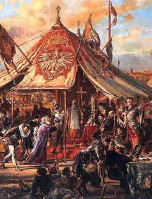
UNION OF LUBLIN. A union agreement between the Grand Duchy of Lithuania and the Kingdom of Poland, signed on 1 July 1569 at a joint assembly of Lithuanian and Polish deputies in Lublin. The treaty gave birth to a single state, the Polish-Lithuanian Commonwealth, with a common elected monarch combining the offices of the Polish king and the Lithuanian grand duke, a common diet and senate, a joint foreign policy, and one monetary system. The Grand Duchy preserved its autonomy with its own laws, government, administration, courts, army, and finances. The treaty was signed by Lithuania at a time when it needed Polish help in its war against Muscovy. For Poland the treaty provided a means of acquiring some Lithuanian territory. Under the treaty Poland (the Polish crown) obtained the Ukrainian territories of Podlachia, Volhynia, Podilia, the Bratslav region, and the Kyiv region. The nobility of those territories were given the same rights and privileges as the Polish nobility. The Grand Duchy retained, apart from Lithuanian territory, Belarus and the Berestia land and Pynsk region. Thus the union gave Poland control over a large part of Ukrainian territory, where it proceeded to subjugate and exploit the indigenous population. As a result of the Union of Lublin, the Lithuanian-Ruthenian state of the 13th to 16th centuries ceased to exist... |
| Union of Lublin |
The preparation, editing, and display of the IEU entries about the history of the Lithuanian-Ruthenian state of the 13th to 16th centuries were made possible by the financial support of the TORONTO UKRAINIAN LIBRARY ASSOCIATION of Toronto, ON, Canada.
With the Union of Lublin, signed on 1 July 1569, the Lithuanian-Ruthenian period in Ukrainian history came to an end. This treaty united Poland and Lithuania into a single Polish-Lithuanian Commonwealth (Rzeczpospolita). In practical terms the union was dominated by the Poles, who now took direct control over most of Ukraine. The Polish influence on Ukraine was profound. Most of the Ukrainian nobles, granted equal rights with their Polish counterparts, were quickly Polonized, and Ukraine was thus bereft of its own social elite. The last vestiges of the Kyivan Rus' state disappeared as the Ukrainian lands were divided into six voivodeships, or provinces. Large tracts of land were granted to Polish nobles, who established sizable manorial estates (filvarky) that could produce effectively for the booming European grain trade. Some of the largest estates (latifundia) in the Commonwealth were situated in Ukraine. Greater demands were placed on the Ukrainian peasantry, which was being reduced to serfdom. The religious tolerance in the Commonwealth, phenomenal for its times, also had an impact in Ukraine, as the Reformation period saw the influence of Protestant groups, such as the Socinians and Lutherans, spread into Ukraine through Poland. Nevertheless pressure was put on the predominantly Orthodox population of Ukraine to convert to Catholicism, and it resulted indirectly in the establishment of the Ukrainian Catholic church by the Union of Berestia (1596). At the same time Ukraine experienced a tremendous revival. Theological and secular education, literature, and the fine arts all began to flourish, and printing was introduced. The ideas of the Renaissance began to work their way into Ukraine through Poland as the 'Golden Age' of 16th-century Polish culture left its mark. The situation in Ukraine under Polish rule became increasingly more volatile in the first half of the 17th century as socioeconomic, religious, and national tensions grew. These tensions peaked in 1648, when a full-scale uprising led by Bohdan Khmelnytsky erupted in Ukraine and engulfed the Commonwealth in the Cossack-Polish War... Learn more about Ukraine under Polish control in the Polish-Lithuanian Commonwealth by visiting the following entries:
|
POLISH-LITHUANIAN COMMONWEALTH. Following the Union of Lublin in 1569, Poland and Lithuania constituted a single, federated state--the Polish-Lithuanian Commonwealth--ruled by a jointly elected monarch; the state was to have a common Diet, foreign policy, currency, and property law. Both partners were to retain separate administrations, law courts, treasuries, armies, and laws, however. Because Poland now possessed the larger territory, it had greater representation in the Diet and thus became the dominant partner. The only Ukrainian lands left in the Grand Duchy of Lithuania were parts of the Berestia land and Pynsk region. Other Ukrainian lands constituted part of the Polish crown. There the Lithuanian Statute--the legal code of the Lithuanian-Ruthenian state--remained in effect, but Ukrainian as the official language was supplanted by Polish and Latin. The integration of the Ukrainian lands into Poland resulted in significant national and religious transformations. Part of the Ukrainian elite became Polonized as a result of the influence of Polish education and in-migrating Polish nobles and Catholic clergy. Even many prominent Ukrainian families, including that of Prince Kostiantyn Vasyl Ostrozky, a leading defender of Orthodoxy, converted to Roman Catholicism and adopted Polish language and culture. Under the new regime, the noble-dominated cities and towns grew in size and number and experienced an economic boom. It was, however, almost exclusively the Catholic German and Polish burghers who benefited from self-government by Magdeburg law. The Orthodox Ukrainian burghers were the victims of persecution and segregation...
|
| Polish-Lithuanian Commonwealth |
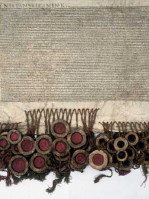
|
UNION OF LUBLIN. A union agreement between the Grand Duchy of Lithuania and the Kingdom of Poland, signed on 1 July 1569 at a joint assembly of Lithuanian and Polish deputies in Lublin. The treaty gave birth to a single state, the Polish-Lithuanian Commonwealth, with a common elected monarch combining the offices of the Polish king and the Lithuanian grand duke, a common diet and senate, a joint foreign policy, and one monetary system. Before the unon, during the height of its expansion, Lithuania's possessions included nearly half of the former territory of Kyivan Rus'. But the Union of Lublin was signed by Lithuania at a time when it needed Polish help in its war against Muscovy, and under the treaty, Lithuania ceded most of its Ukrainian lands to Poland. The Grand Duchy preserved its limited autonomy within the Commonwealth with its own laws, government, administration, courts, army, and finances. For Poland the treaty provided a means of acquiring much of Lithuanian territory. Under the treaty the Polish crown obtained the Ukrainian territories of Podlachia, Volhynia, Podilia, the Bratslav region, and the Kyiv region. The nobility of those territories were given the same rights and privileges as the Polish nobility. The Grand Duchy retained, apart from Lithuanian territory, Belarus and the Berestia land and Pynsk region. Thus the union gave Poland control over a large part of Ukrainian territory, where it proceeded to subjugate and exploit the indigenous population... |
| Union of Lublin |
_s.jpg)
|
NOBILITY. By the mid 15th century the nobility in Poland had gained legislative powers in matters of war and peace and exemption from the royal court. King Jan I Olbracht's Piotrkow statute (1496) bound the peasantry to the land and exempted the nobility from paying duties on imported goods. The Union of Lublin in 1569 brought Volhynia, Podlachia, the Kyiv region, and the Bratslav region under direct Polish control. At the same time the rights of the local Ukrainian nobility were brought into line with those of Poland. The newly acquired territories soon saw an influx of Polish magnates, including the Zolkiewski, Potocki, Koniecpolski, and Kalinowski families. It also set in motion a long process of Polonization that became a feature of Right-Bank Ukraine: by the early 19th century little non-Polonized Ukrainian nobility remained. By the 16th century, the nobility developed a corporate sense as the 'szlachta nation.' In 1573 the nobles obtained the right to the election of the king by direct vote. That right effectively transformed the Polish-Lithuanian Commonwealth into an aristocratic republic and made the regal position an increasingly ineffectual one. The nobility progressively lost its military characteristics and became a class of agrarian entrepreneurs. The latifundialists and the middle gentry, in search of money income, were producing for export. This transition from a subsistence to a market-oriented agricultural economy led to an intensification of corvee (panshchyna) and the increasingly inhumane exploitation of the peasants... |
| Nobility |
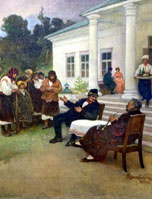
|
SERFDOM. As Polish rule spread throughout Ukraine in the second half of the 15th and in the 16th centuries, the position of the peasantry in Ukrainian territories changed radically. In Poland alodial land ownership was already an established privilege of the ruling class. The nobility had been exempted from any form of conditional (feudal) land tenure, and the peasants had been deprived of their former rights to land. The Polish magnates and nobles extended their serf system to Western Ukraine and, after the Union of Lublin in 1569, to Right-Bank Ukraine as well. To equalize the obligations of the different categories of peasant, the voloka land reform was introduced in 1557 in Ukrainian territories and was implemented gradually over the next century. Polish nobles set up filvarky on the better lands and began to specialize in grain farming for export. The nobles' diets of 1496, 1505, 1519, and 1520 issued decrees tying the peasants ever more closely to the land, depriving them of the right to move, subjecting them completely to the nobles' courts, and increasing their obligations to the nobles. Finally, the amount of labor owed by the serfs and all other matters affecting them were left to the decision of the nobles, their tenants, or their stewards. A uniform system of serf obligations and relations was maintained on the royal estates, where serfs received better treatment than on the private estates of the nobility. As the serfs became increasingly exploited in the western and middle belt, the peasants fled to the territories under Cossack control and joined Cossack uprisings. Those conditions contributed to the Cossack-Polish War... |
| Serfdom |
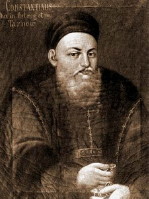
|
OSTROZKY, KOSTIANTYN VASYL, b 1526 or 1527 in Dubno, d 23 February 1608 in Ostrih, Volhynia. Ukrainian nobleman and political and cultural figure; starosta of Volodymyr and marshal of Volhynia from 1550, voivode of Kyiv from 1559, and senator from 1569; the most powerful magnate in Volhynia and one of the most influential figures in the Lithuanian-Ruthenian state and Polish-Lithuanian Commonwealth. He was a candidate for the Polish throne after the death of Sigismund II Augustus (the last member of the Jagiellon dynasty) in 1572, and for the Muscovite throne after the death of Tsar Fedor Ivanovich (the last member of the Riurykide dynasty) in 1598. Ostrozky defended Ruthenian (Ukrainian and Belarusian) political rights and was the de facto leader of Ukraine in the negotiations leading up to the 1569 Union of Lublin, during which he demanded that Ruthenia be treated as an equal partner of Poland and Lithuania. A generous patron of Ukrainian culture and an ardent defender of the Orthodox faith, he organized and led the resistance to the 1596 Church Union of Berestia. Although he was not opposed in principle to Orthodox-Catholic unification, he felt that it had to be an open, ecumenical process involving secular church patrons, not just a secret clerical accord. Ostrozky was an important figure in the 16th-century Ukrainian cultural and national rebirth. He is best known for founding the Ostrih Academy (ca 1576), the Ostrih Press (ca 1578), and the press at the Derman Monastery (1602). He maintained relations with the Ukrainian Cossacks and for this and other reasons he was condemned by the Polish nobility... |
| Kostiantyn Vasyl Ostrozky |
|
CHURCH UNION OF BERESTIA. An agreement, proclaimed in 1596, between the Ruthenian (Ukrainian-Belarusian) Orthodox church in Poland and Lithuania and the Holy See. The recognition of the pope as the head of the church and the implications of this position for the faith, morals, practices, and church administration were accepted by the Orthodox clergy. For his part, the pope agreed to the retention of the Eastern rite and confirmed the administrative rights and autonomy of the Kyiv metropoly. The Orthodox bishops, who initiated the plan for the union, hoped to gain not only ecclesiastical benefits from the it, but also an end to the Polonization of the upper classes and equality for the Orthodox church in the Commonwealth. The union was supported by leading Polish circles because it was politically and religiously advantageous to them. Roman Catholic clerics and the Orthodox bishops, especially Ipatii Potii, the bishop of Volodymyr, who tried to gain the support of Prince Kostiantyn Vasyl Ostrozky, all worked to bring about a union. Prince Ostrozky, however, insisted on the participation of the Byzantine and the Muscovite churches in the talks. The sobor in Berestia in 16-20 October 1596 split into two groups--for and against the union with Rome--and thus two councils went on concurrently. Prince Ostrozky led the opposition. The union was accepted by Metropolitan Mykhailo Rahoza, five bishops, and part of the clergy and gentry. Each opposing group at the sobor condemned and anathematized the other. The Church Union of Berestia split the Ruthenian church and the faithful in two and led to a long and bitter domestic struggle... |
| Church Union of Berestia |
The preparation, editing, and display of the IEU entries about Ukraine under Polish control in the Polish-Lithuanian Commonwealth in the 16th and 17th centuries were made possible by the financial support of the MICHAEL KOWALSKY AND DARIA MUCAK-KOWALSKY ENCYCLOPEDIA ENDOWMENT FUND at the Canadian Institute of Ukrainian Studies (Edmonton, AB, Canada).
X. THE ORIGINS AND EARLY HISTORY OF THE UKRAINIAN COSSACKS
The name Cossack (Ukrainian: kozak) is derived from the Turkic kazak (free man), meaning anyone who could not find his appropriate place in society and went into the steppes, where he acknowledged no authority. In European sources the term first appears in a dictionary of the Cuman language in the mid-13th century. By the end of the 15th century the name was applied to those Ukrainians who went into the steppes to practice various trades and engage in hunting, fishing, beekeeping, the collection of salt and saltpeter, and so on. In the mid-16th century the Cossack structure in the Zaporizhia was created in the process of the steppe settlers' struggle against Tatar raids. The ranks of the Zaporozhian Cossacks were greatly increased by fugitive peasants and townspeople who fled to the sparsely populated steppe to escape serfdom and other forms of oppression suffered under their Polish landlords. A second category of Cossacks, known as town Cossacks, was formed for the defense of the towns. In time the Cossacks acquired military strength and experience as well as prestige in their own society and fame throughout Europe, which at that time was resisting the Turkish onslaught. The Cossacks became particularly strong in the first quarter of the 17th century, when Hetman Petro Konashevych-Sahaidachny not only spread their fame through his successful campaigns against the Tatars and the Turks and his aid to the Polish army at Moscow in 1618 and at the Battle of Khotyn in 1621, but also tied Cossack interests to the Ukrainian struggle against Poland, reviving the traditions of the Kyivan Rus' state... Learn more about the origins and the early history of the Ukrainian Cossacks by visiting the following entries:

|
COSSACKS. The history of the Ukrainian Cossacks has three distinct aspects: their struggle against the Tatars and the Turks in the steppe and on the Black Sea; their participation in the struggle of the Ukrainian people against socioeconomic and national-religious oppression by the Polish magnates; and their role in the building of an autonomous Ukrainian state. The first period of the Cossacks' history spans the years 1550-1648. The town Cossacks were organized by the local officials, such as Ostafii Dashkevych, Przeclaw Lanckoronski, Samuel Zborowski, and Prince Dmytro Vyshnevetsky (Baida), to defend the southeastern borders of the Polish-Lithuanian Commonwealth from Tatar incursions. Following the establishment of the Zaporozhian Sich, the town and Zaporozhian Cossacks ventured far into the steppes in pursuit of the Tatars in order to rescue captives or to attack Tatar and Turkish coastal towns. By the end of the 16th and beginning of the 17th century, the Cossacks also mounted several bloody uprisings against the oppressive Polish landowners and the Polish government... |
| Cossacks |

|
THE ZAPORIZHIA. The name of the military and political organization of the Ukrainian Cossacks and of their autonomous territory (approx 80,000 sq km) in Southern Ukraine from the mid-16th century to 1775. The name was derived from the territory's location 'beyond the Rapids' (za porohamy). Its center was the Zaporozhian Sich. The Zaporizhia's territory was situated to the south and east of Polish-ruled Right-Bank Ukraine. To the northeast it bordered on the Left-Bank Ukraine's Hetman state. To the east it was separated from Russian-ruled Slobidska Ukraine by the Donets River. To the southeast it bordered on the lands of the Don Cossacks. The Zaporizhia extended southward deep into the steppe, where it bordered on the Crimean Khanate. The Cossacks gained renown in the late 15th century as defenders of the Lithuanian-Ruthenian state against the Crimean Tatars. The rise of the Zaporizhia resulted from the increasing colonization of that frontier by Ukrainians fleeing serfdom. There they established homesteads and, to defend themselves from Tatar raids, built fortified camps (sichi), which were later united to create a central fortress, the Zaporozhian Sich... |
| The Zaporizhia |

|
ZAPOROZHIAN SICH. The name of several Cossack keeps on the Dnieper River that were the centers of the Zaporizhia. The first Sich was established ca 1552 by Prince Dmytro Vyshnevetsky on Mala Khortytsia Island in the Dnieper River, near present-day Zaporizhia. It was besieged and destroyed by Crimean Tatars in 1558. The new Tomakivka Sich was built 60 km to the south on a now-inundated island near present-day Marhanets. It was also razed by Tatars, in 1593, and the Bazavluk Sich was built on Bazavluk Island, now also inundated, farther south near the mouths of the Chortomlyk River and the Pidpilna River. A fourth Sich was built at nearby Mykytyn Rih, the site of present-day Nykopil; it is first mentioned in 1628 and was captured by Hetman Bohdan Khmelnytsky in 1648. The Chortomlyk Sich was also built nearby, at the mouth of the Chortomlyk River, in 1652. It was destroyed by a Russian force on 25 May 1709, after Otaman Kost Hordiienko and his Zaporozhian Host allied with Hetman Ivan Mazepa and Charles XII of Sweden against Peter I. That last Sich was destroyed by a Russian army in June 1775... |
| Zaporozhian Sich |

|
VYSHNEVETSKY, DMYTRO, b after 1516, d 29 October 1563 in Istanbul. The first Cossack otaman in the history of Ukraine, a founding member of the Cossack nobility, and a landowner in southern Volhynia; nephew of Kostiantyn Ostrozky. In the 1550s he was starosta of Cherkasy and Kaniv. He built a fort (ca 1552) on Mala Khortytsia Island, in the Dnieper River, which became the first Zaporozhian Sich. He recruited Cossacks for war against the Tatars, which he waged with the help of Lithuania and Muscovy, and he traveled to Turkey to enlist the aid of the Ottoman Empire in 1553. In 1557-61 he served the Muscovite government and then again organized wars against the Tatars, but his attempts to form an alliance to do battle in the Crimea failed in 1561. In 1563, during a military campaign in Moldavia, he was defeated, taken prisoner by the Turks, and executed. Vyshnevetsky is the hero of the folk historical song about Baida. Because of his noble origin, Soviet historians disputed the fact that he founded the Zaporozhian Sich and that he is the folk hero Baida... |
| Dmytro Vyshnevetsky |
 (portrait).jpg)
|
NALYVAIKO, SEVERYN (Semerii), b ca 1560 in Husiatyn, Galicia, d 21 April 1597 in Warsaw. Cossack leader. He participated in campaigns of the Zaporozhian Cossacks against Turkey and the Crimean Tatars and then served as a captain in Prince Kostiantyn Vasyl Ostrozky's private army. In 1594 he became otaman of an independent Cossack force in the Bratslav region and led it on a campaign into Moldavia, where it defeated the Crimean Tatars advancing against Hungary. In the spring of 1595, together with Hryhorii Loboda and Matvii Shaula, he successfully engaged the Turks in Moldavia and Transylvania, thereby halting their advance on Austria. After Nalyvaiko returned to Ukraine, he led a popular rebellion against the Poles that spread from the Bratslav region throughout Right-Bank Ukraine and into Belarus. On 26 May 1596 the rebels were surrounded by a superior Polish army near Lubny. After a two-week Polish siege a mutiny arose among the rebels. Hryhorii Loboda was lynched, and Nalyvaiko and Shaula were handed over to the Poles. Nalyvaiko was taken to Warsaw, where he was cruelly tortured before being beheaded... |
| Severyn Nalyvaiko |
.jpg)
|
KONASHEVYCH-SAHAIDACHNY, PETRO, b 1570? in Kulchytsi, Sambir region, Galicia, d 20 April 1622 in Kyiv. Zaporozhian hetman, organizer of Ukrainian Cossack armies, and political and civic leader. He was a member of the Orthodox nobility in Galicia, and he studied at the Ostrih Academy. He traveled to the Zaporozhian Sich in 1601 and participated in campaigns against the Tatars and Turks. Under his leadership the Cossacks captured Ochakiv and Perekop (1607) and various towns along the Anatolian coast in Turkey (1608), including Sinop and Trabzon, where they destroyed a force of 10,000 Turks and freed many slaves. In 1618 Sahaidachny led a 20,000-strong Cossack army in Wladyslaw IV Vasa's Polish campaign against Muscovy. Sahaidachny's transformed the Cossack Host into a regular military formation and imparted a statist character to the Cossack movement. He also fought for the religious and cultural rights of the Ukrainian people. He contributed to the establishment of a cultural center in Kyiv and sought to unite Cossack military might with the Ukrainian clergy and nobility... |
| Petro Konashevych-Sahaidachny |
The preparation, editing, and display of the IEU entries featuring the origins and the early history of the Ukrainian Cossacks were made possible by the financial support of the MICHAEL KOWALSKY AND DARIA MUCAK-KOWALSKY ENCYCLOPEDIA ENDOWMENT FUND at the Canadian Institute of Ukrainian Studies (Edmonton, AB, Canada).
XI. BOHDAN KHMELNYTSKY, THE COSSACK-POLISH WAR, AND THE PEREIASLAV TREATY OF 1654
Hetman Bohdan Khmelnytsky is one of the most celebrated and at the same time most controversial political figures in Ukraine's early-modern history. A brilliant military leader, his greatest achievement in the process of national revolution was the formation of the Cossack Hetman state of the Zaporozhian Host (1648-1782). His statesmanship was demonstrated in all areas of state-building--in the military, administration, finance, economics, and culture. At the same time, at the height of the Cossack-Polish War (1648-57), Khmelnytsky concluded the fateful Pereiaslav Treaty of 1654 with Tsar Aleksei Mikhailovich of Muscovy, as a result of which Ukraine became a protectorate of the tsar and was placed in the Muscovite sphere of influence. Some of the most prominent Ukrainian intellectuals, such as Taras Shevchenko, criticized Khmelnytsky for this strategic error which resulted in the centuries of Muscovite/Russian domination over Ukraine. Learn more about Bohdan Khmelnytsky, the Cossack-Polish War, and the Pereiaslav Treaty of 1654 and its consequences for Ukraine's historical fate by visiting the following entries:
.jpg)
|
KHMELNYTSKY, BOHDAN, b ca 1595-6, d 6 August 1657 in Chyhyryn. Hetman of the Zaporozhian Host from 1648 to 1657, founder of the Hetman state (1648-1782). By birth he belonged to the Ukrainian lesser nobility and bore the Massalski, and later the Abdank, coat of arms. His father, Mykhailo, served as an officer under the Polish crown hetman Stanislaw Zolkiewski. Bohdan received his elementary schooling in Ukrainian, and his secondary and higher education in Polish at a Jesuit college, possibly in Jaroslaw, but more probably in Lviv. At school he acquired a broad knowledge of world history and fluency in Polish and Latin. Later he acquired a knowledge of Turkish, Tatar, and French. The Battle of Cecora (1620), in which he lost his father and was captured by the Turks, was his first military action. After spending two years in Istanbul, he was ransomed by his mother and returned to Ukraine... |
| Bohdan Khmelnytsky |

|
COSSACK-POLISH WAR (1648-57). The conflict began in 1648 as a typical Cossack uprising but quickly turned into a war of the Ukrainian populace, particularly the Cossacks and peasants, against the Polish Commonwealth. Hetman Bohdan Khmelnytsky assumed leadership of the Ukrainian forces. The war can be divided into six phases. January-November 1648. In this period a series of brilliant Cossack victories aroused the whole Ukrainian people and won wide support for Bohdan Khmelnytsky. What was strictly a Cossack rebellion became transformed into a mass movement against the Polish nobility. On 21 January 1648 Khmelnytsky led a small unit of registered Cossacks and Zaporozhian Cossacks in an attack on the Polish garrison on Bazavluk Lake (on the Dnieper River) and overpowered it. This freed the Zaporozhian Sich from Polish control and won the Zaporozhian Cossacks over to Khmelnytsky's side. He was elected hetman... |
| Cossack-Polish War |

|
JAN II CASIMIR VASA, b 22 March 1609 in Cracow, d 16 December 1672 in Nevers, France. King of Poland and grand duke of Lithuania in 1648-68; the son of Sigismund III Vasa. The last ruler of the Vasa dynasty to occupy the Polish and Lithuanian thrones, Jan was elected king after the death of his brother Wladyslaw IV Vasa. During his reign the Polish magnates pressed him to expend Poland's resources on winning the Cossack-Polish War of 1648-57. In 1649 and 1651, he personally directed military campaigns against Hetman Bohdan Khmelnytsky and the Cossacks in Ukraine... |
| Jan II Casimir Vasa |

|
VYHOVSKY, IVAN, b ?, d 19 March 1664 in Olkhivka, near Korsun. Hetman of Ukraine in 1657-9 and close confederate of Bohdan Khmelnytsky. He studied at the Kyivan Mohyla Academy, worked in the Kyiv civic court, and joined the Lutske Brotherhood of the Elevation of the Cross. Before the Cossack-Polish War he was secretary to a Polish starosta in Lutske, and in 1648 served in a crown force under the command of Stanislaw Rewera Potocki. He was captured by the Tatars at the Battle of Zhovti Vody. His release was arranged by Khmelnytsky, who admired his learning and experience. Vyhovsky then joined forces with the hetman. He became the military chancellor and then general chancellor; he participated in diplomatic negotiations and drafted some of the more important treaties of the time. After Khmelnytsky's death he became the guardian of and second-in-command to Yurii Khmelnytsky... |
| Ivan Vyhovsky |

|
PEREIASLAV TREATY OF 1654. A fateful alliance the Hetman state under Bohdan Khmelnytsky concluded with Tsar Aleksei Mikhailovich during the Cossack-Polish War. After the Crimean Tatar army betrayed the Cossacks for the third time during the siege of Zhvanets in 1653, and Khmelnytsky realized he could no longer rely on Ottoman support against Poland, the hetman was forced to turn to Muscovy for help. Moscow responded favorably to an alliance with Ukraine because it would prevent closer Ukrainian-Turkish ties. Negotiations began in January 1654 in Pereiaslav between Khmelnytsky and his General Military Council on one side and Muscovite envoys led by Vasilii Buturlin on the other. They were concluded in April in Moscow by the Ukrainians Samiilo Bohdanovych-Zarudny and Pavlo Teteria and by A. Trubetskoi, V. Buturlin, and other Muscovite boyars... |
| Pereiaslav Treaty of 1654 |
The preparation, editing, and display of the IEU entries associated with the Cossack-Polish War (1648-57) were made possible by a generous donation from ARKADI MULAK-YATSKIVSKY of Los Angeles, CA, USA.
XII. THE COSSACK HETMAN STATE (1648-1782)
The Khmelnytsky Uprising and the Cossack-Polish War led to the establishment of the Cossack Hetman state. At the time of Bohdan Khmelnytsky's death, the Cossacks controlled the former Kyiv, Bratslav, and Chernihiv voivodeships, an area inhabited by about 1.5 million people. The entire area was divided into 16 military and administrative regions corresponding to the territorially based regiments of the Cossack army. At the pinnacle of the Cossack military-administrative system stood the hetman. Assisting the hetman was the General Officer Staff, which functioned as a general staff and a council of ministers. The capitals of the Hetman state were Chyhyryn (1648-63), Hadiach (1663-8), Baturyn (1669-1708 and 1750-64), and Hlukhiv (1708-34). From 1654 the Hetman state was nominally a vassal of Muscovy. The political relationship between the two countries was renegotiated with the election of each new hetman, which led to the steady erosion of the Hetmanate's sovereignty. In the 18th century, the increasing political control of the Hetman state by Russia precluded the independent evolution of its administrative, financial, and judicial institutions. During the reign of Catherine II (1762-96) Ukrainian autonomy was progressively destroyed and the office of hetman was finally abolished by the Russian government in 1764... Learn more about the history of the Ukrainian Hetman state by visiting the following entries:

|
HETMAN STATE or Hetmanate. The name of the Ukrainian Cossack state, which existed from 1648 to 1782. It came into existence as a result of the Cossack-Polish War and the alliance of the registered Cossacks with the Cossacks of the Zaporozhian Sich and other segments of the Ukrainian populace. The territory of the state at the time of its first hetman, Bohdan Khmelnytsky (1648-57), consisted of most of central Ukraine as well as part of Belarus. In 1663 the Hetman state in Right-Bank Ukraine came under Polish domination, while the Left Bank came under Muscovite control. A period of civil war ensued, known as the Ruin, as various Left- and Right-Bank hetmans, backed by their respective supporters, attempted to re-establish a unitary state. Despite these efforts, the partition of the Hetmanate was confirmed by the Muscovite-Polish Treaty of Andrusovo (1667) and the Eternal Peace of 1686. When the Cossacks were abolished by Poland in 1700 on the Right Bank, the Hetmanate was left with only the lands of the Left Bank... |
| Hetman state |

|
HETMAN. (from the German Hauptmann and the Polish hetman: 'leader'). In the Polish Kingdom in the 16th century, local military commanders and administrators were known as hetmans. The title was also used for the supreme military commander both in Poland and in the Grand Duchy of Lithuania. At the end of the 16th century the commander of the Cossacks, originally known as the elder (starshyi), also became known as the hetman. The first Cossack hetmans included Kryshtof Kosynsky, Severyn Nalyvaiko, Petro Konashevych-Sahaidachny, and Taras Fedorovych. From 1648 the hetman was the head of the Cossack Hetman state. In this capacity he had broad powers as the supreme commander of the Cossack army; the chief administrator and financial officer, presiding over the state's highest administrative body, the General Officer Staff; the top legislator; and from the end of the 17th century, the supreme judge as well. The first hetman who was also head of the state was Bohdan Khmelnytsky... |
| Hetman |

|
REGIMENTAL SYSTEM. The administrative, territorial, military, and judicial structure of the 17th- to 18th-century Hetman state and Slobidska Ukraine. Under Hetman Bohdan Khmelnytsky there were initially 22 regiments, which were named after towns where their headquarters were located. Their colonels and other officers (Cossack starshyna) had jurisdiction over both the Cossacks and the civilian population in their territories. The colonels belonged to the hetman's Council of Officers. Before 1648 they had been appointed by the Polish government. Hetman Khmelnytsky, however, frequently appointed colonels personally. From the hetmancy of Ivan Samoilovych to that of Ivan Mazepa they were elected by a regimental council in the presence of the hetman's representatives. After 1709 Peter I and other Russian tsars appointed or dismissed colonels by fiat, and often chose Russians, Moldavians, Serbs, and other foreigners. Hetman Danylo Apostol's government had the right only to recommend candidates to the tsar... |
| Regimental system |
.jpg)
|
COMPANY SYSTEM. In the Cossack Hetman state and in Slobidska Ukraine the company (sotnia) administration consisted of the captain (sotnyk) and the company officers, including the town or company otaman, secretary, aide-de-camp, and flag-bearer. The captain was the company's commander in chief and carried out in its territory military, administrative, fiscal, and judicial functions similar to those performed by the colonel in the regiment territory, including keeping peace and public order in the company. He was the head of the company court, which looked into civil and minor criminal matters involving Cossacks and sometimes even the civilian population in the company's territory. Originally the captain was elected by a company council and confirmed by a higher, regimental or hetman, government. But from Ivan Mazepa's hetmancy the captain was usually appointed by the colonel or the hetman himself. After Mazepa's defeat at the Battle of Poltava in 1709, captains were often appointed by the tsar's government... |
| Company system |
.jpg)
|
COSSACK STARSHYNA or simply starshyna (officers). General title applied to persons holding positions of authority in a Ukrainian Cossack regiment and in the administration of the Hetman state (1648-1782). The starshyna was divided into the General Officer Staff and regimental and company staffs. A regimental starshyna consisted of a colonel, an oboznyi (quartermaster, artillery commander), a judge, a chancellor, an osaul (aide-de-camp, the colonel's closest aide), and a khorunzhyi (flag-bearer, protector of the regimental banner). A company staff consisted of a captain, company or town otaman (lieutenant), a scribe, an osaul, and a flag-bearer. Often the term 'Cossack starshyna' was applied to the entire social elite of the Hetman state, including the notable military fellows, who did not hold government or military posts. In the 18th century, the Cossack starshyna established itself as a gentry elite in Left-Bank Ukraine... |
| Cossack starshyna |
The preparation, editing, and display of the IEU entries dealing with the Cossack Hetman state were made possible by a generous donation from ARKADI MULAK-YATSKIVSKY of Los Angeles, CA, USA.
XIII. THE PERIOD OF "THE RUIN" AND THE PARTITION OF UKRAINE IN THE LATE 17th CENTURY
The death of Hetman Bohdan Khmelnytsky was followed in Ukraine by a period of instability and decline which culminated at the time of the "Ruin." An important event that precipitated Ukraine's political decline took place on 17-18 June 1663 when thousands of common Cossacks, Zaporozhians, and 'non-Cossack volunteers' assembled at a chorna rada near Nizhen to elect a new hetman for Left-Bank Ukraine. In a sequence of events described later in the historical novel by Panteleimon Kulish, Moscow-backed adventurer Ivan Briukhovetsky managed to sway the Zaporozhians and chern' (poorest Cossacks and peasants) with his demagoguery and promises and was elected hetman. He went on to execute his rival Cossack officers and sign a pact with Moscow whereby he placed Ukraine under the direct authority of the tsar. In subsequent years Muscovy succeded in inflaming class and religious differences within the Hetman state and provoking a civil conflict which led to a bloody internecine warfare. Ukraine became divided along the Dnieper River into two hostile regions. Neighboring states (Poland, Muscovy, the Ottoman Empire) interfered in Ukrainian internal affairs, and the policies of various Ukrainian leaders were skewed by efforts to curry favor among the various occupational forces. The Ukrainian Orthodox church was subordinated to the Moscow patriarchate in 1686, and Hetman state lost many of its sovereign powers... Learn more about the destructive legacy of the time of the Ruin by visiting the following entries:

|
RUIN. A period in the late 17th century in the history of Ukraine, characterized by the disintegration of Ukrainian statehood and general decline. Some historians (eg, Mykola Kostomarov) correlate it with the tenures of three Moscow-backed hetmans (Ivan Briukhovetsky, Demian Mnohohrishny, and Ivan Samoilovych) and limit it chronologically to 1663-87 and territorially to Left-Bank Ukraine. Other historians consider the Ruin to apply to both Left- and Right-Bank Ukraine from the death of Bohdan Khmelnytsky to the rise of Ivan Mazepa (1657-1687). During the Ruin Ukraine became divided along the Dnieper River into Left-Bank Ukraine and Right-Bank Ukraine, and the two halves became hostile to each other. Ukrainian leaders during the period were largely opportunists and men of little vision who could not muster broad popular support for their policies. The hetmans who did their utmost to bring Ukraine out of decline were Ivan Vyhovsky, Petro Doroshenko, and Ivan Samoilovych... |
| Ruin |

|
KHMELNYTSKY, YURII, 1641-85. Hetman of Ukraine (1657, 1659-63) and hetman of Right-Bank Ukraine (1677-81, 1685); the younger son of Bohdan Khmelnytsky. His father, who hoped to establish a hereditary hetmancy, designated him as his successor after the death of his older son, Tymish Khmelnytsky. Although this was opposed by many Cossacks, who favored an elected hetmancy, Yurii was initially chosen hetman while his father was still alive. After his father's death in 1657, however, when it became clear that the 16-year-old was incapable of governing on his own, the Cossacks elected Ivan Vyhovsky as hetman. Subsequently, Vyhovsky lost the support of the Cossacks and abdicated in September 1659. Khmelnytsky was again elected hetman of Ukraine, supported primarily by the pro-Muscovite Cossack families. Capitalizing on the anarchy that was developing in Ukraine and Khmelnytsky's inexperience and weakness, the Muscovite government forced Khmelnytsky to ratify the Pereiaslav Articles of 1659, which limited the sovereign rights of Ukraine... |
| Yurii Khmelnytsky |

|
BRIUKHOVETSKY, IVAN, b ?, d 18 June 1668. Hetman of Left-Bank Ukraine. Briukhovetsky was a registered Cossack and Bohdan Khmelnytsky's courier and diplomatic emissary. After Khmelnytsky's death Briukhovetsky went to the Zaporozhian Sich (1659) and became its otaman (1661-3). In 1663 at the Chorna rada near Nizhen he was elected hetman with the support of the Zaporozhian Cossacks and the Cossack masses (chern). After doing away with his opponents, Col Yakym Somko and Col Vasyl Zolotarenko, he went to Moscow and signed the Moscow Articles of 1665, thereby placing Ukraine under the direct authority of the tsar and his voivodes and thus relinquishing Ukraine's autonomy. For this he received the title of boyar, land, and the hand of Prince Dolgoruky's daughter. By this time Briukhovetsky had forfeited the support of the population. An angry Cossack mob killed him in the village of Budyshchi near Opishnia... |
| Ivan Briukhovetsky |

|
DOROSHENKO, PETRO, b 1627 in Chyhyryn, d 19 November 1698 near Moscow. Hetman of Right-Bank Ukraine from 1665 to 1676. He served under Hetman Bohdan Khmelnytsky in a military and diplomatic capacity. After Khmelnytsky's death Doroshenko supported Ivan Vyhovsky and signed the Treaty of Hadiach in 1658. In January 1666 he was elected hetman of Right-Bank Ukraine. Doroshenko's main aim was to restore the Hetman state on both banks of the Dnieper River. In the struggle with Poland over Right-Bank Ukraine, Doroshenko crushed the Polish army with Crimean Tatar help at Brailiv in Podilia. Meanwhile a revolt against Muscovy broke out on the Left Bank, where after Ivan Briukhovetsky's execution Doroshenko was proclaimed hetman of all Ukraine on 8 June 1668. However, an unexpected Polish offensive forced Doroshenko to return to the Right Bank. His opponents on the Left Bank took advantage of the situation and, with Muscovite support, elected Demian Mnohohrishny hetman of Left-Bank Ukraine... |
| Petro Doroshenko |

|
MNOHOHRISHNY, DEMIAN, b ca 1630 in Korop, Chernihiv region, d after 1701 in Selenginsk Staryi, Siberia. Hetman of Left-Bank Ukraine. In June 1668 Hetman Petro Doroshenko appointed Mnohohrishny acting hetman in Left-Bank Ukraine. In the autumn Mnohohrishny pledged loyalty to the tsar and was recognized as 'Siversk hetman.' On 13 March 1669 he was elected full hetman of Left-Bank Ukraine. A staunch supporter of Ukrainian independence, he spoke out against Muscovite encroachments and Muscovy's territorial concessions to Poland, and later he conducted secret negotiations with Petro Doroshenko and sent him money and troops to fight the Poles. Mnohohrishny favored autocratic rule by a strong hetman. He did not trust the senior Cossack starshyna, and appointed many of his relatives colonels and captains and granted them estates. The aggrieved Cossack starshyna engineered a Moscow-supported coup and Mnohohrishny was arrested in Baturyn on 23 March 1672 and secretly taken in chains to Moscow... |
| Demian Mnohohrishny |

|
SAMOILOVYCH, IVAN, b near Skvyra, d 1690 in Tobolsk, Siberia. Cossack leader. During the tenure of Hetman Demian Mnohohrishny he served as colonel of Chernihiv regiment and as general judge. After Mnohohrishny was deposed, Samoilovych was elected hetman of Left-Bank Ukraine. He sought to unite Left-Bank Ukraine and Right-Bank Ukraine under his rule and fought against the Right-Bank hetman, Petro Doroshenko. On 17 March 1674 a council of 10 senior Cossack starshyna officers of Right-Bank Ukraine recognized him as their hetman, but he could not rule de facto until Doroshenko abdicated, on 19 September 1676. Samoilovych opposed a Muscovite-Polish alliance, but he supported peaceful relations between Moscow and the Crimean Khanate and Turkey. The Chyhyryn campaigns, 1677-8, of the Turks, however, which devastated Right-Bank Ukraine and resulted in a mass forced migration to Left-Bank Ukraine (1680), brought about Samoilovych's political demise... |
| Ivan Samoilovych |
The preparation, editing, and display of the IEU entries associated with the period of the Ruin at the end of the 17th-century were made possible by the financial support of the MICHAEL KOWALSKY AND DARIA MUCAK-KOWALSKY ENCYCLOPEDIA ENDOWMENT FUND at the Canadian Institute of Ukrainian Studies (Edmonton, AB, Canada).
XIV. HETMAN IVAN MAZEPA, TSAR PETER I, AND THE BATTLE OF POLTAVA (1709)
Hetman Ivan Mazepa was one of the most famous and enigmatic Ukrainian leaders. Although there have been controversial assessments of his reign as hetman of the Cossack Hetman state, he has remained a symbol of Ukrainian independence. The period of his hetmancy has justifiably been known as the Mazepa renaissance. Mazepa's political program had become evident during his service to Hetmans Petro Doroshenko and Ivan Samoilovych in the 1670s and 1680s. He was a firm supporter of a pan-Ukrainian Hetman state, and his main goal as hetman was to unite all Ukrainian territories in a unitary state that would be modeled on existing European states but would retain the features of the traditional Cossack order. Initially Mazepa believed that Cossack Hetman state could coexist with Muscovy on the basis of the Pereiaslav Treaty of 1654 and he actively supported Muscovy's wars with Turkey and the Crimean Khanate and sent his forces to help those of Tsar Peter I. However, Peter I not only interfered in the Hetmanate's internal affairs and mercilessly exploited the population in his belligerent pursuits, but embarked on a policy of annihilating Ukrainian autonomy and abolishing the Cossack order and privileges. When Peter's intentions became clear, Mazepa, supported by most of his senior officers, began secret negotiations in 1706 with King Stanislaus I Leszczynski of Poland and then with Charles XII of Sweden, and forged with them an anti-Muscovite coalition in 1708. Mazepa's efforts at organizing a broad anti-Muscovite front in Eastern Europe proved unsuccessful, and his and Charles XII's defeat at the Battle of Poltava on 8 July 1709 sealed Ukraine's fate. Having condemned Mazepa as a traitor, Peter I ordered the Russian and Ukrainian churches to anathematize him. Thereafter, imperial, both Russian and Soviet, propagandists and historians did their utmost to vilify this Ukrainian patriot and statesman... Learn more about Ivan Mazepa and other actors of the fateful Battle of Poltava (1709) by visiting the following entries:

|
MAZEPA, IVAN, b 20 March 1639 in Mazepyntsi, near Bila Tserkva, d 2 October 1709 in Bendery, Bessarabia. Hetman of Ukraine in 1687-1709. Educated in Western Europe, Mazepa entered in 1669 the service of Hetman Petro Doroshenko. Later he served under Doroshenko's rival in Left-Bank Ukraine, Ivan Samoilovych. In 1682 he was appointed Samoilovych's general osaul, and on 25 July 1687 he was elected the new hetman by the Cossack council that deposed Samoilovych. Mazepa contributed to the development of Ukraine's economy, particularly its industry. He also supported Ukrainian scholarship and education (the transformation of the Kyivan Mohyla College into the Kyivan Mohyla Academy, the establishment of Chernihiv College). Under his hetmancy literature flourished, and Mazepa himself wrote some verse. He was a generous patron of painting and architecture, who funded many churches built in the Cossack baroque style. Although Mazepa was able to establish a new and loyal senior Cossack officer stratum, he also faced considerable opposition from many members of the Cossack elite, and even open rebellion (especially by Petro Petryk, Vasyl Kochubei, and Ivan Iskra). Mazepa's many attempts to secure the rights of the Cossacks as an estate, the burghers, and the peasantry could not stem the growth of social discontent caused by endless wars and abuse of the population by Muscovite troops stationed in Ukraine. Mazepa's alliance with Peter I also caused onerous responsibilities and losses to be inflicted on the population, in particular as a result of the Great Northern War and Muscovite exploitation in Ukraine. Consequently Mazepa was deprived of the popular support he needed at a critical juncture in Ukrainian history when he forged the anti-Muscovite coalition with Poland and Sweden in 1708... |
| Ivan Mazepa |

|
PETER I, b 9 June 1672 in Moscow, d 8 February 1725 in Saint Petersburg. Muscovite tsar from 1682 and first Russian emperor from 1721; son of Tsar Aleksei Mikhailovich. In 1696, after deposing the Muscovite regent, his half-sister, Sofiia Alekseevna, Peter conducted an aggressive, expansionist foreign policy that affected the Hetman state, Slobidska Ukraine, and the Zaporizhia throughout his reign. He exploited Ukraine economically and militarily as part of Muscovy's participation in the Holy League against the Ottoman Empire; the expansionist Russo-Turkish wars of 1695-6 and 1710-13; the Great Northern War with Sweden (1700-21), by which Russia gained a foothold on the Baltic Sea coast; and the war with Persia (1722-3), which fortified Russia's hold in Transcaucasia and the Caspian Sea littoral. Those wars exacted a heavy human and economic toll in Ukraine. Peter's internal reforms had as their goal the modernization and Europeanization of Muscovy. His cultural revolution provided a sound basis for the further expansion of Russian absolutism and imperialism. In Ukraine Peter's policies until 1708 continued the Muscovite tradition of the gradual erosion of regional sovereignty, although the Hetman state still remain largely autonomous of Russia. This changed dramatically after Hetman Ivan Mazepa and Otaman Kost Hordiienko sided with Charles XII of Sweden in 1708-9, particularly after the Battle of Poltava (July 1709). After defeating the Swedes and their Cossack allies, Peter initiated a reign of terror in Ukraine and instituted administrative measures to bring the Hetman state more directly under Muscovite rule... |
| Peter I |
.jpg)
|
KOCHUBEI, VASYL, ca 1640, d 25 July 1708. Statesman. Under Hetman Petro Doroshenko he carried out diplomatic assignments such as the mission to Adrianople in 1675. Under Hetman Ivan Samoilovych he was the supervisor of the General Military Chancellery and in 1685 his envoy in Moscow. He helped Hetman Ivan Mazepa to come to power. Under Mazepa he was general chancellor (1687-99) and general judge (1699-1708), and on occasion he served as acting hetman. Kochubei led the Poltava Cossack officers' opposition to Ukraine's participation in the anti-Turkish coalition at the end of the 17th century, which culminated in Petro Petryk's rebellion against Mazepa and Tsar Peter I. This affected his hitherto friendly relations with Mazepa. Mazepa's love affair with Kochubei's daughter, Motria Kochubei, further strained relations between the two men in 1704. Upon learning of Mazepa's secret negotiations with King Stanislaus I Leszczynski of Poland, Kochubei and the colonel of Poltava, Ivan Iskra, denounced Mazepa's political plans to Peter, possibly in the hope of winning the hetman's office. Peter initiated an investigation, which found nothing to prove Kochubei's accusations. Trusting Mazepa, Peter had Kochubei and Iskra arrested and taken to Vitsebsk where, under torture, they were forced to recant. Peter had them returned to Ukraine and beheaded. They were buried at the Kyivan Cave Monastery... |
| Vasyl Kochubei |
.jpg)
|
CHARLES XII, b 17 June 1682 in Stockholm, d 30 November 1718 in Fredrikshald, Norway. King of Sweden from 1697. In the Great Northern War (1700-21) against the coalition of Russia, Denmark, and Saxony (headed by the Polish king Frederick Augustus II), Charles conquered Denmark, occupied Poland, and forced Augustus to abdicate. In the course of the war with Russia Charles entered into negotiations with Hetman Ivan Mazepa (initially through the mediation of the new Polish king Stanislaus I Leszczynski, then directly), which were soon formalized in a Ukrainian-Swedish alliance. In the fall of 1708 Charles advanced into Ukraine, where in 1709 he suffered defeat by Russia in the decisive Battle of Poltava. With the remainder of his army and his Ukrainian allies led by Mazepa Charles found refuge in Turkish territory at Bendery, Moldavia. After Mazepa's death in October 1709 Charles negotiated an alliance with Hetman Pylyp Orlyk and the Crimean Tatars and induced the Tatars, for a time, to engage in war with Russia (the Prut campaign)... |
| Charles XII |

|
BATTLE OF POLTAVA. The turning point in the Great Northern War (1700-21) between Sweden and Muscovy (later Russia). After the main Swedish army entered Ukraine, Hetman Ivan Mazepa openly sided with Charles against Peter. However, because of the harsh winter of 1708-9 and a series of military defeats the situation of the Swedish army in Ukraine became precarious. The assistance Charles XII expected from Turkey and the Crimean Khanate did not materialize, and the Polish army of King Stanislaus I Leszczynski and a Swedish corps were forced to remain in Poland. Charles's only success at that time was enlisting the support of Otaman Kost Hordiienko and his army of 8,000 Zaporozhian Cossacks in April 1709. In early May 1709, on Ivan Mazepa's advice, Charles XII decided to capture Poltava. Peter I arrived to relieve the town and decided his army of 42,500 soldiers and 102 cannons would attack the Swedes. Cossack forces loyal to Peter under the command of Hetman Ivan Skoropadsky cut off possible Swedish retreat to the Dnipro River between Pereiaslav and Kremenchuk. Charles had 31,000 men but only 4 cannons; 6,000 of his soldiers were engaged in maintaining the siege or guarding the Vorskla River rear. The Swedish army was defeated at Poltava, and thousands of soldiers were forced to capitulate and surrender. Charles XII, Ivan Mazepa, and Kost Hordiienko and a contingent of 3,000 Swedes and Cossacks fled to Turkish-occupied territory. The Battle of Poltava resulted in Russian military rule in the Hetman state and increasing curtailment of its autonomy... |
| Battle of Poltava |

|
ORLYK, PYLYP, b 11 October 1672 in Kosuta, Ashmiany county, Vilnius voivodeship, Lithuania, d 26 May 1742 in Iasi, Moldavia. Cossack statesman and hetman-in-exile. A nobleman of Bohemian ancestry, in 1699 he became a senior member of the Hetman state's General Military Chancellery and in 1706 Hetman Ivan Mazepa appointed Orlyk general chancellor. In that capacity he was Mazepa's closest aide, facilitated Mazepa's secret correspondence with the Poles and Swedes, and assisted Mazepa in his efforts to form an anti-Russian coalition in Eastern Europe. After the defeat at the Battle of Poltava in July 1709, Orlyk fled abroad with Mazepa and became a leader of the first Ukrainian political emigration. After Mazepa's death, on 16 April 1710, Orlyk was elected hetman, with the backing of Charles XII of Sweden, in Bendery. The chief author of the Constitution of Bendery, he pursued policies aimed at liberating Ukraine from Russian rule. He gained the support of the Zaporozhian Host, concluded a treaty with Charles XII in May 1710, and sought to make the Ukrainian question a matter of international concern by continuing Mazepa's attempts at establishing an anti-Russian coalition. In 1711-14 he led Cossack campaigns against the Russians in Right-Bank Ukraine. Despite initial victories they ultimately failed. Orlyk and a part of his General Officer Staff emigrated in 1714 to Sweden, in 1720 to Silesia, and in 1721 to Poland. From 1722 until his death he was interned in Turkish-controlled territories--in Salonika until 1734, then in the Budzhak, and finally in Moldavia... |
| Pylyp Orlyk |
The preparation, editing, and display of the IEU entries associated with the reign of Hetman Ivan Mazepa and the Battle of Poltava (1709) were made possible by the financial support of the MICHAEL KOWALSKY AND DARIA MUCAK-KOWALSKY ENCYCLOPEDIA ENDOWMENT FUND at the Canadian Institute of Ukrainian Studies (Edmonton, AB, Canada).
XV. THE HAIDAMAKA UPRISINGS OF THE 18TH CENTURY
The fragmentation of the Cossack Hetman state in the late 17th century and the incorporation of Right-Bank Ukraine into the Polish Commonwealth was followed by a period of increased social, national, and religious oppression of the local Ukrainian Orthodox population by the Polish administration. In response to the increased corvee obligations and the abuse of power by Polish magnates and nobles and their Jewish stewards, numerous, at times large-scale, popular rebellions erupted throughout the 18th century, referred to as the haidamaka uprisings. The haidamaka formations were made up of peasants, impoverished Cossacks, and petty burghers who fled from their oppressors into the steppes or forests. There they formed bands, which moved swiftly from one area to another to attack their unwary enemy and disappeared again into the wilds. Zaporozhian Cossacks played leading roles as organizers of the rebel bands, which plundered and burned towns and nobles' estates, killing Roman Catholic and Uniate clerics, nobles and their agents, innkeepers, and money lenders, thereby inflicting heavy economic losses on the latifundia system. The Poles reacted by further repressing the peasantry. Haidamakas who were captured were tortured and cruelly executed. Yet the haidamakas' call for a land free from landlords, for the abolition of serfdom, and for the free exercise of the Orthodox faith found sympathy among the peasantry and many Orthodox monks, who often provided them with shelter, supplies, and hiding places. The small Polish army in Ukraine and the magnates' household militias (consisting of Cossacks who often switched sides) found it hard to counteract them, and haidamaka raids became more and more common, thus turning into mass uprisings that covered the entire breadth of Right-Bank Ukraine... Learn more about the haidamaka uprisings of the 18th century by visiting the following entries:
.jpg)
|
HAIDAMAKA. A participant in spontaneous, popular uprisings against the Polish regime in Right-Bank Ukraine in the 18th century. The term's origin is Turkish (hajdemak, 'to pursue'); it signifies a restless, rebellious individual. The Balkan Slavs have a corresponding term--hajduk. The Galician Ukrainian equivalent is opryshok. Haidamakas were recruited from among dissatisfied peasants, fugitive serfs, hired laborers, and even artisans and burghers. They formed detachments or bands under the leadership of chieftains, often from the ranks of Zaporozhian Cossacks, who collaborated to organize large-scale rebellions known as the haidamaka uprisings. The earliest information about haidamakas comes from 1708, when rebels led by H. Pashchenko were active in Volhynia; by 1712 they had extended their operations to Podilia and the Bratslav region and Kyiv region. The term was first used in a document dated 22 February 1717. The largest and bloodiest of the haidamaka uprisings was the Koliivshchyna rebellion of 1768... |
| Haidamaka |
.jpg)
|
HAIDAMAKA UPRISINGS. The first major haidamaka uprising broke out in 1734 during the war for the Polish throne after the death of Frederick Augustus II. Russian troops, which had been sent to depose King Stanislaus I Leszczynski, were viewed as the harbingers of liberation from Polish oppression, and the masses of the Kyiv region rebelled. The uprising quickly spread to Podilia and part of Volhynia, where it became particularly violent. Verlan, the former captain of the Lubomirski family's Cossack militia in Sharhorod, became the supreme commander of the rebel army. Other leaders included Sava Chaly, who eventually betrayed the haidamakas, and Matvii Hryva. The uprising was crushed by the intervention of Russian troops, after Augustus III ascended the Polish throne. The second major uprising broke out in 1750 without an external stimulus, but simply as a result of the movement's increased popular support. Having organized themselves on the territory of the Zaporozhian Cossacks, the haidamakas crossed into the southern part of the Kyiv palatinate and roused almost the entire populace of Right-Bank Ukraine to revolt... |
| Haidamaka uprisings |

|
KOLIIVSHCHYNA REBELLION. A major haidamaka uprising that broke out in Right-Bank Ukraine in May 1768. The word Koliivshchyna is probably derived from kil (pike or lance), the weapon used by the rebels (called kolii). The rebellion was provoked by the Confederation of Bar and the anti-peasant and anti-Orthodox positions taken by the Polish nobles there. The center of the rebellion was Kholodnyi Yar and its leader was a Zaporozhian Cossack Maksym Zalizniak. Following their first successes, the number of haidamakas increased, and separate groups dispersed in various directions, seizing centers in the Kyiv region and Bratslav region and then in Podilia and Volhynia. A major achievement of the uprising was the capture of the fortified town of Uman, an important trading center in Right-Bank Ukraine. The captain of the Uman militia, Ivan Gonta, joined the insurgency with the Cossacks under his command. A major demand of the insurgents was the restoration of the Cossack political and social order established under Bohdan Khmelnytsky. Again, the Poles managed to crush the uprising only with the help of Russian troops... |
| Koliivshchyna rebellion |
.jpg)
|
ZALIZNIAK, MAKSYM, b ca 1740 in Medvedivka, Chyhyryn region, d ? Zaporozhian Cossack and haidamaka leader of the Koliivshchyna rebellion. In response to the Confederation of Bar and the Polish vendetta against the Ukrainian peasantry, he organized a rebel group of Zaporozhian Cossacks in Kholodnyi Yar. By late May 1768 they controlled Medvedivka, Zhabotyn, Smila, Cherkasy, Korsun, Kaniv, Bohuslav, Moshny, Fastiv, Kamianyi Brid, Lysianka, and Zvenyhorodka. Together with Ivan Gonta's forces they captured Uman (the trading center of Right-Bank Ukraine) on 20-21 June 1768. Zalizniak was proclaimed hetman and began governing the territories according to the Cossack order. On 8 July 1768 he and virtually all of his leading starshyna were arrested by Gen Mikhail Krechetnikov, who was commissioned by Empress Catherine II. Zalizniak was given a life sentence of hard labor in the ore mines of Nerchinsk, where he probably died. He became the subject of Ukrainian historical songs and epic literary works, including Taras Shevchenko's 'Haidamaky,' 'Kholodnyi iar, and 'Nevol'nyk' (The Captive)... |
| Maksym Zalizniak |

|
GONTA, IVAN, b ? in Rozsishky near Uman, Bratslav voivodeship, d 1768 in Serby (now Gontivka) near Mohyliv-Podilskyi, Kamianets-Podilskyi voivodeship. One of the leaders of the Koliivshchyna rebellion. A captain in the Cossack household militia of Franciszek Salezy Potocki, the voivode of Kyiv, in Uman from 1757, he was ordered to attack the approaching haidamaka forces led by Maksym Zalizniak. Instead, he and his militia joined the rebels, and the joint forces captured and ravaged Uman on 21 June 1768, massacring Polish nobles, Jews, and Uniates. Gonta was proclaimed colonel of Uman. Fearing that the rebellion would spread into their domain, the Russian government sent a regiment of Don Cossacks to Uman to suppress it. Its colonel, Gurev, tricked the rebels into believing he sided with them. He invited them to a banquet, at which about 900 of them were seized and handed over to the Poles. Before being executed, Gonta and others were tortured cruelly for several days. Many folk songs and legends were composed about him, and he is one of the heroes in Taras Shevchenko's poem 'Haidamaky'... |
| Ivan Gonta |
The preparation, editing, and display of the IEU entries featuring the haidamaka uprisings of the 18th century were made possible by the financial support of the STEPHEN AND OLGA PAWLUK UKRAINIAN STUDIES ENDOWMENT FUND at the Canadian Institute of Ukrainian Studies (Edmonton, AB, Canada)..
XVI. THE LAST RULERS OF THE HETMANATE AND THE DISSOLUTION OF UKRAINIAN AUTONOMY
The Russian victory in the Battle of Poltava in 1709 freed Tsar Peter I from any further restraint in his policy aimed at absorbing Ukraine into the Russian Empire. Devastated by war, Russian repressions, and a plague epidemic, Left-Bank Ukraine became a military colony. The Cossack army was put under Russian command, and the hetman became subject to constant supervision by Russian residents of the tsar. In 1722 Peter I set up the Little Russian Collegium, which sharply reduced the powers of the Ukrainian government. Cultural and religious life was also subjected to restrictions: Ukrainian printing was proscribed in 1720, and the Kyivan Mohyla Academy was repressed. Several decades later Empress Catherine II completed the policy of centralization and institutional Russification that Peter I began in Ukraine. In 1764 she forced the abdication of the last Cossack hetman, Kyrylo Rozumovsky, and restored the Little Russian Collegium. The task of its president, Count Petr Rumiantsev, was to gradually eliminate Ukrainian autonomy. He neutralized the Ukrainian elite by recruiting their members into Russian service and giving them rank and promotions. In 1775 the Zaporozhian Sich was destroyed. By 1782 all the traditional Cossack regiments of the Hetman state were abolished. The imperial bureaucracy replaced Ukrainian administrative, judicial, and fiscal institutions and social and legal norms were replaced with Russian ones. In 1783 the Russian system of conscription and serfdom was extended into Ukraine. The Ukrainian elite acquiesced becaused they benefited from the changes: the 1785 charter gave them the privileges of Russian nobility. The Hetman state and the Cossack social order ceased to exist and Ukraine was transformed into a province of Russia... Learn more about the last rulers of the Cossack Hetman state and the dissolution of Ukrainian autonomy in the 18th century by visiting the following entries:
.jpg)
|
SKOROPADSKY, IVAN, b 1646 in Uman, d 14 July 1722 in Hlukhiv. Cossack leader and hetman of Ukraine (1708-22). After the Turks leveled Uman in 1674, he moved to Left-Bank Ukraine, where he served under Hetman Ivan Samoilovych. In 1706 Mazepa appointed him colonel of Starodub regiment. Skoropadsky was elected hetman at the Council of Officers in Hlukhiv on 6 November 1708. Peter I never fully trusted him, however; he refused to ratify the Reshetylivka Articles of 1709 drawn up by Skoropadsky for a new agreement between Ukraine and Russia, and he held up the official documents confirming Skoropadsky as hetman until 1710. Skoropadsky, with the troops of Cossacks loyal to him, nevertheless fought alongside Russian troops in the Battle of Poltava. Following his victory, Peter I stationed 10 dragoon regiments on Ukrainian territory at the expense of the local population and interfered increasingly in Ukraine's internal affairs. The capital of the Hetman state was moved to Hlukhiv in 1709, and the hetman became subject to constant supervision by Russian residents of the tsar... |
| Ivan Skoropadsky |
.jpg)
|
POLUBOTOK, PAVLO, b ca 1660, d 29 December 1724 in Saint Petersburg. Cossack statesman. Because of his involvement in Cossack starshyna conspiracies against Hetman Ivan Mazepa, he was barred from government positions until 1706, when he was appointed colonel of Chernihiv regiment. After Mazepa's defeat at the Battle of Poltava in 1709 and flight abroad, Polubotok submitted his candidacy for the position of hetman, but Peter I did not trust him and favored Ivan Skoropadsky's candidacy instead. After Skoropadsky's death in 1722, Polubotok became acting hetman. Peter, however, forbade the election of a new hetman and created the Little Russian Collegium to rule in the Hetman state in place of the General Military Chancellery. Polubotok's repeated appeals to Peter to abolish the collegium, fully restore the starshyna's privileges, and allow the election of a new hetman angered the emperor and resulted in the arrest of Polubotok in November 1723. He was imprisoned in Saint Petersburg's Peter and Paul Fortress, where he died a year later... |
| Pavlo Polubotok |
.jpg)
|
APOSTOL, DANYLO, , b 14 December 1654, d 28 January 1734 in Sorochyntsi, Myrhorod regiment. Colonel of the Myrhorod regiment and then hetman of Left-Bank Ukraine in 1727-34. At first Apostol opposed Ivan Mazepa, then supported him. In November 1708, however, he abandoned Mazepa and the Swedes and joined Peter I. The martial law established in Ukraine by Peter I after his victory at the Battle of Poltava, the rule of the Little Russian Collegium, and other restrictions on Ukrainian autonomy persuaded Apostol to side with the Ukrainian officers under the leadership of Pavlo Polubotok. Apostol was the initiator of the Kolomak Petitions in 1723, which led to the imprisonment of Polubotok in Saint Petersburg and the deportation of Apostol. The influential Prince Aleksandr Menshikov, however, supported Apostol for his own economic reasons and helped to secure his election as hetman in 1727. The Authoritative Ordinances imposed on Ukraine by the Russian government in 1728 limited the powers of the hetman considerably. Apostol's rule was characterized by a compromise between the old political arrangements and the new, which were more restrictive of Ukraine's autonomy...
|
| Danylo Apostol |

|
ROZUMOVSKY, KYRYLO, b 29 March 1728 in Lemeshi, Kyiv regiment, d 15 January 1803 in Baturyn, Chernihiv gubernia. The last hetman (1750-64) of the Cossack Hetman state. He was brought to Saint Petersburg as the brother of Oleksii Rozumovsky, Empress Elizabeth I's favorite. Elizabeth agreed to restore the office of hetman under the pressure of O. Rozumovsky and other Ukrainian nobles, and she chose Kyrylo for the position. Rozumovsky sought to rebuild the Hetmanate as an independent state. With his support, the reformist faction of the Cossack starshyna proposed a system of enlightened absolutism for the Hetman state with a hereditary monarchy (the Rozumovsky dynasty) and a constitutional parliament. Rozumovsky's wide-ranging program for modernizing the Hetman state and the political activation of the Ukrainian nobility were completely at odds with the aims of the Russian government, and from the 1750s the government began limiting the Hetmanate's economic and political rights. Finally, the new empress, Catherine II, forced Rozumovsky's resignation in November 1764, and placed the Hetmanate under the control of the Little Russian Collegium... |
| Kyrylo Rozumovsky |

|
LITTLE RUSSIAN COLLEGIUM. (Malorosiiska kolehiia). Two distinct administrative institutions set up in Ukraine in the 18th century by the imperial Russian government. The first collegium was established by Peter I in 1722. Its purpose was to oversee and monitor the activities of the hetman and the Cossack officers in Ukraine. The collegium consisted of six staff officers from Russian regiments and garrisons stationed in Ukraine and a procurator, all of whom were appointed by the tsar. Taking advantage of the interregnum after Hetman Ivan Skoropadsky's death, the collegium usurped the powers of the hetman and acted as the highest administrative, judicial, and financial body in Ukraine. Its interference in the affairs of the hetman administration and arbitrary behavior aroused the indignation of the Cossack officers and the collegium was abolished in 1727. The second collegium was established by Catherine II in 1764. With the abolition of the Hetman state it was to act as the highest governing body in Ukraine. Its task was to eradicate the last vestiges of Ukraine's autonomy, destroy the Cossack starshyna, and increase the economic exploitation of Ukraine... |
| Little Russian Collegium |

|
CATHERINE II, b 5 May 1729 in Stettin, Prussia, d 17 November 1796 in Saint Petersburg. A member of the German Anhalt-Zerbst princely house; empress of Russia, 1762-96. The reign of Catherine II was marked by an extremely reactionary internal policy (the institution of a system of total serfdom, and the expansion of the rights and privileges of the Russian nobility) and by a highly successful imperialistic foreign policy (wars with Turkey; the partitions of Poland). Catherine's policies towards the non-Russian nations and peoples of the empire were centralist, especially with respect to Ukraine. In 1764 the hetman office was abolished, and in the 1780s Ukraine's autonomy was wholly liquidated. In 1765 the regiments of Slobidska Ukraine were abolished, and in 1775 the Zaporozhian Sich was destroyed. In 1783 the Crimea and in the 1790s the entire Right-Bank Ukraine were incorporated into the empire. In the cultural sphere, Catherine's reign was marked by further Russification in Ukraine. The rights and interests of the Ukrainian church were curtailed and in Right-Bank Ukraine Catherine's government advanced a policy aimed at the annihilation of the Ukrainian Catholic church... |
| Catherine II |
The preparation, editing, and display of the IEU entries featuring the last rulers of the Cossack Hetmanate and the dissolution of Ukrainian autonomy were made possible by the financial support of the MICHAEL KOWALSKY AND DARIA MUCAK-KOWALSKY ENCYCLOPEDIA ENDOWMENT FUND at the Canadian Institute of Ukrainian Studies (Edmonton, AB, Canada).
The Revolution of 1848-9 in the Habsburg monarchy played a decisive role in the process of the emergence of Ukrainian political organizations and the shaping of a modern Ukrainian identity in Western Ukraine. Prior to the revolution there had been a Ukrainian national revival in Galicia and Transcarpathia, but the movement had been entirely cultural. With the outbreak of the revolution, however, the Ukrainian question became a political question. The first representative Ukrainian political organization was founded in Lviv on 2 May 1848, the Supreme Ruthenian Council. The major political goal advocated by Ukrainians during the revolution was the creation of a predominantly Ukrainian crown land within the Habsburg monarchy. Although the relatively underdeveloped Ukrainian movements in Transcarpathia and Bukovyna were as yet unclear on the point, the Ukrainians of Galicia repeatedly emphasized in their publications that the Ukrainians of the Habsburg monarchy were part of the same distinct Ukrainian nation that could be found in Ukraine in the Russian Empire. In June 1848 the Ukrainians of Galicia and Bukovyna participated in the first parliamentary elections ever held on Ukrainian territory and 30 Ukrainians were elected to the constituent Austrian Reichstag. The first Ukrainian-language newspaper, Zoria halytska, began to appear in Lviv on 15 May 1848, and the Halytsko-Ruska Matytsia, a Ukrainian literary and educational society, was established later that year. When the revolution was defeated in the fall of 1849, many of the achievements of the revolutionary years were undone. The Ukrainian leadership assumed a conservative 'Old Ruthenian' or Russophile orientations, but the legacy of revolutionary achievements shaped the Ukrainophile populist movement which became dominant in Galicia at the end of the 19th century... Learn more about the Revolution of 1848-9 in the Habsburg monarchy by visiting the following entries:

|
REVOLUTION OF 1848-9 IN THE HABSBURG MONARCHY. The unsuccessful democratic revolution that encompassed much of Europe in 1848-9, which broke out also in the Habsburg monarchy, including the Ukrainian territories. Inspired by a republican revolution in Paris in February 1848, demonstrations broke out in Vienna in March. By mid-month, under pressure from the people, Emperor Ferdinand I had dismissed his reactionary adviser Klemens von Metternich, authorized the formation of a national guard, and promised to establish a parliament. The news of those revolutionary events reached the Ukrainian territories of Galicia, Bukovyna, and Transcarpathia on the weekend of 18-19 March. Immediately crowds gathered in the squares of Lviv, where Polish democrats circulated a petition calling for civil rights and the abolition of serfdom. In Chernivtsi mobs attacked the unpopular mayor and police commissioner. In the small, largely Magyarized towns of Transcarpathia people gathered to discuss the 12 demands put forward by radical Hungarian activists in Pest. Thus began a period of revolutionary development that did not come to an end until the Hungarian revolutionary army surrendered on 13 August 1849. By May the Supreme Ruthenian Council gathered 200,000 signatures on a petition calling for the division of Galicia into separate Ukrainian and Polish provinces... |
| Revolution of 1848-9 |
.jpg)
|
SUPREME RUTHENIAN COUNCIL. The first legal Ukrainian political organization in modern times, founded in May 1848 in Lviv. The Supreme Ruthenian Council was established in direct response to the Revolution of 1848-9 in the Habsburg monarchy, in particular to the formation in Galicia of the Polish People's Council (Rada Narodowa), which declared itself the representative political body for the province. The emergence of the Supreme Ruthenian Council in turn prompted the creation of yet another council, the pro-Polish Ruthenian Congress. Encouraged by the Austrian governor of Galicia, Count Franz Stadion, over 300 Ukrainians representing various social groups (except the peasantry) met on 2 May at the chancery of Saint George's Cathedral. They organized a council of 30 members (eventually increased to 66). The purpose of the Supreme Ruthenian Council was to strengthen the Ukrainian people in Austria by encouraging publications in Ukrainian, introducing the Ukrainian language in schools and the local administration, and defending the constitutional rights of Ukrainians. At the same time it served the parallel function of upholding the interests of the Greek Catholic clergy. In June 1848, three delegates from the Supreme Ruthenian Council participated in the Slavic Congress in Prague in order to defend Ukrainian interests against Polish pretensions... |
| Supreme Ruthenian Council |
.jpg)
|
SLAVIC CONGRESS IN PRAGUE, 1848. A congress of representatives of the Slavic peoples of the Austrian Empire, called at the initiative of and organized by Czech activists, such as Pavel Safarik. The assembly was convened to consolidate the forces of the Slavs in response to calls for the unification of all German lands (including Austria with Czech-inhabited Bohemia) by the German parliament in Frankfurt. A number of Galician Ukrainians participated in the congress, including delegates from the Supreme Ruthenian Council (Ivan Borysykevych, Hryhorii Hynylevych, and Oleksii Zaklynsky); none were present from Transcarpathia. A delegation from the pro-Polish Ruthenian Congress also took part in the assembly. A total of 363 delegates attended the congress, of whom 61 belonged to the Polish-Ukrainian contingent from Galicia. Three working commissions were struck: Czecho-Slovak, Polish-Ukrainian, and Southern Slav. As a result of talks held in the Polish-Ukrainian commission an agreement was reached concerning the political, cultural, and national equality of Poles and Ukrainians. A majority of the commission accepted a proposal put forward by the Supreme Ruthenian Council to divide Galicia into eastern (Ukrainian) and western (Polish) sections, but under Polish pressure the matter was referred to the Galician Diet and the State Council...
|
| Slavic Congress in Prague, 1848 |

|
ZORIA HALYTSKA (Galician Star). The first Ukrainian-language newspaper, published in Lviv weekly from May 1848, semiweekly in 1849-52, and then weekly again to 1857 (a total of 717 issues). As the organ of the Supreme Ruthenian Council until 1850, the newspaper stressed the separateness of the Ukrainian nation and the ethnic unity of Ukrainians in the Austro-Hungarian Empire and the Russian Empire. In 1850-4 Zoria halytska was funded by the Stauropegion Institute and controlled by Russophiles. Throughout most of this period it was called Zoria halytskaia and was published in the artificial Ukrainian-Russian yazychiie. It was a journal from 1853. In late 1854 it was taken over by Ukrainophiles, but financial difficulties forced it to fold. Zoria halytska published news and articles on political, economic, religious, and community affairs. From 1850 it devoted much attention to literature. It was actively supported by the Greek Catholic clergy, and in 1853-4 it published a religious supplement, Poucheniia tserkovnyia. The paper was edited by Antin Paventsky (1848-50), M. Kossak (1850), Ivan Hushalevych (1850-3), B. Didytsky (1853-4), Severyn Shekhovych (1854), Pliaton Kostetsky (1855-6), and Mykola Savchynsky (1857)...
|
| Zoria halytska |

|
HALYTSKO-RUSKA MATYTSIA. A literary and educational society established in June 1848 in Lviv by the Supreme Ruthenian Council. Modeled on Serbian (1826), Czech (1831), and other similar predecessors, the Halytsko-Ruska Matytsia fostered schooling and general cultural enlightenment by publishing popular-science literature, grammars, and textbooks. Rev Mykhailo Kuzemsky was its first head. In 1850 it had 193 dues-paying members, 69 of whom were priests. In 1861 its statute was ratified. In the 1860s it was taken over by the Russophiles (Yakiv Holovatsky, Antin Petrushevych, B. Didytsky, and others), who promoted the use of the artificial, bookish yazychie language and later even Russian. Consequently, the Galician populists founded the Prosvita society in 1868. The activity and influence of the Halytsko-Ruska Matytsia declined in the 1880s, but it continued to exist (with periods of inactivity, 1895-1900, 1909-22) until 1939. The Halytsko-Ruska Matytsia published about 60 books and some scholarly serials. It also published scholarly serials: Galitskii istoricheskii sbornik (3 vols, 1853-60), Naukovyi sbornik (4 vols, 1865-8), Literaturnyi sbornik (15 vols), and Nauchno-literaturnyi sbornik (8 vols)... |
| Halytsko-Ruska Matytsia |
.jpg)
|
PEOPLE'S HOME IN LVIV. The oldest and wealthiest Ukrainian cultural-educational institution in Galicia. The People's Home was established in 1849 by the Supreme Ruthenian Council with the express purpose of developing Ukrainian national and cultural life throughout Galicia. The institution was based on a Czech model. The Austrian government granted it land near Lviv University, on which a building was erected in 1851-64. Over time it amassed a substantial number of assets, including several buildings and a church in Lviv, two villages in the Peremyshl region, a museum, a library, and a publishing house. The People's Home provided a spiritual haven and organizational center for various organizations and causes, most notably the Halytsko-Ruska Matytsia society (which undertook cultural-educational work and published school textbooks). Until the 1860s its work was conducted in the conservative and clerical-minded spirit of the Old Ruthenians. The leadership of the People's Home then fell into the hands of Russophiles, who took it over completely in 1872. Ukrainophile cultural and political activists were excluded from membership in the People's Home, and the institution virtually ceased to be active in promoting Ukrainian national interests. Much of the activity of the People's Home from approximately 1900 consisted of maintaining a museum and archives... |
| People's Home in Lviv |
The preparation, editing, and display of the IEU entries featuring the Revolution of 1848-9 in the Habsburg Monarchy were made possible by a generous donation of the CANADIAN FOUNDATION FOR UKRAINIAN STUDIES.
XVIII. UKRAINIAN POPULISM AND ITS GRASS-ROOTS "ORGANIC WORK" IN THE LATE 19TH AND EARLY 20TH CENTURY
The Ukrainian populist movement that emerged in the second half of the 19th century, first in Russian-ruled Ukraine and soon afterwards in Western Ukraine, played a crucial role in the evolution of Ukrainian national life and the formation of modern Ukrainian national identity. The populists, who included primarily members of the Ukrainian intelligentsia, idealized the people (narod), which, practically speaking, meant the peasantry. The main tenets of Ukrainian populism were federalism, the emancipation of the peasantry, and the recognition of the cultural distinctiveness of the Ukrainian people. While some populists became involved in revolutionary activities, the dominant trend was for peaceful change and the majority of populists focused on the "organic work" among the peasants. Initially, this work focused on educational and cultural endeavors, such as Ukrainian Sunday schools for adults and children, village reading rooms, and various publishing activities of such organizations as the Prosvita (Enlightenment) society. Later, in their attempt to help Ukrainians improve their lives through their own resources, populist organizations became involved in economic activities, most notably in the co-operative movement. Populists also played an important role in various aspects of social work (including sports, physical-education, and scouting organizations) and health care (such as the temperance movement whose efforts to battle the wide-spread problem of alcoholism among the peasants were particularly effective in Western Ukraine)... Learn more about the Ukrainian populist movement in the late 19th and early 20th century by visiting the following entries:
.jpg)
|
POPULISM, RUSSIAN AND UKRAINIAN. Populism in Russian-ruled Ukraine began to crystallize following the Crimean War, when the Russian government began enacting fundamental reforms to prepare the groundwork for the modernization of Russia. The Ukrainian populist movement began with the return from exile of the old members of the Cyril and Methodius Brotherhood, the appearance of the khlopoman movement, and the organization of hromadas in the late 1850s. The Cyrillo-Methodians were the first to formulate a populist political platform based on social and national emancipation, albeit couched in religious and romantic terms. In Kyiv Volodymyr Antonovych, leader of the khlopomany, issued a typically populist manifesto in which he called on the Polish lords to renounce their privileges and work for the benefit of the people among whom they lived, the Ukrainian peasantry. Members of the hromadas organized Sunday schools to teach literacy to peasants and workers, supported and contributed to Ukrainian populist journals, and promoted Ukrainian scholarship... |
| Populism, Russian and Ukrainian |

|
WESTERN UKRAINIAN POPULISM. A cultural and then political movement initiated in the 1860s by the young Ukrainian intelligentsia in Galicia (known commonly as narodovtsi, or populists). It arose in counterpoint to the clerical conservatism of the older intelligentsia, who had become disillusioned with the possibility of independent Ukrainian national development after the failure of efforts to secure full national emancipation and had begun to orient itself increasingly (both culturally and politically) to Russia. The narodovtsi sought to help Ukrainians better themselves through their own resources. They identified themselves with Ukrainians in the Russian Empire and insisted on the use of vernacular Ukrainian language in literature and education. Their movement, deeply influenced by the writings of Taras Shevchenko, Markiian Shashkevych, Panteleimon Kulish, and others, built on the traditions of the Ukrainian national revival of the 1830s and 1840s as represented by the Cyril and Methodius Brotherhood in Kyiv, the Ruthenian Triad, and the Supreme Ruthenian Council in Lviv... |
| Western Ukrainian populism |

|
PROSVITA SOCIETIES. Ukrainian community organizations active in Ukraine from the late 1860s to the 1940s and in other countries from the early 20th century. Prosvita societies were first established in Galicia and became most developed there. The first Prosvita society was founded in Lviv in 1868 by a group of young populists. Initially these societies had a general educational purpose and incorporated only the intelligentsia, but over time they assumed a mass character and diversified into a number of areas of activity. In several instances they laid the groundwork for the establishment of economic co-operatives, educational societies, and other groups that were instrumental in the Ukrainian national movement. In central and eastern Ukraine the development of Prosvita societies was stymied by political hostility of the Russian government to the Ukrainian populist ideals that underpinned their work. Nevertheless, the small number of Prosvitas established after the Revolution of 1905 had a substantial impact on the development of Ukrainian national consciousness... |
| Prosvita societies |

|
CO-OPERATIVE MOVEMENT. In Russian-ruled Ukraine, the co-operative movement began in the 1860s: the first consumer co-operative was established in Kharkiv in 1866. The first credit co-operative appeared in Hadiach in 1869. The movement grew rapidly after the Revolution of 1905, and from then on national aspirations, particularly the demand for independent co-operative associations, became increasingly marked in the co-operative movement in Ukraine. The origins of the Ukrainian co-operative movement in Galicia in the 1870s were connected with the efforts mainly of the clergy to alleviate misery among the peasants by organizing self-help fraternal loan associations, community warehouses, and other enterprises in parishes and communities. But only the co-operatives that were founded under the 1873 Austrian law on commercial-trade associations proved to be truly viable. From 1904 the Provincial Audit Union was the auditing center of the Ukrainian co-operative movement in Galicia. It developed into the leading organizational and ideological center of the movement... |
| Co-operative movement |
.jpg)
|
SICH SOCIETIES. Associations that began with a mass physical-education and fire-fighting organization that was active in Galicia from 1900 to 1930 and then spread to Bukovyna, Transcarpathia, and Ukrainian communities abroad. Beyond its immediate practical purpose, it strove to promote national consciousness and to raise the educational and cultural level of the peasantry and working class. Organized by leading members of the Ukrainian Radical party, its ideology was secular and somewhat anticlerical. The first Sich society was founded by Kyrylo Trylovsky in Zavallia, Sniatyn county, in May 1900. A central association for all of Galicia was formed in Stanyslaviv in 1908. The number of local societies increased steadily; by 1913 there were over 900 branches, with a combined membership of 80,000. Sich members wore the local folk costume, a crimson sash over the shoulder inscribed with the wearer's place-name, and a hat decorated with a red feather and a star-shaped badge. The Sich societies held annual county and, later, province-wide congresses... |
| Sich societies |
.jpg)
|
TEMPERANCE MOVEMENT. The earliest Ukrainian temperance movement was begun in Galicia in the 1840s. Modeled on Irish temperance missions and societies, it was part of a wider sobriety campaign supported by the Catholic church in many parts of Europe. By the 1850s, however, the movement had faltered. The impetus for the movement's revival was provided by the publication in 1869 of Rev Stepan Kachala's pamphlet and by two pastoral letters from Metropolitan Yosyf Sembratovych in 1874 on the harmful effects of alcohol and the need for sobriety missions. Priests began to encourage temperance from their pulpits, and the best orators from among the clergy went among the general population and proclaimed the sobriety message. Their activity gave rise to an upsurge in missions, the goal of which was the establishment of sobriety brotherhoods. The Prosvita society contributed further to the spread of sobriety through the provision of temperance literature and the engagement of speakers on the topic. In Russian-ruled Ukraine, a widespread temperance movement never developed and those efforts that existed were usually localized... |
| Temperence movement |
The preparation, editing, and display of the IEU entries featuring the Ukrainian populist movement in the late 19th and early 20th century were made possible by the financial support of the CANADIAN FOUNDATION FOR UKRAINIAN STUDIES.
XIX. WOMEN'S EDUCATION AND WOMEN'S MOVEMENT IN UKRAINE
In Ukraine the development of organized groups of women sharing common goals and common interests was hampered by the nonexistence of a Ukrainian state and the severe limitations placed upon Ukrainian community organizations by various foreign authorities. Nevertheless, from the 1880s on, Ukrainian women managed to create effective organizations under all the states that occupied Ukraine--the Russian Empire and Austria-Hungary and interwar Poland, Romania, Czechoslovakia, Hungary, and even the USSR. Women's organizations were also established by immigrant women in Europe and the New World. Ukrainian women's organizations were primarily self-help and community-oriented in nature. The members were not initially interested in feminism, women's liberation, or traditional women's causes such as the struggle against prostitution and the promotion of philanthropy, education, and suffrage. Instead the thrust of the women's movement in Ukraine was similar to that under all colonial regimes: it addressed the needs of the entire community, and not only of women. Organized Ukrainian women sought to expand the role of women in existing institutions and the national-liberation struggle and to ameliorate poverty, disease, and illiteracy. They adapted to existing institutions and mores and, instead of challenging society, highlighted the importance of the family and of the economic and socializing role of the mother. They also, however, maintained their political independence and did not become adjuncts of male-dominated political parties. As the women's organizations grew, opposition forced women to articulate a feminist agenda. Interest in feminism among those women developed as a result of their activism. The beginnings of the Ukrainian women's movement date from the tsarist suspension of the Higher Courses for Women in Kyiv in 1886. The ban led to the creation of the first independent women's study circle, on the initiative of O. Dobrohraieva. In Kharkiv women founded schools under the aegis of the Kharkiv Literacy Society. There Khrystyna Alchevska became the major spokesperson for adult education and ran the oldest and largest adult literacy school in Ukraine... Learn more about women's education and women's movement in Ukraine by visiting the following entries:

|
EDUCATION OF WOMEN. Information on education for girls and women prior to the 18th century is fragmentary. The earliest known monastery school where women were taught writing, religious knowledge, and singing was established in 1088 by Princess Anna Vsevolodivna at Saint Andrew's Monastery in Kyiv. A 17th-century traveler, Paul of Aleppo, testified to the high standard of education attained by women in the Cossack Hetman state. In those areas of Ukraine that were incorporated into the Russian Empire some girls attended parochial schools in the villages or county schools in the towns. A high proportion of girls went to Sunday schools, which were established in the 1850s-1860s in the towns throughout Ukraine by the Ukrainian intelligentsia. Some of these schools (such as the Kharkiv Women's Sunday School) were designed only for girls. However, in 1897 scarcely 11.2 percent of females over the age of five in Ukraine were literate (compared to 34.2 percent of males). The institutes for daughters of the nobility were the first secondary schools for women in Russian-ruled Ukraine. Higher education was closed to women for a long time. Only in 1860 did women in Russian-ruled Ukraine gain the right to study at universities, and this was revoked two years later. The first higher educational institution for women in Ukraine, the Higher Courses for Women, was established at Kyiv University in 1878. It was closed down by the authorities in 1886. In Galicia and Bukovyna under the Austrian regime, the school reforms of the 1860s introduced universal education with co-educational lower schools in the villages, but segregated higher schools in the towns. Several private Ukrainian elementary schools were opened in the towns, including girls' schools...
|
| Education of women |
|
|
KHARKIV WOMEN'S SUNDAY SCHOOL. One of the first and most important institutions of adult education not only in Ukraine but in the Russian Empire. A Sunday school, it was founded by Khrystyna Alchevska in 1862 as a literacy school for women, mostly working-class women, and for many years it was the only school of its kind in the entire Russian Empire. Before its official opening in 1870, it operated illegally at the home of its founder. Instruction was free and the minimum age of admission was 10. By the 1890s the enrollment reached over 450. For four hours on Sundays the students were taught elementary-school subjects and read the works of Ukrainian writers, particularly of Taras Shevchenko. With her teaching staff Alchevska worked out a methodology for adult education that stressed the use of literary works instead of primers, close student-teacher contact, discussion instead of rote learning, and student involvement in curriculum planning. Convinced that students should be taught in the language that they know best, Alchevska taught in the Ukrainian language until it was banned by the Russian authorities. The school's teachers compiled a bibliographic guide for adult students and a teaching manual for instructors. Funded by private donations, the school existed for over 50 years and served as a model for literacy schools throughout Ukraine and Russia... |
| Kharkiv Women's Sunday School |

|
WOMEN'S MOVEMENT. The women's movement in Kyiv and much of Russian-ruled Ukraine was characterized by close co-operation between Ukrainian, Jewish, and Russian women. There in 1901 an exclusively Ukrainian women's organization, the Women's Hromada in Kyiv, was founded. Because specifically Ukrainian organizations were banned by the tsarist regime, the hromada, and other such groups functioned clandestinely and met under the guise of ladies' teas. After the Revolution of 1905, when public organizations were legalized, the hromada's members functioned openly. Women joined Prosvita societies and the co-operative movement that sprang up following the revolution and frequently established women's sections in local Prosvita and co-operative branches. In Austrian-ruled Galicia community organizations were able to develop legally. The first separate women's organization with a formal statute and structure was the Society of Ruthenian Ladies (founded in 1878). In 1884 Nataliia Kobrynska organized the first public meeting of Galician women in Stanyslaviv. About 100 women from various Galician towns and villages attended the meeting and officially established the short-lived Society of Ruthenian Women. In 1887 Kobrynska and Olha Kosach, who wrote under the pen name of Olena Pchilka, published, with the help of Ivan Franko, the first literary miscellany by Ukrainian women living under both Austrian and Russian rule, Pershyi vinok (First Wreath). Under Bolshevik rule all independent women's organizations were disbanded and banned, and women who had been in their forefront (eg, Olena Pchilka) were excluded from public life. The only sanctioned organizations were those that were affiliated with the Communist Party and had as their goal the mobilization of support for the Party... |
| Women's movement |

|
WOMEN'S PRESS. In Ukraine, as in other countries, the women's movement found it necessary to establish its own press organs, in which it could discuss issues of interest to women and encourage women to take part in the national liberation movement and be active in community affairs. The literary miscellanies Pershyi vinok (The First Wreath, 1887) and Nasha dolia (Our Fate, 3 vols, 1893, 1895-6) were the precursors of women's periodicals. Published by the pioneering Western Ukrainian feminist Nataliia Kobrynska, they elucidated the theoretical foundations of feminism, the social and political status of women, and their most immediate tasks. The first feminist journal, the semimonthly Meta, was published by the Circle of Ukrainian Women, in Lviv in 1908. It was followed by Zhinoche dilo, a supplement to the Lviv daily Dilo in 1912, edited by Olena Kysilevska; Zhinochyi vistnyk, a semimonthly published by the Ukrainian Women's Union in Kyiv in 1917; Nasha meta, a journal published by the Ukrainian Social Democratic party in Lviv in 1919-20; and Zhinochyi vistnyk, a weekly supplement to Dilo in 1921, edited by Milena Rudnytska. As women's organizations in Western Ukraine expanded in the 1920s, the demand for women's periodicals increased. In 1925, Olena Kysilevska and the Kolomyia branch of the Union of Ukrainian Women began publishing the monthly (later biweekly) Zhinocha dolia, and the Ukrainske Narodnie Mystetstvo co-operative association began publishing the magazine Nova khata in Lviv. Ukrainian women's periodicals were also published in several Ukrainian emigre communities... |
| Women's press |
.jpg)
|
UNION OF UKRAINIAN WOMEN (SU). The largest Ukrainian women's organization in Western Ukraine during the interwar period. It sought to improve the educational and economic status of Ukrainian women, and to involve them in civic affairs. It undertook activities related to community sanitation, social welfare, the co-operative movement, and the research and development of Ukrainian folk arts. It had a three-tiered structure, with a central executive in Lviv, branch organizations in larger cities and towns (67 in 1936), and village circles (1,101 in 1936). The work of the SU proceeded in several directions and at several levels. One of the earliest concerns was the adaptation of Ukrainian folk arts to urban uses; it was followed by the improvement of life among rural women as well as an involvement in the international women's movement. To develop cadres to work in the field, training courses were organized in 1927, 1929, 1932, and 1937. Besides explaining the aims and methods of the SU the specialists lectured on topics such as the operating of co-operatives and nursery schools, housekeeping and garden tending, and the basics of hygiene. In 1937 alone the SU sponsored 177 courses in various Galician villages, 81 on cooking, 13 on housekeeping, 52 on knitting and crocheting, 21 on pattern-making and sewing, and 7 on embroidery. The SU also added the organization of summer preschool education programs for children and the establishment of youth affiliates around village circles to its activities. The presidents of the SU were Yevheniia Makarushka (1917-22), Katria Hrynevycheva (1923-4), Mariia Biletska (1924-5), Olena Fedak-Sheparovych (1925-6), M. Dontsova (1926-7), I. Vitkovytska (1927-8), and Milena Rudnytska (1928-39)... |
| Union of Ukrainian Women |

|
RUDNYTSKA, MILENA, b 15 July 1892 in Zboriv, Galicia, d 29 March 1976 in Munich. Journalist, politician, civic leader, and prominet women's movement activist. After graduating from Lviv University she taught secondary school and later lectured at the Higher Pedagogical Courses in Lviv (1921-8). In the interwar period she became one of the leading activists of the women's movement in Western Ukraine: in the 1920s she was an executive member and then president (1929-38) of the Union of Ukrainian Women; she was one of the organizers of the First Ukrainian Women's Congress in Stanyslaviv (1934); in 1937 she was elected president of the World Union of Ukrainian Women; and in 1938 she headed the Druzhyna Kniahyni Olhy. She also edited the women's semimonthly Zhinka (1935-9) and represented Ukrainian organizations at international women's conferences. A founder and executive member of the Ukrainian National Democratic Alliance (UNDO), she was elected to the Polish Sejm in 1928 and 1930. She was a member of the Sejm's educational and foreign affairs committees. As a member of the Ukrainian Parliamentary Representation she presented petitions from the Ukrainian people to the League of Nations, particularly on the issues of the Polish Pacification of Western Ukraine and the Famine-Genocide of 1932-3 in Soviet Ukraine. After emigrating in 1939, she lived in Cracow, Berlin, Prague, Geneva (where she directed the Ukrainian Relief Committee in 1945-50), New York, Rome, and Munich. Besides contributing articles on educational and women's issues to the Ukrainian press from 1919, she wrote several books... |
| Milena Rudnytska |
The preparation, editing, and display of the IEU entries about women's education and women's movement in Ukraine were made possible by the financial support of the CANADIAN FOUNDATION FOR UKRAINIAN STUDIES.
XX. THE UKRAINIAN CO-OPERATIVE MOVEMENT
Co-operative associations are based on the ideas of economic co-operation and mutualism. By participating in a co-operative enterprise the members seek either to minimize their costs or to maximize their profits. The main features of co-operative associations are an unrestricted number of members, voluntary membership, equality of rights and obligations, and the election of officers. A co-operative attempts to gain for its enterprise lower interest rates on capital, a fair price for goods and services, and adequate wages. Some co-operatives try to improve the cultural life or the moral and civic virtues of their members. The co-operative movement in Western Europe emerged in response to the needs of industrial workers. The Ukrainian co-operative movement, however, emerged in the late 1860s in response to the socioeconomic needs of the recently emancipated peasants and the petty artisans and laborers in the towns. The Ukrainians attributed greater importance to the movement than did most nations. Under the political conditions of the time, it served as a means of social and economic self-defense and became an integral part of the struggle for national independence. The self-governing economic associations not only strengthened the people's economic power and taught the masses civic responsibility, but also trained large numbers of civic leaders, who played a prominent role in the period of Ukrainian statehood in 1917-20. Because of different political and legal conditions, the co-operatives developed differently in Russian-ruled central and eastern Ukraine, in Western Ukraine, and under the Soviet regime. The first co-operative associations in Russian-ruled Ukraine were the Union of Credit Co-operatives in Berdiansk (1901) and the unions of consumer co-operatives in Kyiv (1908) and Vinnytsia (1910). The origins of the Ukrainian co-operative movement in Galicia in the 1870s were connected with the efforts mainly of the clergy to alleviate misery among the peasants by organizing self-help fraternal loan associations, community warehouses, and other enterprises in parishes and communities. In 1899 the Farming and Trading Association was founded in Peremyshl, and in 1911 it merged with the trade syndicate of the Silskyi Hospodar association to form the Provincial Union of Farming and Trading Associations... Learn more about the Ukrainian co-operative movement by visiting the following entries:

|
CO-OPERATIVE MOVEMENT. Until 1917 the co-operative movement in Russian-ruled Ukraine was closely tied to the movement in Russia. It began in the 1860s: the first consumer co-operative was established by Mykola Ballin in Kharkiv in 1866. The first credit co-operative appeared in Hadiach in 1869, and the second was founded by Hryhorii Galagan in Sokyryntsi in Poltava gubernia in 1871. Up to the 1890s development was slow because of insufficient awareness of the potential of co-operatives among the population and the organizers, the government's hostile attitude to co-operatives, and the lack of co-operative legislation. The movement grew more rapidly in the 1890s, owing to a general upsurge in civic life and the enactment of co-operative legislation. In Western Ukraine, the first truly viable co-operative was the Narodna Torhovlia consumer co-operative, which was established in 1883 in Lviv by Vasyl Nahirny. Credit unions developed more rapidly, particularly after Teofil Kormosh established a model co-operative credit union called Vira in Peremyshl. In 1898 the first association of credit co-operatives--the Provincial Credit Union--was organized. It became the principal financial institution of the co-operative movement, as well as its highest organizational center. From 1904 the Provincial Audit Union developed into the leading organizational and ideological center of the co-operative movement. Agricultural co-operatives began to be organized in 1904, and in 1907 they formed an association known as Maslosoiuz Provincial Dairy Union... |
| Co-operative movement |

|
CREDIT UNION. Voluntary, co-operative organization that provides its members with short-term loans out of the co-operative's accumulated savings. Individual credit co-operatives appeared in Ukraine in the second half of the 19th century: the first society of this kind was organized in 1869 in Hadiach. At the end of the 19th century Raiffeisen credit co-operatives spread from Germany to Ukrainian territories under Russia and Austria. Generally, credit unions or savings and loan associations were the first co-operatives in Ukraine: by 1895 there were about 240 of them. Their development was encouraged by the zemstvos and by the Russian law of 1 June 1895 on the organization of small-scale credit. As the number of credit unions in Ukraine increased, local associations of credit unions arose: the first association was founded in Berdiansk in 1901. By 1914 there were about 2,500 savings and loan and credit societies in Russian-ruled Ukraine. Credit unions played a conspicuous role in improving and modernizing agriculture. In Galicia the origins of the Ukrainian credit co-operative movement date back to 1894 when the Vira co-operative bank was established in Peremyshl. By 1898 the Provincial Credit Union (Tsentrobank) was founded in Lviv. In 1914 the Audit Union of Ukrainian Co-operatives represented 340 credit unions, which constituted 61 percent of the co-operative societies belonging to the union. Furthermore, about 400 smaller credit organizations of the Raiffeisen credit co-operative type were supported by the Galician provincial administration...
|
| Credit union |

|
CO-OPERATIVE PRESS. Issues of co-operative movement were always discussed in the general press and to some extent in agronomic journals. Special co-operative periodicals appeared only when the co-operative movement had greatly expanded. In Russian-ruled Ukraine the first information about co-operatives appeared in an article by Mykola Ziber in Kievskii telegraf in 1868. As the co-operative movement grew rapidly in the 1890s, its problems were frequently discussed in the publications of provincial economic associations, particularly in Khutorianin, which was published by the Poltava Agricultural Society in 1895 1917. The first specialized co-operative periodicals appeared after the Revolution of 1905 in Russian. Only in 1913 did a Ukrainian co-operative journal appear; this was Nasha kooperatsiia, which was published by an association Nasha Kooperatsiia in 1913 14. A number of new periodicals appeared during Ukraine's struggle for independence (1917-20). In Western Ukraine, in Galicia and Bukovyna, for a long time information about co-operatives appeared only in the general economic press. It was only in 1904 that the Provincial Audit Union in Lviv began to publish the monthly Ekonomist, which contained much material on co-operatives. In 1909 14 it also published a popular monthly for members of co-operatives, Samopomich. The department for agricultural co-operatives of the Provincial Executive in Lviv published Chasopys dlia spilok ril'nychykh (1904 21) for the Ukrainian units of the so-called Stefczyk banks. The dairy co-operatives published Hospodar i promyslovets' (1909 11)... |
| Co-operative press |

|
CO-OPERATIVE STUDIES. The first Ukrainian works of a statistical-descriptive and then of a historical nature on the co-operative movement dealt with consumer co-operatives: Mykola Ziber wrote a monograph on consumer societies (1869) and studies of the theoretical foundations and the history of co-operatives. The first study of credit unions was Pavlo Chubynsky's monograph about the savings-and-loan association founded by Hryhorii Galagan in Sokyryntsi in 1871. After a long interval, several brochures by two theoreticians and practical organizers of co-operatives, Vasyl Domanytsky and Osyp Yurkevych, were published. The history of credit unions was presented in the books by Serhii Borodaievsky, Volodymyr Kosynsky, Heorhii Kryvchenko, and others. During Ukraine's struggle for independence (1917 20) research on co-operatives developed rapidly and emphasized the peculiarities of the Ukrainian co-operative movement. In 1917 the Ukrainian Central Co-operative Committee was established in Kyiv to pursue such research. Such famous Ukrainian economists as Mykhailo Tuhan-Baranovsky, Kostiantyn Vobly, Kost Matsiievych, Borys Martos, and Valentyn Sadovsky belonged to the committee. In Western Ukraine prior to the First World War research on the co-operative movement was conducted by the Provincial Audit Union, which published the journal Ekonomist. In the 1920s and 1930s such research was pursued by the Society of Ukrainian Co-operators in Lviv and by the Economic, Sociological, and Statistical Commission of the Shevchenko Scientific Society... |
| Co-operative studies |

|
SILSKYI HOSPODAR. The most important Ukrainian agricultural organization in Galicia. In was founded in 1899 in the town of Olesko, Zolochiv county, with the goal of raising the living standard of the peasantry by improving agriculture and agricultural education. Initially the organization limited its activities to the Zolochiv region. In 1903 its headquarters was transferred to Lviv, and in 1904 it was reorganized into the Silskyi Hospodar Provincial Agricultural Society with a mandate to organize branches throughout Galicia. The rapid development of Silskyi Hospodar began with the first agricultural exhibition, organized in 1909 in Stryi by the Prosvita society. At the annual meeting of Silskyi Hospodar held during the exhibition, its statute was amended to expand its range of activities and restructure it into a three-tiered organization, with a central office, county branches, and village locals. The association's president Yevhen Olesnytsky, assisted by Stepan Onyshkevych and Hryhorii Velychko, extended the organization's activities to all parts of Galicia and took over almost all agricultural work formerly done by various co-operatives. In 1910 Silskyi Hospodar had 85 branches, 317 locals, and 12,500 members. It acted as the legal representative of Ukrainian peasants before the government; organized courses and lectures for agricultural instructors and farmers; established research stations and model farms, orchards, apiaries, and livestock and poultry farms; instructed peasants about agricultural machinery and equipment, the collective use of machines, and effective land management; and organized a school of orcharding and farming... |
| Silskyi Hospodar |
|
|
MASLOSOIUZ PROVINCIAL DAIRY UNION. An association of dairy co-operatives that was founded in Stryi in 1905 by the Stryi branch of the Prosvita society and was first called the Union of Ruthenian Dairy Co-operatives. The organizers and first leaders of Maslosoiuz were Yevhen Olesnytsky, Ostap Nyzhankivsky, L. Horalevych, and I. Bachynsky. By 1914 it represented about 100 small dairy unions, which together collected some 7.5 million l of milk from peasants and produced about 300,000 kg of butter annually. The union was reorganized in 1924, after recovering from the First World War. In 1925 it changed its name and statute. Individual members were replaced by corporate members, and new people--mostly former officers of the Ukrainian Galician Army who had graduated from professional schools abroad--took over the management of the union. In 1927 Maslosoiuz began to export its butter to Czechoslovakia and Austria and restored the dairy school that had been founded in Stryi in 1913. To improve efficiency and facilitate mechanization, small dairy co-operatives serving single localities were reorganized into larger regional co-operatives called district dairy associations. Almost all of the district dairies had modern equipment and trained technical staff. In 1938 Maslosoiuz had 12 departments, with 26 wholesale and 57 retail stores. The association was the most vital part of the co-operative movement in Western Ukraine, and the leading force behind the movement's modernization... |
| Maslosoiuz Provincial Dairy Union |
The preparation, editing, and display of the IEU entries about the Ukrainian co-operative movement were made possible by the financial support of NADIA KAZYMYRA of Ottawa, ON, Canada.
XXI. THE REVOLUTION OF 1905 AND THE UKRAINIAN POLITICAL LIFE IN RUSSIAN-RULED UKRAINE
The Revolution of 1905 in the Russian Empire had an important impact on the development of the Ukrainian movement in Russian-ruled Ukraine. In the face of widespread social unrest Tsar Nicholas II made concessions to the people in a manifesto of 30 October 1905. Among other things, the October manifesto established a limited parliament, the State Duma, in which Ukrainians participated in 1906-17. The manifesto also promised fundamental civil rights, including freedom of the press and freedom of association, which did much to accelerate the development of the Ukrainian movement in the Russian Empire. In the wake of the October manifesto Ukrainian newspapers and journals, previously banned by Petr Valuev's circular and the Ems Ukase, began to appear in Kharkiv, Kyiv, Lubny, Odesa, Poltava, and elsewhere. In 1906, 18 Ukrainian periodicals appeared. Several Ukrainian political parties--from the liberal nationalist Ukrainian Democratic Radical party to the Marxist Ukrainian Social Democratic Spilka--vigorously expanded their activity. By 1908, however, government restrictions against the rapidly spreading Ukrainian movement had mounted again. Attempts made during the revolution to introduce the Ukrainian language into educational institutions were thwarted by the Russian government. Most Ukrainian-language periodicals were banned and few of the voluntary Ukrainian associations, such as branches of the adult educational and cultural society Prosvita, survived the reactionary period... Learn more about the Revolution of 1905 and the subsequent development of Ukrainian political life in Russian-ruled Ukraine by visiting the following entries:

|
REVOLUTION OF 1905. A period of revolutionary unrest and radical reform in the Russian Empire in 1905-7. The revolution broke out on 22 January 1905, when the tsarist authorities opened fire on a peaceful demonstration of workers in Saint Petersburg. During the next few weeks workers throughout the empire went on strike, including those in the Ukrainian cities of Katerynoslav, Kharkiv, Kyiv, Mykolaiv, and Odesa. The revolution spread to the military, particularly the Black Sea Fleet. In June 1905 the crew of the battleship Potemkin in Odesa harbor mutinied; one of the chief leaders of the mutiny was the Ukrainian P. Matiushenko, and another prominent mutineer was Oleksander Kovalenko, who had been a founder of the Revolutionary Ukrainian party. Peasant unrest was a characteristic feature of the revolution in Ukraine. A wave of agricultural laborers' strikes engulfed Right-Bank Ukraine in the spring and summer of 1905, 1906, and, to a lesser extent, 1907. Among Ukrainian political parties the most active in support of the peasant movement was the Ukrainian Social Democratic Spilka... |
| Revolution of 1905 |
.jpg)
|
UKRAINIAN DEMOCRATIC RADICAL PARTY (URDP). A liberal nationalist political party formed in Kyiv in December 1905 out of the merger of the Ukrainian Democratic party and Ukrainian Radical party (Kyiv) (URP). It consisted primarily of members of the intelligentsia (eg, Yevhen Chykalenko, Petro Chyzhevsky, Vasyl Domanytsky, Borys Hrinchenko, Mykhailo Hrushevsky, Modest Levytsky, Fedir Matushevsky, Volodymyr Shemet, Illia Shrah, Yevhen Tymchenko, Andrii Viazlov, Fedir Vovk, Serhii Yefremov) who were active in the Prosvita societies and the co-operative movement. The party adopted a revised version of the URP program, without the independence clause. Its organs were Hromads'ka dumka, Rada (Kyiv), and Ridnyi krai. Many members of the Ukrainian caucus in the Russian State Duma (eg, three-quarters of the caucus in the Second State Duma) belonged to the UDRP. In early 1908 the UDRP fell apart, and most of its members joined the clandestine Society of Ukrainian Progressives... |
| Ukrainian Democratic Radical party |

|
UKRAINIAN CAUCUS IN THE RUSSIAN STATE DUMA. The 497-member First Russian State Duma (1906) had 101 deputies from the nine Ukrainian gubernias, 63 of whom were nationally conscious Ukrainians. To promote their goal of Ukrainian national-territorial autonomy and to represent more successfully Ukrainian national interests, 44 Ukrainian deputies from various parties constituted a caucus, the Ukrainian Parliamentary Club, chaired by Illia Shrah. In the Second Duma (1907) the more radical 47-member caucus, the Ukrainian Duma Hromada, demanded democratic freedoms, autonomy for all the non-Russian peoples of the Russian Empire, the use of the Ukrainian language and other national languages in civic and government institutions, the reform of zemstvo and municipal governments, the distribution of all land to the peasants, an eight-hour workday, the abolition of capital punishment, and the introduction of Ukrainian-language elementary schools and teachers' seminaries and of Ukrainian studies courses at Ukraine's schools... |
| Ukrainian caucus in the Russian State Duma |

|
RADA (KYIV). A political and cultural newspaper published in Kyiv from September 1906 to August 1914. In that period it was the only Ukrainian-language daily in tsarist-ruled Ukraine. Initially an organ of the Ukrainian Democratic Radical party, Rada succeeded the banned daily Hromads'ka dumka. It was published by Borys Hrinchenko and, from 1907, by Yevhen Chykalenko, who provided most of the funding. Some capital investment came from Vasyl Symyrenko, Volodymyr M. Leontovych, Petro Stebnytsky, Mykhailo Komarov, Pavlo Pelekhin, and Leonid Zhebunev. From 1908, although officially nonpartisan, Rada reflected the political views of the Society of Ukrainian Progressives, to which Chykalenko and many of the contributors belonged. Its chief editors were Fedir Matushevsky, Metodii Pavlovsky (1907-13), and Andrii Nikovsky. By providing news from all the Ukrainian lands and responding to all political and cultural developments, Rada played a key role in the crystallization of a nationally conscious Ukrainian intelligentsia... |
| Rada (Kyiv) |

|
UKRAINIAN SOCIAL DEMOCRATIC WORKERS' PARTY (USDRP). A clandestine party of the nationally conscious, revolutionary Marxist intelligentsia in Russian-ruled Ukraine that superseded the Revolutionary Ukrainian party at the end of that party's third congress in December 1905. Prominent among the founding members were Dmytro Antonovych, Volodymyr Doroshenko, Dmytro Dontsov, Andrii Livytsky, Borys Martos, Lev Matsiievych, Isaak Mazepa, Mykola Porsh (the first leader and ideologist), Symon Petliura, Mykhailo Tkachenko, Serhii Tymoshenko, Volodymyr Vynnychenko, Lev Yurkevych, and Andrii Zhuk. The approx 3,000 members of the USDRP did political work among the proletarianized peasantry of Chernihiv gubernia, Kharkiv gubernia, Kyiv gubernia, Podilia gubernia, Poltava gubernia, Volhynia gubernia and the Kuban. In 1906-7 the USDRP boycotted and condemned the 'bourgeois' Ukrainian caucus in the Russian State Duma. From late 1906 on, the USDRP suffered mass arrests, repressions, and desertions, as well as internal conflicts... |
| Ukrainian Social Democratic Workers' party |

|
UKRAINIAN SOCIAL DEMOCRATIC SPILKA (USDRP). A party formed by Mariian Melenevsky and other orthodox Marxists who left the Revolutionary Ukrainian party (RUP) in December 1904. They rejected as bourgeois and nationalist the program of the RUP majority. They saw as their primary goal social revolution and fusion with the Russian Social Democratic Workers' party (RSDRP). In January 1905 the Spilka was constituted as the autonomous, territorial section in Ukraine of the Menshevik wing of the RSDRP. Because the Spilka worked closely with the Russian and Jewish Mensheviks and the Jewish Workers' Bund, it built a mass-based organization in Ukraine's villages and small towns that was stronger and had more influence than RUP and its successor, the Ukrainian Social Democratic Workers' party. The Spilka had within its ranks not only nationally conscious Ukrainians and nationally indifferent ones, but also ethnic Ukrainians who were hostile to the Ukrainian national movement and non-Ukrainians... |
| Ukrainian Social Democratic Spilka |
.jpg)
|
SOCIETY OF UKRAINIAN PROGRESSIVES (TUP). A clandestine, nonpartisan political and civic organization of Ukrainians in the Russian Empire. It was founded in 1908 at the instigation of former members of the Ukrainian Democratic Radical party to co-ordinate the Ukrainian national movement and to protect it from the rising wave of reaction by the Russian government. The central office of TUP in Kyiv co-ordinated the activities of about 60 TUP hromadas in Ukraine as well as 2 in Saint Petersburg and 1 in Moscow. The group's main aim was to defend the gains of the Ukrainian movement and to demand further rights. Until 1917 TUP, in effect, directed the Ukrainian movement in central Ukraine, in that it co-ordinated the work of the Prosvita societies and various cultural and educational clubs and collaborated closely with the Ukrainian Scientific Society in Kyiv. On 17 March 1917, after the February Revolution of 1917, TUP convened a conference of Ukrainian organizations and parties in Kyiv and set up the Central Rada... |
| Society of Ukrainian Progressives |
The preparation, editing, and display of the IEU entries about the Revolution of 1905 and the subsequent Ukrainian political life in Russian-ruled Ukraine were made possible by the financial support of the MICHAEL KOWALSKY AND DARIA MUCAK-KOWALSKY ENCYCLOPEDIA ENDOWMENT FUND at the Canadian Institute of Ukrainian Studies (Edmonton, AB, Canada).
In 1917, by the third year of the First World War, the multinational Russian Empire, Austria-Hungary, and Ottoman Empire all showed signs of internal weakness and disintegration. In the Russian Empire, military defeats, disorganization, inflation, and serious food shortages provoked mass social discontent and unrest, which culminated in the February Revolution of 1917 and the collapse of the monarchy. Following the abdication of Nicholas II on 15 March 1917, most of the opposition parties in the Russian State Duma banded together to form the Russian Provisional Government. The Bolsheviks, however, who came to dominate the soviets of workers' and soldiers' deputies in Petrograd and elsewhere, refused to participate in the government. In this situation of social and economic chaos and dual political authority, the Provisional Government found it impossible to maintain control. Taking advantage of the revolutionary situation, Ukraine's national leaders put forth not only social but also national and political demands and initiated the process of the Ukrainian struggle for independence. On 17 March 1917, the representatives of various Ukrainian political, community, cultural, and professional organizations gathered in Kyiv and formed the Ukrainian Central Rada as an all-Ukrainian representative body. The congress of co-operatives held in Kyiv on 27-28 March came out in support of Ukrainian autonomy, as did a mass rally of over 100,000 people in Kyiv on 1 April. Soon the authority of the Central Rada was recognized by the majority of Ukrainians and representatives of national minorities in Ukraine. The Central Rada issued four key universals, the fourth of which (in January 1918) proclaimed Ukraine's state independence... Learn more about the first stage of the Ukrainian struggle for independence (1917-20), the Central Rada period, by visiting the following entries:
.jpg)
|
STRUGGLE FOR INDEPENDENCE, 1917-20. The term used to describe the political, military, and diplomatic activities to achieve Ukrainian statehood in all Ukrainian territories. At first this struggle concerned the central Ukrainian territories. On 17 March the Central Rada was created in Kyiv and on 25 January 1918 it declared the independence and sovereignty of the Ukrainian National Republic (UNR). Mykhailo Hrushevsky was elected president. But a coup d'etat staged with the support of the Germans by Gen Pavlo Skoropadsky led to the creation of the Ukrainian State ruled by the Hetman government. The anti-hetman uprising that culminated in December 1918 restored the republican rule of the UNR and the Directory of the UNR introduced the labor principle of rule with the Labor Congress as the highest legislative body and with the Council of National Ministers as the executive organ. In the western Ukrainian lands that formed part of the Austro-Hungarian Empire, the Ukrainian National Rada was formed in Lviv in October 1918 and proclaimed a Ukrainian state on the territory of Galicia, Bukovyna, and Transcarpathia...
|
| Struggle for Independence (1917-20) |
.jpg)
|
CENTRAL RADA. At first, an all-Ukrainian center that united political, community, and cultural organizations; later, following the All-Ukrainian National Congress (April 1917), the revolutionary parliament of Ukraine that directed the Ukrainian national movement and by its four universals led Ukraine from autonomy to independence. The Central Rada was founded in Kyiv on 17 March 1917 on the initiative of the Society of Ukrainian Progressives and other political parties. After the All-Ukrainian National Congress the Rada was composed of 150 members, elected from political parties, professional and cultural organizations, and delegates from the regions. A new presidium was elected, with Mykhailo Hrushevsky as president and Serhii Yefremov and Volodymyr Vynnychenko as vice-presidents. To take care of current matters, the Rada chose an executive committee, the Little Rada, which consisted of members of the presidium, secretaries, and two representatives from each political party. All important matters were first decided by meetings of the Little Rada, and later ratified by the plenum of the Central Rada... |
| Central Rada |

|
HRUSHEVSKY, MYKHAILO, b 29 September 1866 in Kholm, d 25 November 1934 in Kislovodsk, RSFSR. The most eminent Ukrainian historian; principal organizer of Ukrainian scholarship, prominent civic and political leader, publicist and writer. Hrushevsky graduated in 1890 from Kyiv University where he was a student of Volodymyr Antonovych. In 1894, he was appointed professor of the chair of Ukrainian history at Lviv University. In 1898 the first volume of his monumental History of Ukraine-Rus' was published in Lviv; by 1937 another nine volumes appeared in Lviv and Kyiv. This work was the first major synthesis of the history of Ukraine ever written. During the First World War, Hrushevsky was arrested by the Russian government in the fall of 1914. After a two-month imprisonment in Kyiv, he was exiled to Russia. Released from exile after the February Revolution of 1917, Hrushevsky quickly emerged as the leader of the Ukrainian national revolution. On 17 March, while still in Moscow, he was elected chairman of the Central Rada. On 29 April 1918, he became the first president of the Ukrainian National Republic... |
| Mykhailo Hrushevsky |

|
ALL-UKRAINIAN NATIONAL CONGRESS. First major Ukrainian political forum after the February Revolution of 1917. Convened in Kyiv from 19 to 21 April 1917 by the Central Rada, the congress was composed of 900 representatives of political, cultural, and professional organizations (of workers, peasants, the intelligentsia, military, clergy, etc); delegates also came from the war front and Ukrainian centers in major Russian cities. The congress demanded a federative-democratic reorganization of the Russian Empire, immediate implementation of autonomist measures for Ukraine, and delimitation of Ukraine's borders in agreement with the people's will. The congress reorganized the Central Rada and elected its president (Mykhailo Hrushevsky), two vice-presidents, and 115 members who represented gubernias, major cities, the Ukrainian communities of Moscow and Petrograd, and civil, political, and cultural organizations. The legal and political significance of the congress went beyond the anticipated goals; it became, in fact, the constituent forum of the first Ukrainian parliament--the Central Rada... |
| All-Ukrainian National Congress |

|
ALL-UKRAINIAN MILITARY CONGRESSES. The First All-Ukrainian Military Congress was held in May 1917 in Kyiv. Over 700 delegates represented about 1.5 million Ukrainian soldiers from almost all units of the Russian army and navy. The congress recognized the Central Rada as 'the only competent body empowered to decide all matters relating to all of Ukraine.' It demanded that Ukraine's national and territorial autonomy be recognized immediately and that Ukrainian military units of the Russian army and navy be separated and Ukrainianized. The second congress was held in June and the third congress -- in November 1917. The third congress demanded 'from its highest revolutionary body--the Central Rada--the immediate proclamation of the Ukrainian Democratic Republic on Ukrainian ethnic territories' and the strengthening of Ukrainian statehood, including the full Ukrainianization of the army and navy. The resolutions of the third congress had a strong influence on the proclamation of the Ukrainian National Republic in the Third of the Universals of the Central Rada... |
| All-Ukrainian military congresses |

|
UNIVERSALS OF THE CENTRAL RADA. In 1917-18 the Central Rada promulgated four edicts possessing the significance of fundamental laws and reflecting the evolution of the Ukrainian state from autonomy within the Russian Empire to independence. Like the edicts of the 17th- and 18th-century Cossack Hetman state, they were called universals. The universals were published in newspapers, broadcast by radio, and posted throughout Ukraine on placards printed in Ukrainian, Russian, Polish, and Yiddish. The First Universal (23 June 1917) proclaimed Ukraine's autonomy ('from this day on we alone will create our life'). The Second (16 July 1917) stated that the Central Rada would be expanded to include representatives from national minorities and would thereby become 'the single supreme body of revolutionary democracy in Ukraine.' The Third (20 November 1917) announced the creation of the Ukrainian National Republic within a federated Russia. And the Fourth Universal (22 January 1918) proclaimed the Ukrainian National Republic an 'independent, subject to no one, free, sovereign state of the Ukrainian people'... |
| Universals of the Central Rada |
The preparation, editing, and display of the IEU entries about the first stage of the Ukrainian struggle for independence (1917-20), the Central Rada period, were made possible by a generous donation of the CANADIAN FOUNDATION FOR UKRAINIAN STUDIES.
The spontaneous movement in defence of Ukrainian national rights in the Russian Empire, which later grew into the full-fledged struggle for independence (1917-20), emerged in Kyiv and central Ukraine in 1917. Following the February Revolution in the Russian Empire, on 17 March the Central Rada, headed by Mykhailo Hrushevsky, was created in Kyiv. At the outset, the struggle for Ukrainian national interests led by the Central Rada was conducted exclusively by political means. However, very soon the critical need to militarily defend Ukraine against the attacks by the Bolshevik forces, the Russian 'White' Army, and other enemy troops, became absolutely evident. The Central Rada itself had no clear plans concerning military organization and did not even recognize the need for a standing army based on compulsory military service. Instead, the concept of Free Cossacks, a volunteer, territorial, national militia, won out and was ratified by the Rada in November 1917. As a result of these policies, prior to the downfall of the Central Rada, the UNR Army consisted only of the Zaporozhian Corps (four infantry regiments, one cavalry regiment, and two light-artillery detachments), the Sich Riflemen Regiment, the Bluecoats, the Graycoats (in the process of formation), plus an indeterminate number of Free Cossacks, for a total of approximately 15,000 soldiers. This small military force found itself faced with a daunting task of not only defending Kyiv against enemy attacks, but also establishing Ukrainian rule in the regions of eastern and southern Ukraine and maintaining general law and order... Learn more about the Ukrainian armed forces during Ukraine's struggle for independence (1917-20) by visiting the following entries:
.jpg)
|
FREE COSSACKS. Ukrainian volunteer militia and military formations in 1917-18, which arose spontaneously at the outset of the Ukrainian struggle for independence and organized themselves at a congress in Zvenyhorodka near Kyiv in April 1917. Their purpose was 'to defend the liberties of the Ukrainian people' and to maintain civil order, which was threatened by bands of Bolshevik-inspired deserters. The units were organized by territory. The officers were elected. Arms were purchased from funds that were provided by taxes. In 1917 the Free Cossack movement spread through Kyiv, Volhynia, Kherson, Poltava, and Chernihiv gubernias. The troops consisted mostly of peasants, but also included workers, particularly in Kyiv. The All-Ukrainian Congress of Free Cossacks in Chyhyryn on 16-20 October 1917 represented 60,000 organized Cossacks. General Pavlo Skoropadsky was elected otaman of the Free Cossacks. The acting otaman was Ivan Poltavets-Ostrianytsia. The Free Cossacks played an important role in battles with the Bolsheviks, particularly in the southern Kyiv region. In April 1918 the Free Cossacks were disarmed on the orders of the German command...
|
| Free Cossacks |
.jpg)
|
ARMY OF THE UKRAINIAN NATIONAL REPUBLIC. Unlike the Ukrainian Galician Army, the regular armed forces of the Western Ukrainian National Republic, the UNR Army was never a regular, well-structured organization, but was made up of various armed volunteer units. The history of the UNR Army can be divided into three main phases: the periods of the Central Rada, the Hetman government, and the Directory of the UNR, although the formation of its units in all phases was to a large degree spontaneous and chaotic. Apart from the formations that were established by the Central Rada, some units were formed by Hetman Pavlo Skoropadsky in 1918. These included the Serdiuk Guard Division (5,000 men), the Graycoats, and the Sich Riflemen unit (revived as a separate detachment). Some of these units took part in the anti-Hetman revolt in the fall of 1918 and supported the Directory of the UNR. Under the Directory and the command of Symon Petliura, the UNR Army was reorganized into four groups: Left Bank (in charge of the Bolshevik front), North Right Bank (in charge of the Bolshevik-Polish front), Southern (in charge of the front against the Entente), and Dnister (on the Romanian front)... |
| Army of the Ukrainian National Republic |
.jpg)
|
ZAPOROZHIAN CORPS. One of the regular formations of the UNR Army in 1918-20. It varied in strength, from 3,000 to 15,000, and structure, from a detachment to a brigade, division, corps, and group. At first the unit was formed on 9 February 1918 out of several small military entities. It consisted of two infantry and one cavalry battalion, an artillery company, and support units. The detachment took part in the first phase of the Ukrainian-Soviet War, 1917-21. In the spring of 1918 it was expanded into a brigade and a separate division, both under Brig Gen Oleksander Natiiv. With the support of German troops it cleared Left-Bank Ukraine, the Donets Basin, and the Crimea of the Red Army, and then in 1919 guarded the Ukrainian-Russian border. In the anti-Hetman revolt the division threw its support behind the Directory of the UNR. In the fall of 1918 it was reorganized into a two-division corps under the command of Petro Bolbochan, who was also the commander of the anti-Bolshevik front in Left-Bank Ukraine. After intense fighting against Soviet forces the corps was cut off from the UNR Army and had to cross Romanian territory to reach Galicia and Volhynia... |
| Zaporozhian Corps |

|
SICH RIFLEMEN. A leading regular unit of the UNR Army which operated from 1917 to 1919 under different organizational forms: as the Galician-Bukovynian Batallion of Sich Riflemen, the First Kurin of Sich Riflemen, the Regiment of Sich Riflemen, the Separate Detachment of Sich Riflemen, and under other names. The core of its name was derived from the Ukrainian Sich Riflemen in Galicia. The Galician-Bukovynian Batallion of the KSS was established in Kyiv on 13 November 1917 by the Galician-Bukovynian Committee. Its first recruits were former soldiers of the Austro-Hungarian army who had escaped from Russian prisoner of war camps and come to Kyiv to participate in the building of a Ukrainian state. By the end of January 1918 the kurin had about 500 men organized in three companies. Under Col Yevhen Konovalets's command it defended Kyiv against a Bolshevik insurrection and, later, against the invading Bolshevik forces, and then secured the UNR government's retreat to Zhytomyr. After recapturing Kyiv on 1 March 1918, the First Kurin of the KSS was assigned the task of guarding government institutions and preserving public order in the city... |
| Sich Riflemen |

|
GRAYCOATS. The popular name of an infantry division formed by the Austrian army in Volodymyr (in Volhynia) during March-August 1918. Recruited from among Ukrainian prisoners of war in Austria, it was officially designated the First Rifle-Cossack Division, under the command of Col Ivan Perlyk. It was composed of four infantry regiments and various other combat and support units, with a total strength of 6,140. On 28 August 1918, the Graycoats were transferred to the Ukrainian Hetman government army and stationed in the vicinity of Konotop. In October 1918, the division was reduced in strength, but during the November insurrection it declared its allegiance to the Directory of the Ukrainian National Republic and was reinforced with insurgents. Reorganized in December 1918 as the Gray Division of the UNR Army and placed under the command of Gen Antin Puzytsky, it fought against Bolshevik forces on the Ovruch-Korosten-Berdychiv line. In April 1919 it was expanded into a corps unit of two infantry divisions and transferred to the Polish front, where in May it was decimated in combat against the Polish army... |
| Graycoats |
.jpg)
|
BLUECOATS. The popular name, named after the color of the coats of the soldiers, of the First Cossack Volunteer Division of the UNR Army. The Bluecoats were actually two Ukrainian divisions formed under the auspices of the Union for the Liberation of Ukraine from Ukrainian prisoners of war in German POW camps after the Peace Treaty of Brest-Litovsk on the basis of the agreement between the Ukrainian peace delegation and Germany. Each division consisted of four infantry regiments (1,200 men including officers) and one artillery regiment. The first division, under Gen Viktor Zelinsky, was formed in Kovel, Volhynia. In the middle of March 1918 it was transferred to Kyiv, where it was disarmed and demobilized by the Germans on the eve of Hetman Pavlo Skoropadsky's coup (29 April 1918). The second division, formed in Holoby, Volhynia, was demobilized even before its transfer to central Ukraine. Many Bluecoats joined other military formations. An attempt to re-form the divisions by the Directory of the Ukrainian National Republic led to the formation of the Seventh Blue Regiment in the Third Iron Rifle Division of the UNR Army... |
| Bluecoats |
The preparation, editing, and display of the IEU entries associated with the Ukrainian armed forces during Ukraine's struggle for independence (1917-20) were made possible by the financial support of the CANADIAN FOUNDATION FOR UKRAINIAN STUDIES.
XXIV. THE STRUGGLE FOR INDEPENDENCE, 1917-20 (3): THE HETMAN GOVERNMENT AND UKRAINIAN STATE
On 9 February 1918 (at the time when much of Ukraine was occupied by the Bolshevik troops) the Peace Treaty of Brest-Litovsk between the Ukrainian National Republic and the Central Powers was signed, and on 19 February German-Austrian armies began their offensive against the Bolshevik-occupied lands. In early March the Ukrainian government was able to return to Kyiv, and by early April the last of the Red Army retreated from Ukraine. However, the German high command interfered in Ukrainian internal affairs as soon as its offensive began. Germany was interested in exploiting Ukraine economically as part of its war effort, and the disorder, anti-German guerrillas, and policies of an uncooperative Ukrainian socialist government made the attainment of this goal difficult. The chief of staff of the German Supreme Army Command in Ukraine, General Wilhelm Groener, began secret negotiations with General Pavlo Skoropadsky, a representative of conservative and landowning circles in Ukraine, about forming a new government that would be favorably disposed to the Germans' aims and policies. On 26-27 April the Ukrainian Bluecoats divisions were disarmed and on 29 April, the day that the Constitution of the Ukrainian National Republic was adopted and Mykhailo Hrushevsky was elected president of the republic, a German-supported coup d'etat was staged, and the congress of the All-Ukrainian Union of Landowners proclaimed Skoropadsky 'Hetman of Ukraine.' Skoropadsky announced the establishment of the Ukrainian State (Ukrains'ka derzhava) and formed an antisocialist Hetman government... Learn more about the stage of the Ukrainian struggle for independence (1917-20) associated with the Hetman government of Pavlo Skoropadsky by visiting the following entries:

|
PEACE TREATY OF BREST-LITOVSK. A peace treaty between the Ukrainian National Republic (UNR) and the Central Powers of Germany, Austria-Hungary, Turkey, and Bulgaria, signed on 9 February 1918 in Brest (today in Belarus). The Central Powers recognized the majority of Ukrainian ethnic territories as such that fall within the UNR's boundaries. However, representatives of Austria-Hungary refused to include the question of Galicia, Bukovyna, and Transcarpathia in the general peace treaty, claiming these territories were an internal issue of the Habsburg monarchy. But they conceded that the Kholm region and Podlachia should be part of the UNR. The Central Powers signed a separate peace treaty with Bolshevik Russia on 3 March 1918 and Russia agreed to recognize the concluded treaty with the UNR. The Treaty of Brest-Litovsk provided Ukraine with German military aid that allowed to clear Bolshevik forces from Ukraine in February-April 1918. However, the Allied Powers received news of the treaty with indignation and suspended relations with the UNR. As a direct result of the treaty, the German army took over the Ukrainian territory that had been occupied by the Bolsheviks, but conflict ensued between the Germans and the UNR because of German interference in the internal affairs of Ukraine...
|
| Peace Treaty of Brest-Litovsk |
.jpg)
|
SKOROPADSKY, PAVLO, b 15 May 1873 in Wiesbaden, Germany, d 26 April 1945 in Metten, Bavaria. Ukrainian nobleman, general, and statesman; scion of the Skoropadsky family. He graduated from the elite cadet school in Saint Petersburg and during the First World War commanded the 34th Corps of the Russian army (at the rank of lieutenant general). After the February Revolution of 1917 he oversaw the Ukrainization of the 34th Corps as the 1st Ukrainian Corps. In October-November 1917 the disciplined 60,000-man Ukrainian force under his command disarmed and demobilized pro-Bolshevik military units returning from the fronts and thereby prevented them from attacking Kyiv and plundering Ukraine. As an opponent of the Central Rada's socialist policies (especially its agrarian reforms) Skoropadsky initiated a right-wing conspiracy consisting of his fellow noble landowners and loyal officers. Its plans to overthrow the Central Rada and establish an authoritarian state ruled by the Skoropadsky family gained the support of the Ukrainian Democratic Agrarian party and the All-Ukrainian Union of Landowners. On 24 April 1918 Skoropadsky was assured by General Wilhelm Groener, the German chief of staff, that the German army would support a coup d'etat... |
| Pavlo Skoropadsky |

|
GROENER, WILHELM, b 22 November 1867 in Ludwigsburg, Wurttemberg, d 3 May 1939 in Bornstedt, Germany. German general; later a statesman in the Weimar Republic. The chief of staff of the German Supreme Army Command in Ukraine from March to December 1918, he was highly critical of the Central Rada as he considered it to be unwilling and unable to fulfil the commitments made by the UNR at the Peace Treaty of Brest-Litovsk. As a result, he engineered Hetman Pavlo Skoropadsky's coup d'etat of 29 April 1918, which led to the formation of the Ukrainian State ruled by the Hetman government. Groener pursued the policy of exploiting Ukraine as an occupied country, extracting from it grain, other foodstuffs, and raw materials. At his insistence the Bluecoats and Graycoats, the Galician Sich Riflemen regiment, and other Ukrainian military formations were disarmed, and he further hindered the formation of Ukrainian military units. Later he was one of the founders of the Ukrainian Scientific Institute in Berlin and the first chairman of its board of trustees (1926-34). His memoirs were published in 1957... |
| Wilhelm Groener |

|
UKRAINIAN DEMOCRATIC AGRARIAN PARTY. A conservative democratic nationalist party founded in Lubny, Poltava region, in May 1917. Among the founding members were Viktor Andriievsky, Vitalii Chyhryn, Serhii Shemet, and Volodymyr Shemet; Mykola Mikhnovsky, Viacheslav Lypynsky, and Dmytro Dontsov were prominent members. Its constituent congress in Lubny on 29 June 1917 was attended by 1,500 rich peasants and 20 landowning nobles. The UDAP adopted a program (written by Lypynsky) of Ukrainian national sovereignty and independence, the preservation of private property as the foundation of the national economy, the preservation of middle-sized landholdings, and an agrarian economy based on well-developed co-operatives. On 27 March 1918 a 200-man UDAP delegation lobbied the Central Rada for the inclusion of UDAP members in the Central Rada, the repeal of the land-socialization law, and new elections to the Constituent Assembly of Ukraine. Because its demands were rejected, the UDAP welcomed Hetman Pavlo Skoropadsky's coup d'etat in April 1918. Later, however, it protested against the Hetman government's reactionary and repressive policies and administrative abuses... |
| Ukrainian Democratic Agrarian party |

|
HETMAN GOVERNMENT. The antisocialist Ukrainian government formed after the coup d'etat of General Pavlo Skoropadsky in Kyiv on 29 April 1918. Although its social and economic policies were a failure, the Hetman government did achieve certain successes in diplomacy and, particularly, in education and culture. It normalized diplomatic relations with the Central Powers and several neutral countries and was even formally recognized by Bolshevik Russia, with which it signed a preliminary peace treaty on 12 June 1918. The government established the Ukrainian state universities of Kyiv and Kamianets-Podilskyi; the Ukrainian Academy of Sciences, a national library, and other institurions; it opened or Ukrainianized 150 gymnasiums and made the teaching of Ukrainian language, history, and geography compulsory in Russian schools. Despite German hindrances, it made strides in the organization of an effective military force; many of its senior officers were, however, pro-White Russians and hostile to the Ukrainian cause. Ukrainian nationalists criticized the Hetman government for its reliance on Russians, including individuals closely identified with the tsarist regime, to staff important positions in the government and military; for its indifference to Ukrainianization of the government; and for its reliance on the German army... |
| Hetman government |

|
UKRAINIAN STATE (Ukrains'ka Derzhava). It was the official name of Ukraine under the Hetman government of Pavlo Skoropadsky, formally announced on 29 April 1918 in the Manifesto to the Entire Ukrainian Nation and the Laws on the Provisional State System of Ukraine. With the support of the German and Austrian armies, Pavlo Skoropadsky's Ukrainian State, with its capital in Kyiv, extended over the territories of the northern, central, eastern (with the exception of a portion of the Donets Basin), and southern Ukraine (with the exception of southern Bessarabia and the Crimea), as well as the regions of Starodub and Belgorod, parts of the Kursk and Voronezh regions, the areas around Homel and Brest, Podlachia, the Kholm region, and parts of Transnistria. The legal structure of the Ukrainian State was a distinctly Ukrainian variant of a constitutional monarchy, based on some traditions of the 18th-century Cossack Hetman state. Following the anti-Skoropadsky uprising and the withdrawal of German troops from Ukraine, the Hetman government dissolved and Pavlo Skoropadsky abdicated on 14 December 1918. The Hetman government was replaced by the Directory of the Ukrainian National Republic and the Ukrainian National Republic was restored... |
| Ukrainian State |
The preparation, editing, and display of the IEU entries about the stage of the Ukrainian struggle for independence (1917-20) associated with the Hetman government of Pavlo Skoropadsky were made possible by a generous donation of the CANADIAN FOUNDATION FOR UKRAINIAN STUDIES.
XXV. A BATTLE FOR UKRAINE: THE UKRAINIAN-SOVIET WAR, 1917-21
Shortly after the October Revolution of 1917, a military struggle for control of Ukraine began and was waged intermittently until 1921 by Ukrainian independentist forces and pro-Bolshevik elements seeking to establish Soviet rule. Notwithstanding the creation of the Ukrainian National Republic (UNR) on 20 November 1917, the Bolsheviks planned to seize power in Ukraine with the aid of Russian or Russified urban elements, Russian garrisons, and army units stationed near the front. Their armed uprising in Kyiv on 11 December 1917 was unsuccessful, however, and the Bolshevized army units were deported from Ukraine in stages. A pro-Bolshevik force under Yevheniia Bosh moving in on Kyiv was also disarmed by Ukrainian troops under Pavlo Skoropadsky and then sent off to Russia. However, in December 1917 a 30,000-strong Red Guards army from Russia set off for Ukraine starting the war that would eventually lead to the establishment of Soviet rule in all of central and eastern Ukraine... Learn more about the history of the fateful Ukrainian-Soviet War by visiting the following entries:

|
UKRAINIAN-SOVIET WAR, 1917-21. The invasion of Ukraine by pro-Soviet forces in early 1918 was accompanied by uprisings initiated by local Bolshevik agitators in cities throughout Left-Bank Ukraine. The Central Rada prepared for the defense of Kyiv by sending advance forces of volunteers to Poltava and Bakhmach. One of those, the Student Battalion, was annihilated by a vastly larger Bolshevik force at the Battle of Kruty on 29 January. On 9 February Soviet troops under Mikhail Muravev's command entered Kyiv and then carried out brutal reprisals against the Ukrainian civilian population. After taking Kyiv the Bolsheviks launched an offensive in Right-Bank Ukraine, but the tide changed following Ukraine's signature of the Peace Treaty of Brest-Litovsk and the entry of German and Austrian troops into the conflict in late February as allies of the Central Rada... |
| Ukrainian-Soviet War, 1917-21 |
.jpg)
|
ARMY OF THE UKRAINIAN NATIONAL REPUBLIC. Unlike the Ukrainian Galician Army, the regular armed forces of the Western Ukrainian National Republic, the Army of the Ukrainian National Republic was never a regular, well-structured organization, but was made up of various armed volunteer units. The formation of Ukrainian units in the Russian army was part of the process of general disintegration of the multinational Russian army along national lines that had begun at the front and in the rear immediately after the February Revolution of 1917. Instances of spontaneous Ukrainianization on the front became widespread. In units that were nationally mixed, the Ukrainian soldiers formed their own subunits, in which both discipline and fighting ability were superior and resistance to the Bolshevik appeals for demobilization was stronger than in other subunits... |
| UNR Army |

|
PETLIURA, SYMON, b 10 May 1879 in Poltava, d 25 May 1926 in Paris. Statesman and publicist; supreme commander of the Army of the Ukrainian National Republic and president of the Directory of the Ukrainian National Republic. He entered the Poltava Theological Seminary in 1895 but was expelled in 1901 for belonging to a clandestine Ukrainian hromada. From 1900 he was also active in a political cell in Poltava that became the nucleus of the Revolutionary Ukrainian party. In 1909 he moved to Moscow and worked there as a bookkeeper until 1912, when he became coeditor, with Oleksander Salikovsky, of the Russian-language monthly Ukrainskaia zhizn' (1912-17). In 1916 and until the beginning of 1917 he was deputy plenipotentiary of the All-Russian Union of Zemstvos aid committee on the Russian western front. In June 1917 he was appointed general secretary of military affairs in the first General Secretariat of the Central Rada... |
| Symon Petliura |

|
PARTISAN MOVEMENT IN UKRAINE, 1918-22. As government and public order in the Russian Empire dissolved after the February Revolution of 1917, a host of partisan groups sprang up in Ukraine. Differing in size and political orientation, they never formed a unified force behind a single leader or program and often switched their support from one to another of the major contenders for control of Ukraine. Formed mostly from among the Ukrainian peasantry, the movement defended the broad social and political goals of the revolution and sided increasingly with the national aspirations of the Ukrainian people. After the defeat of the UNR Army, the partisan movement became the chief opponent of Bolshevik power in Ukraine. The first partisan groups were formed in 1917 in the Kyiv region to defend the local population from roving bands of soldiers returning from the front. The peasant brigades then took part in resisting the Bolshevik offensive on Kyiv in January-February 1918... |
| Partisan Movement, 1918-22 |
.jpg)
|
WINTER CAMPAIGNS. Offensives of the Army of the Ukrainian National Republic behind the lines of the Volunteer Army and Red Army in 1919-20 and 1921. The First Winter Campaign lasted from 6 December 1919 to 6 May 1920. As conventional military action in the Ukrainian-Soviet War became impossible, the UNR government decided to demobilize those units unfit for battle and to send its battle-ready troops behind enemy lines to conduct partisan warfare until it could set up a regular front. The Second Winter Campaign took place in November 1921, while the UNR government and its disarmed army were in Poland, and the partisan movement was still active in Ukraine. The goal of the raid behind the Bolshevik lines was quite bold: to unify the partisan operations and to sweep the Soviet regime from Ukraine... |
| Winter Campaigns |
The preparation, editing, and display of the IEU entries associated with the Ukrainian-Soviet War of 1917-21 were made possible by a generous donation from Dr. MICHAEL DASHCHUK of Toronto, ON, Canada..
XXVI. THE WESTERN UKRAINIAN NATIONAL REPUBLIC AND THE WAR IN GALICIA, 1918-19
After the independent Ukrainian National Republic (UNR) was established in January 1918 on the central Ukrainian territories, in the western Ukrainian lands that formed part of the Austro-Hungarian Empire, the Ukrainian National Rada was formed in Lviv in October 1918 and proclaimed a Ukrainian state on the territory of Galicia, northern Bukovyna, and Transcarpathia. It assumed power in Galicia on 1 November 1918 and in the Ukrainian part of Bukovyna on 6 November. On 9 November the UNRada announced the establishment of the Western Ukrainian National Republic (ZUNR) and formed a government. The Polish rejection of Ukrainian efforts to take control of eastern Galicia lead to an armed conflict between the Ukrainian Galician Army and the Polish troops. On 22 January 1919 the union of the ZUNR with the UNR was solemnly proclaimed in Kyiv; following this event, the ZUNR officially became the Western Province of the Ukrainian National Republic... Learn more about the history of ZUNR and the Ukrainian-Polish War in Galicia, 1918-19, by visiting the following entries:
.jpg)
|
WESTERN UKRAINIAN NATIONAL REPUBLIC (ZUNR). A nation-state established on the Ukrainian ethnic territory of former Austria-Hungary on 19 October 1918 by the Ukrainian National Rada in Lviv. The Constitution of 13 November 1918 determined its name and defined the territory of the ZUNR as that which encompassed the Ukrainian regions of the Austrian crown lands of Galicia and Bukovyna and the Transcarpathian Szepes komitat, Sros komitat, Zemplen komitat, Ung komitat, Bereg komitat, Ugocsa komitat, and Maramaros komitat. A Ukrainian government took power on 1 November 1918 in Galicia, on 6 November in Bukovyna, and on 19 November in Transcarpathia. The governments in the last two territories were short-lived. In spite of the Ukrainian-Polish War in Galicia, the government of the ZUNR held out longest in eastern Galicia... |
| ZUNR |
.jpg)
|
UKRAINIAN-POLISH WAR IN GALICIA, 1918-19. The Ukrainian-Polish War broke out in late 1918 as a result of the Polish rejection of Ukrainian efforts to establish an independent state?the Western Ukrainian National Republic?in the wake of the dissolution of the Austro-Hungarian Empire. The major issue of dispute in the conflict was control over eastern Galicia, a predominantly Ukrainian ethnic territory regarded by the Poles as an integral part of the historical Polish realm. As the boundaries of the new Polish state had not yet been established, and the ZUNR had not been granted international diplomatic recognition, the matter was ultimately reduced to a question of control by military force. The outbreak of hostilities can be dated to 1 November, when Poles in Lviv organized resistance to Ukrainian efforts to take control of the city... |
| War in Galicia, 1918-19 |

|
NOVEMBER UPRISING IN LVIV, 1918. The first stage of armed conflict in the Ukrainian-Polish War in Galicia, 1918-19. The proclamation of the Ukrainian National Rada on 18 October 1918 concerning the founding of an independent Ukrainian state initiated preparations on the part of Ukrainians for taking power in eastern Galicia. The Rada originally hoped to establish a Ukrainian administration with the support of the Austrian authorities, but when those hopes were only partially fulfilled, it decided to act unilaterally. The seizure of Lviv was planned originally for 3 November 1918. It was to be carried out by the Ukrainian soldiers who constituted the majority of the Austrian troops garrisoned in the city as well as by a brigade of the Ukrainian Sich Riflemen garrisoned in Bukovyna. The creation in Cracow of the Polish Liquidation Commission compelled the Ukrainian politicians to move up the date of the operation... |
| November Uprising, 1918 |

|
UKRAINIAN GALICIAN ARMY (UHA). The regular army of the Western Ukrainian National Republic. It was formed around a nucleus consisting of the Legion of Ukrainian Sich Riflemen and other Ukrainian detachments of the Austro-Hungarian army, which recognized the authority of the Ukrainian National Rada and took part in the November Uprising in Lviv, 1918. The UHA was a well-organized and disciplined force. It was established as a regular army of the ZUNR by the law of 13 November 1918 on compulsory military service, which empowered the State Secretariat for Military Affairs to divide the country into military districts, to define an organizational structure for the army, and to call up Ukrainian males between the ages of 18 and 35 for military duty... |
| Ukrainian Galician Army |

|
PETRUSHEVYCH, YEVHEN, b 3 June 1863 in Buzke, Galicia, d 29 August 1940 in Berlin. Lawyer, political leader, and president of the Western Ukrainian National Republic. An executive member of the National Democratic party, he was elected to the Austrian parliament and to the Galician Diet and served as vice-chairman of the Ukrainian Parliamentary Representation in Vienna (1910-16) and the Ukrainian caucus in the Diet (1910-14). At the end of 1916 he was elected chairman of the Ukrainian Parliamentary Representation in the Austrian parliament and was recognized as the leading Ukrainian politician of his day. With a number of other Slavic leaders he proposed to transform Austria-Hungary into a federation of national states, including a Ukrainian one composed of eastern Galicia, northern Bukovyna, and Transcarpathia... |
| Yevhen Petrushevych |
The preparation, editing, and display of the IEU entries associated with the history of the Western Ukrainian National Republic and the Ukrainian-Polish War of 1918-19 were made possible by the financial support of the MICHAEL KOWALSKY AND DARIA MUCAK-KOWALSKY ENCYCLOPEDIA ENDOWMENT FUND at the Canadian Institute of Ukrainian Studies (Edmonton, AB, Canada).
XXVII. THE UKRAINIAN GALICIAN ARMY: THE REGULAR ARMY OF THE WESTERN UKRAINIAN NATIONAL REPUBLIC
The Ukrainian Galician Army was created following the 1 November 1918 Uprising in Lviv and the establishment of the Western Ukrainian National Republic (ZUNR). It was set up as a regular army of the ZUNR by the law of 13 November 1918 on compulsory military service, which empowered the State Secretariat for Military Affairs (DSVS) to divide the country into military districts, to define an organizational structure for the army, and to call up Ukrainian males between the ages of 18 and 35 for military duty. Initially, the UHA was formed around a nucleus consisting of the Legion of Ukrainian Sich Riflemen and other Ukrainian detachments of the Austro-Hungarian army, which recognized the authority of the Ukrainian National Rada and took part in the November Uprising. The first regular UHA units were soon joined by worker and student detachments, which sprang up spontaneously to resist the Polish underground in Lviv and the Polish army invading Galicia. At the beginning of December 1918, when Gen Mykhailo Omelianovych-Pavlenko took command of the UHA, the army numbered 30,000 officers and men, half of whom were combat-ready. In June 1919 the UHA at its maximum strength numbered 70,000 to 75,000 men, including reserves. Its proportion of officers to men was very low, only 2.4 percent. To overcome the shortage of staff and higher officers, non-Ukrainian specialists of the Austrian-Hungarian army and officers of the Army of the Ukrainian National Republic were recruited. To train young officers three infantry schools, an artillery, and a communications cadet school were set up in Galicia, and one infantry and artillery school in central Ukraine. The bulk (67 percent) of the combat force was infantry. Each kurin had a machine-gun company. About 10 percent of the soldiers belonged to artillery units, with 58 batteries on the Polish front and 47 on the Soviet front. The UHA also had two or three armored cars and two armored trains. Cavalry did not play an important role. In the Ukrainian-Polish War in Galicia, 1918-19, the UHA scored some important victories against the numerically stronger and better-equipped Polish forces. After the Chortkiv offensive it retreated across the Zbruch River and joined up with the UNR Army to take part in the Ukrainian-Soviet War, 1917-21. Reduced by typhus to a mere 5,000 combat-ready men, the UHA accepted absorption into the Red Army and became the Red Ukrainian Galician Army. Having been thrown into battle against the Poles, its First Brigade was defeated and captured; its Second and Third brigades deserted the Red Army and allowed themselves to be disarmed by the Poles. By the end of April 1920 the UHA had ceased to exist... Learn more about the Ukrainian Galician Army, the regular army of the Western Ukrainian National Republic, by visiting the following entries:
.jpg)
|
UKRAINIAN GALICIAN ARMY (UHA). The regular army of the Western Ukrainian National Republic. The Supreme Command of the UHA was set up in November 1918 in Lviv. Its chief, the UHA supreme commander, was appointed by the head of the Ukrainian National Rada and later by the dictator of the Western Province of the Ukrainian National Republic. The supreme commanders of the UHA were Col Dmytro Vitovsky (29 October-5 November 1918), Col Hryhorii Kossak (to 9 November), Col Hnat Stefaniv (to 10 December), Brig Gen Mykhailo Omelianovych-Pavlenko (to 9 June 1919), Maj Gen Oleksander Hrekov (to 5 July), Brig Gen Myron Tarnavsky (to 7 November), and Brig Gen Osyp Mykytka (to 10 February 1920). The UHA was a well-organized and disciplined force. The territory under its control was divided into 13 military districts of four or five counties each. The commands of the districts were responsible for security and public order in the army's rear. They conducted drafts, trained draftees and organized them into infantry units, and protected government property. In December 1918 all field units were brought under the Supreme Command of the UHA, and in January-February 1919 they were organized into three corps, each consisting of four brigades. A brigade generally had three to six infantry battalions (sometimes merged into two regiments), a cavalry company, a field artillery regiment with four to six batteries, a sapper company, and communications, auxiliary, and support groups. In June 1919 the UHA at its maximum strength numbered 70,000 to 75,000 men, including reserves...
|
| Ukrainian Galician Army |

|
OMELIANOVYCH-PAVLENKO, MYKHAILO, b 8 December 1878 in Tbilisi, d 29 May 1952 in Paris. Supreme commander of the Ukrainian Galician Army and the Army of the Ukrainian National Republic. Having commanded a company in the Russian Army during the Russo-Japanese War and graduated from general staff school (1910), he served during the First World War as a regiment commander, corps chief of staff, and director of an officer candidate school in Odesa. In 1917 he joined the UNR Army and commanded a Ukrainian brigade in Katerynoslav, the Third Rifle Division in Poltava (1918), and the Zaporozhian Kish. Between 10 December 1918 and 7 June 1919 he was the supreme commander of the UHA. After returning to the UNR Army he took command of the Zaporozhian Corps and then of the entire army (December 1919-November 1920) during and after the First Winter Campaign. During the interwar years he lived in Prague, where he headed the Alliance of Ukrainian Veterans' Organizations. After the Second World War he served as defense minister in the Government-in-exile of the Ukrainian National Republic (1945-8), which promoted him from major general to lieutenant general, and continued to be active in veterans' affairs in West Germany and France. He is the author of Ukrains'ko-pol's'ka viina 1918-1919 rr. (The Ukrainian-Polish War of 1918-19, 1929), Zymovyi pokhid (The Winter Campaign, 1934), and two books of memoirs (1930, 1935)... |
| Mykhailo Omelianovych-Pavlenko |
.jpg)
|
JEWISH BATALLION OF THE UKRAINIAN GALICIAN ARMY. The battalion was formed from Jewish militia units in the city of Ternopil during June 1919 as part of the UHA. It was commanded by Lieutenant Solomon Leimberg and initially was under direct operational control of the First Corps Headquarters. The battalion reached a total strength of 1,200 soldiers, who were organized into four infantry companies, one machine-gun company, one engineer company, and other units. After basic training in Ostapie, Skalat county, the battalion was sent to the Polish front and was in combat from 14 July 1919. During the withdrawal of the UHA to the east, the battalion initially had responsibility for rear guard security and later participated in combat against the Red Army forces in Proskuriv and captured the town of Mykhalpil (Mykhailivka). In Vinnytsia the battalion's mission was to secure the city and the headquarters of the First Corps. In the march on Kyiv in late August 1919 the battalion was attached to the 6th Brigade with the mission of gaining and securing the rail station at Sviatoshyne. In September 1919 the battalion was temporarily stationed in Berdychiv, where its actions in securing the town gained wide support among the local people. After transfer to Vinnytsia in late autumn 1919, the battalion was so decimated by the typhus epidemic that it was disbanded and its surviving soldiers were reassigned to other UHA units... |
| Jewish Battalion of the Ukrainian Galician Army |
.jpg)
|
CHORTKIV OFFENSIVE. Military operation by the Ukrainian Galician Army, under the command of Oleksander Hrekov, against the Polish army from 7 to 28 June 1919, which resulted in the UHA's retreat to a triangle of land in southeastern Galicia bounded by the Zbruch River and Dnister River and the Husiatyn-Ulashkivtsi-Tovste-Ustechko line. The goal of the operation was to throw back the Polish forces to the Zolota Lypa River in order to give the UHA, which numbered 19,000 combat-ready officers and men and 50 batteries, greater space to maneuver. The offensive, which began on 7 June, initially yielded a tactical advantage: on 8 June the UHA took Chortkiv, defeated the Polish army, and forced it to retreat a distance of 150 km. The UHA successfully fought engagements at Yazlivets (10 June), Buchach (11 June), Pidhaitsi (14 June), Nyzhniv (14 June), and heavy battles at Ternopil (14 June) and Berezhany (21 June), but a shortage of arms and ammunition prevented it from consolidating these victories. On 28 June the Polish forces, armed with 38,600 bayonets, 2,100 sabers, 797 machine guns, and 207 cannons, broke through the Ukrainian front lines at Yanchyn and forced the UHA, armed with 24,000 bayonets, 400 sabers, 376 machine guns, and 144 cannons, to retreat to the Zbruch River and enter the territory of central Ukraine on 16 July. The Chortkiv offensive, waged with inadequate forces, could not yield strategic gains for the UHA. Nonetheless, the UHA's victories displayed its value as a military force and gave proof of its high morale, later exhibited in battles against the Red Army in eastern Ukraine... |
| Chortkiv Offensive |
.jpg)
|
TARNAVSKY, MYRON, b 29 August 1869 in Baryliv, Kaminka-Strumylova county, Galicia, d 29 June 1938 in Lviv. Commander of the Ukrainian Galician Army. After attaining the rank of major (1916) in the Austrian army, he was given command of the Legion of Ukrainian Sich Riflemen. He was promoted to lieutenant colonel (1918), and commanded the 16th Infantry Regiment in central Ukraine. In February 1919 he joined the UHA, and soon he became commander of the Second Corps and a full colonel. In July 1919 Tarnavsky was appointed supreme commander of the UHA and was promoted to brigadier general. He oversaw UHA operations in central Ukraine, its Kyiv offensive (and the caprure of Kyiv on 30 August 1919), and its tragic demise in the so-called Quadrangle of Death, when, in order to save the remnants of his army, he was forced to negotiate with Anton Denikin's Volunteer Army. On 7 November 1919 he was relieved of duty and courtmartialed for arranging a politically unauthorized armistice with Denikin. After his acquittal he served briefly as acting supreme commander of the UHA. In 1920 he was interned in the Polish internment camp in Tuchola. After his release he lived in rural Galicia... |
| Myron Tarnavsky |
.jpg)
|
RED UKRAINIAN GALICIAN ARMY (ChUHA). The official name of the Ukrainian Galician Army after its forced absorption into the Red Army in February 1920. By December 1919 the 20,000-strong UHA stationed in eastern Podilia and northwestern Kherson gubernia was reduced to 5,000 active men by a typhus epidemic. The army began negotiations with the advancing Red Army and on 12 February 1920 agreed to become an autonomous part of the Red Army, on the condition that it would fight on the Polish front. Gen Osyp Mykytka, the commander of the UHA, and Gen Gustav Ziritz, his chief of staff, were deported to Moscow and executed. Under Volodymyr Zatonsky's direction the Bolsheviks reorganized the UHA into three brigades and assigned them to different Soviet divisions. The commanders of the brigades were Lt Col Alfred Bizanz, Capt Yuliian Holovinsky, and Capt Osyp Stanimir. The Bolshevik interference and propaganda aroused much hostility among the rank and file. In mid-April 1920, shortly before the Polish invasion of Ukraine, the Second and Third brigades of the ChUHA deserted the Red Army. Soon afterward they were surrounded by the Poles, and surrendered. The Bolsheviks retaliated by executing many Galician soldiers and officers left in the rear. The First Brigade continued to fight as part of the Red Army's Tarashcha Division against the invading Polish army. The Poles defeated it at Makhnivka and then let most of the soldiers return home but interned the officers... |
| Red Ukrainian Galician Army |
The preparation, editing, and display of the IEU entries about the Ukrainian Galician Army, the regular army of the Western Ukrainian National Republic, were made possible by the financial support of the CANADIAN FOUNDATION FOR UKRAINIAN STUDIES.
XXVIII. THE UKRAINIAN AUTOCEPHALOUS ORTHODOX CHURCH AND THE REVIVAL OF UKRAINIAN ORTHODOXY
From the time of the dissolution of the Cossack Hetman state in the 18th century, all church authority in Russian-ruled Ukraine was monopolized by the Russian Orthodox church. The movement for an independent Ukrainian Orthodox church gained strength following the struggle for independence (1917-20) and the rebirth of the Ukrainian state. The All-Ukrainian Orthodox Church Council, with representatives of the clergy and laity from throughout Ukraine, began the process of Ukrainizing church life and establishing a permanent organizational structure for the Ukrainian church. The autocephaly was proclaimed in May 1920. The UAOC grew rapidly in the 1920s under Metropolitan Vasyl Lypkivsky. By early 1924 the church had some 30 bishops, 1,500 priests, and 1,100 parishes. At its peak it had as many as 6 million followers in Ukraine. It also began to spread its influence to Ukrainian communities abroad. However, the Soviet authorities led an active campaign to destroy the UAOC. In 1929 the church was accused of collaborating with the fictitious Union for the Liberation of Ukraine, and many of its leaders were arrested. The UAOC was formally abolished in January 1930, and the 1930s brought the physical liquidation of the entire UAOC hierarchy and many of its priests and faithful. Although the UAOC was destroyed in Soviet Ukraine, Ukrainian Orthodoxy survived in those territories that came under Polish rule in the interwar period, and later in the emigration. The political liberalization of the late 1980s permitted the rebirth of the UAOC in Ukraine. Relations were established with the UAOC abroad, and Mstyslav Skrypnyk was elected patriarch of Kyiv and all Ukraine at the first sobor of the reborn UAOC in June 1990... Learn more about the history of the Ukrainian Autocephalous Orthodox church and the revival of Ukrainian Orthodoxy by visiting the following entries:
.jpg)
|
UKRAINIAN AUTOCEPHALOUS ORTHODOX CHURCH (UAOC). The Ukrainian Autocephalous Orthodox church was closely allied with the Ukrainian national revival of the revolutionary period and the 1920s. It was primarily supported by the Ukrainian intelligentsia (and lower clergy) and envisioned playing a major role in raising the national consciousness of the masses. Politically it was committed to the social reforms of the Ukrainian National Republic (Volodymyr Chekhivsky, the most influential ideologue of the UAOC, had headed the Council of National Ministers of the UNR). One of the major tenets of the church was an insistence on the separation of church and state. Second, the leaders of the church were committed to the independence (autocephaly) of the UAOC. They called for jurisdictional independence from the Moscow patriarch and the creation of an independent church hierarchy, equal to and recognized by the entire Orthodox community. A third feature of the new church was a commitment to conciliarism or sobor rule. This concept stressed the complete democratization and decentralization of church life and the active participation of the laity in decision-making. Fourth feature was the Ukrainization of the church rite and the revitalization of Ukrainian liturgical and ecclesiastical traditions... |
| Ukrainian Autocephalous Orthodox church |
.jpg)
|
ALL-UKRAINIAN ORTHODOX CHURCH COUNCIL. The council was formed in 1917 at the Saint Sophia Cathedral in Kyiv and consisted of representatives of the clergy and the laity from all parts of Ukraine. It was headed by well-known church leaders--Archbishop Oleksii Dorodnytsyn and Rev O. Marychiv. The council was determined to put an end to the church's dependence on Moscow and summoned the All-Ukrainian Church Sobor at the beginning of 1918. The council also devoted special attention to the Ukrainianization of the parishes and the liturgy. The first liturgy in Ukrainian was conducted in Kyiv at Saint Nicholas's Military Cathedral on 9 May 1919. Through the efforts of the council, the Ukrainian Orthodox church declared itself to be autocephalous on 5 May 1920 in Kyiv. In 1921 a sobor was summoned, and it established the hierarchy of the Ukrainian Autocephalous Orthodox church. The council was active, with a different membership, up to the forced dissolution of the UAOC in 1930. As a result of the Soviet Stalinist terror, by 1937 of the church's 2,000 parishes none was left. Almost all of the council's members and staff, as well as the bishops and clergy of the UAOC, died in Soviet concentration camps...
|
| All-Ukrainian Orthodox Church Council |
.jpg)
|
LYPKIVSKY, VASYL, b 19 March 1864 in Popudna, Lypovets county, Kyiv gubernia, d 27 November 1937. Church leader; cofounder and metropolitan of the Ukrainian Autocephalous Orthodox church (UAOC). In 1903-5 he lectured on canon law in the Kyiv Church Teachers' School, but he lost this position for his support of a separate Ukrainian church. With the fall of the tsarist regime in 1917, Lypkivsky joined the struggle for the establishment of an independent Ukrainian Orthodox church. In May 1919 he celebrated the first Liturgy in the Ukrainian language--after translating many of the liturgical books into modern Ukrainian. In October 1921 the All-Ukrainian Orthodox Church Council in Kyiv, which had declared the establishment of the Ukrainian Autocephalous Orthodox church in May 1920, elected Lypkivsky the first metropolitan of the church. Insisting on the active participation of the laity in church affairs, the metropolitan propagated many church reforms and was insistent on preserving the independence of the Ukrainian church vis- -vis the Moscow Patriarchate. His popularity soon earned him the enmity of the Soviet authorities, who, after arresting him a few times, had him dismissed by the All-Ukrainian Orthodox Church Council in 1927. He was arrested by the NKVD in November 1937, charged with anti-Soviet activity, and executed... |
| Metropolitan Vasyl Lypkivsky |

|
CHEKHIVSKY, VOLODYMYR, b 19 July 1876 in Horokhuvatka, Kyiv gubernia, d 3 November 1937 in the Solovets Islands. Prominent civic, political, and church leader. Chekhivsky graduated from the Kyiv Theological Academy in 1900 (DTh). In 1906 he was elected to the first Russian State Duma. After a year's exile in Vologda gubernia he lived and taught in Odesa. He was a member of the Central Rada, and in 1918 the chairman of the Ukrainian Military Revolutionary Committee, which planned the overthrow of Hetman Pavlo Skoropadsky. In 1918-19 he headed the Council of National Ministers of the UNR and served as the minister of foreign affairs. At the same time he was a prominent figure in the Ukrainian Autocephalous Orthodox church. It was under his leadership that the UNR government adopted the law on the autocephalous status of the Ukrainian Orthodox church on 1 January 1919. In 1921 he became a member of the Presidium of the All-Ukrainian Orthodox Church Council and chairman of the Ideological Commission of the church. Chekhivsky was arrested by the Soviet authorities on 29 July 1929. In 1933 he was transferred to the prison on the Solovets Islands, where he was executed in 1937... |
| Volodymyr Chekhivsky |

|
SIKORSKY, POLIKARP, b 20 June 1875 in Zelenky, Kaniv county, Kyiv gubernia, d 22 October 1953 in Aulnay-sous-Bois, near Paris. Metropolitan of the Ukrainian Autocephalous Orthodox church (UAOC). A graduate of the Kyiv Theological Academy (1898) and the law faculty of Kyiv University (1910), he was a member of the Hromada of Kyiv, a section head in the Ministry of Religious Faiths of the UNR Government-in-exile (1918-19), and deputy director of that government's Department of General Affairs (1919-21). He served as a member of the All-Ukrainian Orthodox Church Council. An emigre in the interwar Poland, in April 1932 he was consecrated Orthodox bishop of Lutsk by Metropolitan Dionisii Valedinsky of the Polish Autocephalous Orthodox church, but he was unable to function fully because of Polish administrative sanctions. During the 1939-41 Soviet occupation of Western Ukraine, Sikorsky refused to recognize the authority of the Patriarch of Moscow. In the fall of 1941, during the German occupation, Metropolitan Valedinsky elevated him to the office of archbishop of Lutsk and Kovel and provisional administrator of the revived UAOC. In May 1942 the Kyiv sobor of UAOC bishops elected him their metropolitan... |
| Metropolitan Polikarp Sikorsky |
.jpg)
|
SKRYPNYK, MSTYSLAV, b 10 April 1898 in Poltava, d 11 June 1993 in Grimsby, Ontario. Orthodox patriarch. A nephew of Symon Petliura, during the Ukrainian-Soviet War (1917-21) he served in the UNR Army. In 1930 he completed a degree in political science in Warsaw. He served as a member of the Polish Sejm (1930-9), where he was especially active in defending the Ukrainian Orthodox church. He was ordained a priest and made bishop of Pereiaslav for the Ukrainian Autocephalous Orthodox church (UAOC) in 1942, but was persecuted by the Gestapo in 1942-3. He emigrated to Germany in 1944 and was active in organizing emigre church life in Western Europe. In 1947-50 he was bishop of the Ukrainian Orthodox Church of Canada. In 1950 he became head of the consistory and deputy metropolitan of the Ukrainian Orthodox Church in the USA. In 1969 he became metropolitan of the Ukrainian Autocephalous Orthodox church in Western Europe, and in 1971, metropolitan of the church in the United States. In 1990, after the revival and legalization of the UAOC in Ukraine, Skrypnyk was elected its patriarch... |
| Patriarch Mstyslav Skrypnyk |
The preparation, editing, and display of the IEU entries about the Ukrainian Autocephalous Orthodox church and the revival of Ukrainian Orthodoxy in the 20th century were made possible by the financial support of the MICHAEL KOWALSKY AND DARIA MUCAK-KOWALSKY ENCYCLOPEDIA ENDOWMENT FUND at the Canadian Institute of Ukrainian Studies (Edmonton, AB, Canada).
XXIX. NATIONAL COMMUNISTS AND THE UKRAINIZATION POLICIES IN THE 1920s
The national-communist policies of Ukrainization grew out of the weakness of early Soviet governments in Ukraine following the Revolution of 1917 and the failed Ukrainian struggle for independence. As early as 1920 Mykola Skrypnyk attributed this weakness to national hostility between the Ukrainian peasantry and the Russified workers, which was reflected in the Ukrainophobic policies of the Soviet authorities. The way to legitimize Soviet rule in Ukrainian eyes lay in the gradual de-Russification of the proletariat in Ukraine and its adoption of Ukrainian culture. The Borotbists, led by Oleksander Shumsky, offered a similar analysis. Despite widespread opposition to Ukrainization within the largely Russian CP(B)U, ex-Borotbists, such as Shumsky, Vasyl Blakytny, Serhii Pylypenko, and Mykhailo Semenko, were given considerable authority over Ukrainian cultural policy. Under Skrypnyk's supervision all postsecondary education was rapidly Ukrainized while the Ukrainian language was promoted among the government bureaucracy and in the military. This process resulted, among others, in the brilliant flourishing of Ukrainian literature (led by such writers as Mykola Khvylovy), culture, and scholarship. The successes of Ukrainization fostered the myth that Ukrainians had achieved a measure of national liberation within the Soviet framework, but the hopes of the national communists were brutally quashed. As part of wide-ranging repressions directed against Ukrainians, in 1932 Stalin ordered the CP(B)U to halt the implementation of Ukrainization and root out 'national deviations' from the Party line. The 1933 Party purge singled out 'national communists' as primary targets. The suicide of Khvylovy in May 1933 and that of Skrypnyk in July 1933 mark the end of openly expressed national-communist ideas in Ukraine... Learn more about national communism and the Ukrainization policies of the 1920s by visiting the following entries:
.jpg)
|
NATIONAL COMMUNISM. A current within the Communist movement or Communist parties that attempted to reconcile national interests with Marxist-Leninist doctrine in order to sanction a national road to socialism. National communism emerged as a political phenomenon in Ukraine in 1918 and has had many counterparts elsewhere. The first Bolshevik to state a national-communist position was Vasyl Shakhrai, a leader of the Poltava Bolshevik organization, who argued that the national question had to be solved in tandem with social problems. In 1919, a group of disaffected Bolsheviks led by Yurii Lapchynsky advocated an independent Soviet Ukraine led by a new Ukrainian party that would select its own leadership and control its own military and economic resources. Some Ukrainian leftists, disenchanted with the policies of the Ukrainian socialist parties, also became national communists. The Borotbists favored federation with Soviet Russia but refused any subordination of Soviet Ukraine to Russia and believed Soviet Ukraine should be led by Ukrainians... |
| National communism |

|
UKRAINIZATION. A series of policies pursued by the Communist Party of Ukraine in 1923-33 to enhance the national profile of state and Party institutions and legitimize Soviet rule in Ukrainian eyes. These policies included the following measures: making Party and state cadres fluent in Ukrainian and familiar with Ukrainian history and culture; actively recruiting Ukrainians into the Party apparatus; establishing separate Red Army units with Ukrainian as the language of command; financially supporting non-Communist cultural institutions, such as the All-Ukrainian Academy of Sciences; developing a pro-Communist Ukrainian intelligentsia to play the leading role in the 'Ukrainian cultural process'; and vastly expanding education and publishing in Ukrainian to raise the social prestige of Ukrainian culture. Ukrainization evolved from an attempt to make the Soviet regime more palatable to the Ukrainian people into the larger project of de-Russifying the urban environment and establishing Ukrainian as the dominant language throughout society... |
| Ukrainization |

|
SHUMSKY, OLEKSANDER, b 2 December 1890 in Zhytomyr county, Volhynia gubernia, d 18 September 1946 en route to Kyiv from Saratov, Russia. Revolutionary and national-communist leader. After the February Revolution of 1917 he became a leading member of the Ukrainian Party of Socialist Revolutionaries, which he represented in the Central Rada. In May 1918, he became a leader of the left faction of the Borotbists. During the second Soviet occupation of Ukraine the Borotbists entered into an entente with the CP(B)U, and Shumsky was appointed commissar of education in the Soviet Ukrainian government. He introduced policies to combat Russification and foster a Ukrainian cultural rebirth. After participating in negotiations on the Peace Treaty of Riga he served as the first and only Soviet Ukrainian ambassador to Poland. After returning to Ukraine in February 1923, Shumsky replaced Volodymyr Zatonsky as Ukraine's commissar of education and actively implemented social and cultural Ukrainization policies... |
| Oleksander Shumsky |
.jpg)
|
KHVYLOVY, MYKOLA, b 13 December 1893 in Trostianets, Kharkiv gubernia, d 13 May 1933 in Kharkiv. Prominent Ukrainian writer and publicist of the Ukrainian cultural renaissance of the 1920s. Born Mykola Fitilev, he graduated in 1916 from the Bohodukhiv Gymnasium. In Kharkiv in 1921, with Volodymyr Sosiura and Maik Yohansen, he signed a landmark literary manifesto Our Universal to the Ukrainian Workers and Ukrainian Proletarian Artists. After publishing two poetry collections, he switched to writing prose. Khvylovy experimented boldly in his prose, introducing into the narrative diaries, dialogues with the reader, speculations about the subsequent unfolding of the plot, philosophical musings about the nature of art, and other asides. In his brief period of creativity (less than five years) he masterfully depicted the revolution in Ukraine and the first hints of its degeneration, using a rich gallery of characters, most of them members of the intelligentsia. At the same time Khvylovy played a key role in the life of Ukrainian literary organizations... |
| Mykola Khvylovy |

|
VOLOBUIEV, MYKHAILO, b 24 January 1900 in Mykolaiv, Kherson gubernia, d 20 June 1972 in Rostov-na-Donu. Ukrainian economist of Russian origin. He worked in the Central Administration for Political Education and as a professor of political economy at the Kharkiv Mechanical and Machine-Building Institute. In 1928 he published a major article, 'Do problemy ukrains'koi ekonomiky' (On the Problem of the Ukrainian Economy). Rejecting the view that the Russian Empire was a unified economic system, he argued that Ukraine should be studied as a separate national-economic entity with its own path of development, and that its separateness should be respected under the Soviet regime. He defended Ukraine's right to control its economic development and its national budget. Volobuiev showed how central control of the economy combined with Russian chauvinism resulted in exploitation of Ukraine. His arguments gained wide support in Ukraine but were attacked vehemently by Party authorities as 'bourgeois nationalist' and anti-Soviet... |
| Mykhailo Volobuiev |

|
SKRYPNYK, MYKOLA, b 25 January 1872 in Yasynuvata, Bakhmut county, Katerynoslav gubernia, d 7 July 1933 in Kharkiv. Bolshevik leader and Soviet Ukrainian statesman. After his first arrest in 1901, Skrypnyk abandoned his studies at the Saint Petersburg Technological Institute and became a full-time Marxist revolutionary. During the Bolshevik coup in Petrograd in November 1917, he was a member of the supreme command of the military-revolutionary committee. He returned as a Bolshevik commissar to Ukraine and persuaded the CC CP(B)U to introduce Ukrainization policies and actively advocated the development of a Ukrainian 'proletarian' culture and literature and Ukraine's political and economic autonomy. A dogmatic Leninist, he remained a determined enemy of the opponents of Soviet rule, including the Ukrainian 'nationalists.' At the same time he saw Russian great-power chauvinism and centralism as the chief threats to Ukrainian culture and fought against them... |
| Mykola Skrypnyk |
The preparation, editing, and display of the IEU entries featuring the Ukrainian national communism and Ukrainization policies of the 1920s were made possible by the financial support of the MICHAEL KOWALSKY AND DARIA MUCAK-KOWALSKY ENCYCLOPEDIA ENDOWMENT FUND at the Canadian Institute of Ukrainian Studies (Edmonton, AB, Canada).
XXX. THE STALINIST COLLECTIVIZATION CAMPAIGN AND THE FAMINE-GENOCIDE OF 1932-3
After Vladimir Lenin's death in 1924, Joseph Stalin managed to consolidate his control of the Central Committee of the Communist Party (Bolshevik) in Moscow. One by one he expelled his allies and potential rivals from the Party and then destroyed them. In the late 1920s he announced the policy of 'socialism in one country,' whereby he abandoned the New Economic Policy and embarked on a program of rapid industrialization and collectivization, which was enforced by means of widespread terror. During the collectivization drive the land of the more prosperous peasants (labelled 'kulaks') was confiscated to create collective farms. At the same time, impossibly high grain delivery quotas were levied on the peasants; this grain was then sold by the government at high prices in order to pay for the implementation the First Five-Year Plan. When the kulaks and other peasants refused or were unable to meet these unrealistic quotas, practically all their grain stocks were confiscated. Special detachments of urban activists searched the homes of collective and independent farmers and seized all the grain they could find to fulfill the delivery quota. Peasants were forbidden to save grain for seed, feed, or even human comsumption; all of it was removed. To minimize peasant opposition, a law introduced the death penalty 'for violating the sanctity of socialist property.' This state of affairs led to the terrible, man-made Famine-Genocide of 1932-3, which resulted in several million deaths from starvation and related diseases in Ukraine... Learn more about the Stalinist collectivization and the Famine-Genocide of 1932-3 by visiting the following entries:

|
STALIN, JOSEPH (real name: Yosif Dzhugashvili), b 21 December 1879 in Gori, Georgia, d 5 March 1953 in Moscow. Soviet political leader and absolute dictator of the USSR. In 1922, as people's commissar of state control and then general secretary of CC of the Russian Communist Party, Stalin rejected the concept of a union of independent and equal republics and advocated instead the incorporation of the national republics into the Russian SFSR. Although his idea was rejected, the Russian republic was made the cornerstone of the new union. Stalin relied on the Russian state bureaucracy to convert the Union into a centralized, totalitarian empire. After Lenin's death he created a mass personality cult that glorified first Lenin and then himself as an all-powerful and all-knowing leader. In the late 1920s he abandoned the New Economic Policy and embarked on a program of rapid industrialization and collectivization, which was enforced by means of widespread terror. Millions of Ukrainian peasants were starved to death during the Famine-Genocide of 1932-3, millions of people were imprisoned in concentration camps, and hundreds of thousands were executed by the secret police... |
| Joseph Stalin |

|
COLLECTIVIZATION. In Soviet terminology the transformation of agriculture from private-capitalist to collective-socialist production. The All-Union Communist Party (Bolshevik) introduced forced collectivization because there was not enough capital to fulfill the First Five-Year Plan of rapid industrialization. Additional capital could be secured only by increasing exports of farm products, and so large quantities of them had to be purchased at low prices. The Soviet government also wanted to deprive the peasants of their own means of production and to draw excess labor resources from the countryside into the cities. At first the government of the Ukrainian SSR resisted the decisions coming from Moscow about an accelerated, forced collectivization, but in November 1930 it agreed to collectivize 70 percent of the land by the spring of 1931. The extent of resistance among the Ukrainian peasants can be seen in the official statistics: during 1931 alone arson was reported on 24.7 percent of the new collective farms, poisoning of cattle on 3.8 percent, destruction of machinery on 9.6 percent, and assault on Party activists on 44 percent. Revolts and uprisings broke out in many villages... |
| Collectivization |

|
COLLECTIVE FARM (Ukrainian: kolhosp; Russian: kolkhoz). In the Ukrainian SSR collective farms were introduced in 1928-33 during the government-enforced collectivization drive. Collectivization was achieved by the abolition of privately owned farms and the intervention of political and police agencies. Apart from the land, which belonged to the state, members of the collective farms owned their principal means of production in common. The main purpose of the collective farms in the Soviet economic system was to provide the state with the maximum cost-free capital for developing heavy industry, arming the military, and maintaining the bureaucracy. Taking into account the demand for agricultural products inside the country and abroad, the government assigned maximal delivery quotas and minimal delivery prices. The government then sold the products delivered by the collective farms at the highest prices, thus reaping a huge profit. The profits of this operation were appropriated by the state treasury through the turnover tax. These profits were to a large extent absolute rents that the state exacted from the collective farms...
|
| Collective farm |

|
KULAK (Ukrainian: KURKUL). A Russian term for a peasant who owned a prosperous farm and a substantial allotment of land, which he worked with the help of hired labor. In the Soviet period the term 'kulak' became an ambiguous Party construct but with a fundamentally negative connotation. At times it was applied to all well-to-do peasants; at other times it was used to tar all peasants who opposed Soviet rule. Soviet leaders regarded the prosperous peasant strata as their chief internal enemy. Any rural revolt was attributed to 'kulaks.' At the beginning of the collectivization drive in 1929 the Party decided to 'liquidate the kulak as a class.' The law allowing land leasing and hired labor was abolished and the confiscation of the kulaks' property and their arrests and deportation to Siberia was allowed. Beginning in February 1930, government orders were zealously pursued by special armed dekulakization brigades. Peasants were informed that their property no longer belonged to them and were forbidden to leave their villages without permission. By 10 March 1930, 11,374 peasant families--one-third of all those dekulakized--had been arrested and deported from the 11 regions targeted for rapid collectivization in Ukraine... |
| Kulak (or Kurkul) |

|
GRAIN PROCUREMENT. The means by which the state obtains large grain reserves to feed the armed forces, the civil service, and the industrial work force, to use as export, and to be fully able to satisfy the consumption needs of the population. In 1920-1, when the main anti-Bolshevik forces had been defeated, Ukrainian grain deliveries to the Soviet state amounted to 2.6 million t out of a gross harvest of about 8.6 million t. This expropriation, combined with drought and reduced sowings, led to the famine of 1921-2 and millions of deaths in the five southern gubernias of Ukraine. After collectivization began in the late 1920s, extremely high delivery quotas were levied. When the kulaks and other peasants refused or were unable to meet them, practically all their grain stocks were confiscated. After the 'liquidation of the kulaks as a class,' the collective farms and state farms assumed the burden of grain deliveries. Peasant opposition to collectivization caused agricultural production to decline dramatically, yet the state continued to demand delivery of the same and even greater grain quotas. This state of affairs led to the terrible, man-made Famine-Genocide of 1932-3... |
| Grain procurement |

|
FAMINE-GENOCIDE OF 1932-3 (Holodomor). The mass murder by Stalin's Soviet regime of millions of Ukrainian peasants. This tragic event was (1) a planned repression of the peasants of Soviet Ukraine for massively resisting the Stalinist state's collectivization drive; (2) a deliberate offensive aimed at undermining, terrorizing, and neutralizing the nucleus and bulwark of the Ukrainian nation and recent Ukrainization efforts; and (3) the result of the forced export of grain, other foodstuffs, and livestock in exchange for the imported machinery the USSR required for the implementation of the Stalinist policy of rapid industrialization. In 1932 Ukraine had an average grain harvest of 146.6 million centers (15.5 million centers more than in 1928), and there was no climatic danger of famine. Yet, because of onerous forced grain requisition quotas that the Bolshevik state imposed upon the Ukrainian rural population, the peasants already experienced hunger in the spring of 1932. The grain collections were brutally carried out by 112,000 special Bolshevik agents sent to Ukraine to extract grain by using terror against both collectivized and independent farmers. Consequently mass starvation and disease became rampant, resulting in millions of deaths...
|
| Famine-Genocide of 1932-3 |
The preparation, editing, and display of the IEU entries featuring the Stalinist collectivization campaign and the Famine-Genocide of 1932-3 were made possible by a generous donation from ARKADI MULAK-YATSKIVSKY of Los Angeles, CA, USA.
XXXI. THE SECOND WORLD WAR IN UKRAINE: PHASE 1, 1939-1941
The prelude to the Second World War was Adolf Hitler's dismemberment of Czechoslovakia, initiated by the Munich Agreement of September 1938. The Ukrainian-inhabited province of Czechoslovakia, Subcarpathian Ruthenia (known also as Carpatho-Ukraine), became autonomous in October 1938 and proclaimed independence in March 1939. However, soon after that, when Hitler did away completely with the Czechoslovak state, he awarded Carpatho-Ukraine to Hungary, which occupied the area and repressed its Ukrainian movement. Thereafter, representatives of Stalin and Hitler began exploratory talks that culminated in the Molotov-Ribbentrop Pact of 1939 which led directly to the outbreak of the Second World War. As a result of this pact, in September 1939 Poland was invided by Nazi Germany from the west and, soon after, by the Soviet Union from the east. Many Ukrainian political activists in Soviet-occupied Galicia fled the oppressive Soviet rule, and Cracow, in the German sector of former Poland, became an important center of Ukrainian emigre life. Nationalists in Western Ukraine were originally enthusiastic about the Germans, considering them the lesser evil when compared to the Soviet Union. Following the German attack on the USSR in June 1941, members of the expeditionary groups of the Organization of Ukrainian Nationalist (Bandera faction) proclaimed an independent Ukrainian state in Lviv hoping thereby to place before the Germans a fait accompli. However, in July, the Germans responded by arresting Stepan Bandera, Yaroslav Stetsko, and many other prominent nationalists, and by initiating the rule of terror in Ukraine. In particular, the Jewish population of Ukraine was singled out by the Nazis for total extermination... Learn more about the first phase (1939 to 1941) of the Second World War by visiting the following entries:
.jpg)
|
MOLOTOV-RIBBENTROP PACT. The popular name of the German-Soviet Nonaggression Pact signed in Moscow on 23 August 1939 by the foreign ministers of the USSR (Viacheslav Molotov) and Nazi Germany (Joachim von Ribbentrop). The pact was signed immediately after the agreement of 19 August, which granted the USSR 180 million marks for the purchase of German goods. The Molotov-Ribbentrop Pact was one of the most important diplomatic acts in Soviet history. Its formal section, consisting of seven articles, was made public. It specified that the signatories would refrain from aggression against each other, remain neutral in case of war with other states, exchange information, and resolve disputes peacefully. The pact was to remain in force for 10 years. A secret protocol of four articles which was appended to the formal part divided Poland between Germany and the USSR along the Sian River-Buh River-Narev River (roughly following the Curzon Line) and thereby handed over most of the Polish-ruled Ukrainian and Belarusian territory to the USSR and assigned Latvia, Estonia, Finland, and Bessarabia to the Soviet sphere of influence and Lithuania to the German sphere. This pact led directly to the Second World War. On 1 September Germany attacked Poland, and on 3 September Britain and France declared war. The USSR invaded Poland from the east on 17 September and occupied the territory assigned to it in the secret protocol... |
| Molotov-Ribbentrop Pact |

|
SECOND WORLD WAR. A secret codicil of the Molotov-Ribbentrop Pact provided for the division of Eastern Europe between Germany and the Soviet Union. The first step in the division, and also the start of the Second World War, was the German invasion of Poland on 1 September 1939, following which Great Britain and France declared war on Germany. Soon thereafter, on 17 September, the Soviet Union occupied Galicia, western Volhynia, and Polisia, areas that had been under Polish rule since the end of the First World War. In June 1940 the Soviets incorporated northern Bukovyna and northern and southern Bessarabia, formerly held by Romania, into the Ukrainian SSR. Nazi-Soviet collaboration ended with the German invasion of the Soviet Union on 22 June 1941. The Germans took Lviv in June, Kyiv in September, and Kharkiv in October. Ukrainian Galicia was incorporated as a separate administrative district into the Generalgouvernement (the name that the Germans gave to the bulk of the territory of the former Polish state). Northern Bukovyna and Bessarabia were reincorporated by Germany's ally Romania. Romania also occupied Transnistria, the territory between the Dnister River and the Boh River, including the port of Odesa. Most of the rest of Ukraine became the Reichskommissariat Ukraine, except for the easternmost parts of Ukraine, which were under direct military occupation, and the Crimea, which was under a separate jurisdiction...
|
| Second World War |

|
GENARALGOUVERNEMENT. Political administrative entity comprising the central part of Poland occupied by Nazi Germany in 1939-45 but not incorporated directly into the Third Reich. The capital of the Generalgouvernement was Cracow. It was created by Adolf Hitler's declaration of 12 October 1939 and was essentially a German colony with a totalitarian regime and only minimal rights for the local population. The Nazis persecuted the inhabitants and deported hundreds of thousands of people to work as forced laborers (Ostarbeiter) in Germany. The Generalgouvernement included the borderlands of Western Ukraine--Podlachia and the Lemko region, Kholm region, and part of the Sian region; covering some 16,000 sq km, these territories had 1.2 million inhabitants of whom 525,000 were Ukrainians and 170,000 were Ukrainian-speaking Roman Catholics (latynnyky). After Germany invaded the USSR, Galicia (the voivodeships of Lviv, Stanyslaviv, and Ternopil) was annexed to the Generalgouvernement on 1 August 1941, increasing its territory to 145,000 sq km and its population to 18 million. Ukrainian territories in the expanded Generalgouvernement covered 63,000 sq km with a population of over 7 million, of which the total number of Ukrainians was nearly 4 million, excluding 500,000 latynnyky... |
| Generalgouvernement |

|
LEGION OF UKRAINIAN NATIONALISTS. A short-lived Ukrainian military formation in the German army during the Second World War. The unit was formed initially in Austria of former soldiers of the Carpathian Sich, who in June 1939 had been released from Hungarian internment. At the end of August 1939 it consisted of two understrength infantry battalions. On 24 September it crossed the former Czech-Polish border and started to advance through the Lemko region, but the Germans quickly intervened and demobilized it. In April 1941 the military department of the OUN (Bandera faction) recruited two battalions with the approval of German military (Wehrmacht) circles: the northern battalion, Spezialgruppe Nachtigall, and the southern battalion, Spezialgruppe Roland. With the outbreak of the German-Soviet War, Nachtigall marched alongside the German army through Radymno, Lviv, and Ternopil. In July 1941 it was sent into front-line combat in the vicinity of Proskuriv (Khmelnytskyi) and, later, Vinnytsia. During the latter part of August, Nachtigall was taken out of the combat zone and transported to Cracow, where it was disarmed and returned to Neuhammer for internment. Roland marched through Romania and Moldavia and entered Ukraine on 25 July. In August, before it could see any action, it too was disarmed and recalled to Austria... |
| Legion of Ukrainian Nationalists |

|
OUN EXPEDITIONARY GROUPS. Secret groups of organizers and propagandists formed by both the Bandera faction and Melnyk faction of the Organization of Ukrainian Nationalists from among their members in German-occupied Galicia, Romanian-occupied Bukovyna, and Central and Western Europe. They went into Soviet Ukraine after the outbreak of the Soviet-German War in June 1941 to organize local sovereign Ukrainian administrations that took power after the Bolshevik authorities had fled and before the Germans had established control. Plans to send in such groups were developed in early 1941, before the German invasion of the USSR, and were contingent upon a quick German victory. The OUN(B) formed and trained three expeditionary groups in the Sian region and the Lemko region. A month after the German invasion began, those groups had reached (mostly by bicycle and wagon) as far east as the cities of Vinnytsia, Berdychiv, Zhytomyr, and Kryvyi Rih. They organized Ukrainian national activity on the local level, recruited new members, and spread integral-nationalist propaganda and news of the Proclamation of Ukrainian statehood, 1941, made in Lviv on 30 June. In early September 1941 the Gestapo conducted mass arrests of the groups' members. Some were executed, and the remainder were sent to concentration camps. The OUN(M) expeditionary groups also suffered German repressions and the majority of them were executed... |
| OUN expeditionary groups |

|
PROCLAMATION OF UKRAINIAN STATEHOOD, 1941. In the wake of Germany's attack on the USSR on 22 June 1941, several members of the OUN (Bandera faction) set out to proclaim a Ukrainian state in Lviv. They put into motion a bold plan to force the German government to commit itself to an independent Ukraine. It was their hope the Germans would take what they perceived to be a rational course of action and ally themselves with the 'enslaved' nations of the USSR; alternately, a proclamation of statehood could provide a rallying point for national resistance in the event that Germany should turn against the interests of the Ukrainian people. Stepan Bandera's lieutenant, Yaroslav Stetsko, entered Lviv on the same day as the Germans, 30 June 1941, and began the task of state-building. A group of 50 to 200 Lviv residents came to a hastily arranged evening meeting to hear what the OUN 'emigres' from Cracow had to report, only to witness Stetsko proclaim the Independence 'Act of 30 June.' A govenrment organized by Stetsko was effectively paralyzed when he was quietly ushered to Berlin for 'discussions' on 12 July 1941, although public perception did not immediately recognize the significance of the move. Shrewdly, the Germans did not begin their mass arrests of OUN(B) members until mid-September, by which time most of Ukraine had been easily occupied. During his brief tenure 29-year-old Stetsko controlled no significant forces and was unable to bring in outside (non-OUN[B]) expertise to his administration... |
| Proclamation of Ukrainian statehood, 1941 |
The preparation, editing, and display of the IEU entries about the first phase (1939 to 1941) of the Second World War were made possible by the financial support of the FOUNDATION OF THE ENCYCLOPEDIA OF UKRAINE (Toronto, ON, Canada).
XXXII. THE SECOND WORLD WAR IN UKRAINE: PHASE 2, 1941-1944
The Nazi-Soviet collaboration, established in 1939 on the basis of the the Molotov-Ribbentrop Pact, ended with the German invasion of the Soviet Union on 22 June 1941. The Germans took Lviv in June, Kyiv in September, and Kharkiv in October. Ukrainian Galicia was incorporated as a separate administrative district into the Generalgouvernement (which included the bulk of the territory of the former Polish state). Northern Bukovyna and Bessarabia were reincorporated by Germany's ally Romania. Most of the rest of Ukraine became the Reichskommissariat Ukraine, except for the easternmost parts of Ukraine, which were under direct military occupation, and the Crimea, which was under a separate jurisdiction. The Second World War in general was characterized by unheard-of violence outside the fields of battle. The violence was particularly brutal in Ukraine. When the Soviets withdrew from Western Ukrainian territory in June 1941, they shot, murdered, or burned to death nearly 20,000 inmates of NKVD prisons. Nazi war crimes in Ukraine were on a yet greater scale. The Germans killed hundreds of thousands of Ukrainian prisoners of war by starvation, gassing, and other methods. Millions of civilians were also murdered. The Reichskommissar of Ukraine, Erich Koch, for instance, authorized the mass murder of Ukrainians living in an area he wished to make into a hunting preserve. Over two million Ukrainians were also deported to Germany to work as forced laborers, the so-called Ostarbeiter. Forced labor also existed in Ukrainian territory. The Nazis singled out the Jews for extermination. Within the first weeks of their invasion of Ukraine the Germans orchestrated a series of pogroms against the Jews in which tens of thousands perished; the Nazis recruited elements of the local population to conduct these first actions against the Jews. Thereafter, the destruction of the Jews became more systematic and was carried out primarily by the Germans themselves. In the Reichskommissariat Ukraine mobile killing units (Einsatzgruppen) went from locality to locality and shot the Jewish population. One of the most notorious of their killing grounds was situated at Babyn Yar in Kyiv. In the district of Galicia the Jews were, in the main, transported to killing centers, such as Auschwitz. After the war Nazi leaders were prosecuted at the Nuremberg trials for their war crimes and crimes against humanity, including those perpetrated in Ukraine... Learn more about the second phase (1941 to 1944) of the Second World War in Ukraine by visiting the following entries:

|
REICHSKOMMISSARIAT UKRAINE (RKU). An administrative unit that included most of the Ukrainian territory under civilian rule during the German occupation of 1941-4. In order to weaken Ukrainian aspirations to independence Adolf Hitler excluded several Ukrainian territories from the proposed Reichskommissariat. Galicia was annexed to the Generalgouvernement, and northern Bukovyna and Transnistria were given to Romania. The town of Rivne in Volhynia, not Kyiv, was made the capital of the RKU. The territory of the RKU comprised 339,275 sq km, with a population of approximately 17 million. The administration of the RKU was directed by Erich Koch, who described himself as 'a brutal dog' and represented Nazi policy at its most ruthless. A German colony, the RKU constituted an important part of Adolf Hitler's Lebensraum and was completely deprived of autonomy or international status. Nazi plans called for the postwar unification of the RKU with the territory of the German Reich; most Ukrainians (considered unfit for Germanization) were to be resettled beyond the Urals to make room for German colonists. In fact Hitler was unable to inspire many Germans to colonize Ukraine. Despite ambitious plans only a few villages were cleared of their Ukrainian inhabitants and populated with Germans (both groups were resettled under duress). Those experiments were profoundly resented by the local population, which saw them as portents of German postwar intentions. Resettlement was also prevented by the German retreat and then by the formal liquidation of the RKU on 10 November 1944... |
| Reichskommissariat Ukraine |

|
GESTAPO (abbreviation of Geheime Staatspolizei). Secret police of Nazi Germany. Created in 1933, it became an adjunct to Heinrich Himmler's SS and developed into the most dreaded Nazi security agency, using its virtually unlimited powers to uncover, imprison, and kill 'enemies of the Reich.' After the signing of the Molotov-Ribbentrop Pact the Gestapo collaborated with the Soviet secret police, NKVD, in persecuting political opponents. Following the invasion of the Union of Soviet Socialist Republics, Gestapo officials headed the SS mobile killer squads (Einsatzgruppen) that murdered Jews in the occupied territories; they also organized the deportation of Jews to extermination camps. The Gestapo's other principal wartime function was to suppress resistance movements throughout Europe. In 1939-40 Gestapo agents arrested members of the Government-in-exile of the Ukrainian National Republic in Warsaw and Paris. When the Ukrainian nationalist movement began to oppose German policy, the Gestapo imprisoned leaders of the OUN (Bandera faction) and killed leading OUN (Melnyk faction) figures in Zhytomyr and Kyiv (including Ivan Irliavsky, Ivan Rohach, and Olena Teliha). It conducted mass arrests and executions of rank-and-file nationalists and played a leading role in terrorizing the population during the Nazi occupation of Ukraine...
|
| Gestapo |
.jpg)
|
KOCH, ERICH, b 19 June 1896 in Elberfeld, North Rhine-Westphalia, Germany, d 12 November 1986 in Barczewo, Poland. German Nazi leader and war criminal. Koch joined the Nazi movement in the early 1920s and from 1933 served as governor of East Prussia. During the Second World War, in 1941 he was appointed Reich commissioner of the Reichskommissariat Ukraine. Until the end of 1944 he ruled most of German-occupied Ukraine with an iron fist. Koch was responsible for the death of 4 million people in Ukraine by starvation or execution, including almost the entire Ukrainian Jewish population. Several villages in Ukraine were destroyed in reprisals against Ukrainian nationalist and Soviet partisan activities. Under his rule, another 2.5 million Ukrainians were deported to Germany to work as slave laborers (Ostarbeiter). Koch viewed Ukrainians as an inferior race to be used solely as a source of manpower in agriculture and industry for the German war effort. After Germany's capitulation, Koch lived incognito in the British occupation zone of Germany until 1949, when he was discovered and extradited to Poland for trial. In 1959 he was convicted for war crimes he committed in East Prussia and sentenced to death, but the sentence was never carried out, allegedly because of his poor health. Koch was allowed to spend the rest of his life in prison in relatively comfortable surroundings. Inexplicably, the Soviet authorities never requested his extradition to stand trial for the heinous crimes he committed as Reich commissioner of Ukraine, and they never openly pressured the Polish government to carry out his death sentence... |
| Erich Koch |

|
OSTARBEITER. The German term for several million civilians from the 'conquered eastern territories' taken to Germany for forced labor during the Second World War. Initially many Ukrainians greeted the Germans as liberators from Soviet rule, and 80 percent of the first labor quotas were filled by volunteers. But the brutal treatment of the volunteers, who were packed into freight cars without food or sanitary facilities, soon became known in Ukraine. By the summer of 1942 there were no more volunteers. With their increasing appetite for manpower, the Germans resorted to forcible means of recruitment. People were rounded up arbitrarily. Towns and villages were ordered to register the able-bodied and to supply quotas of workers; those who failed to report for duty were subject to confiscation of grain and property, the burning down of their houses and villages, and incarceration in concentration camps. Official reports and German soldiers' letters to relatives described the beatings and mistreatment of Ostarbeiter as everyday occurrences in Ukraine. Families were often separated, and relatives who tried to give departing workers food and clothing were brutally thrust aside. Throughout 1942 and 1943 the forced requisition of workers in Ukraine took a dreadful toll in manpower. In Kyiv, for example, instructions were given in April 1942 to round up 20,000 workers aged 16 to 55. In September 1942 part of the city was cordoned off, and all unemployed able-bodied inhabitants were pressed into service. By the summer of 1943, 440,000 workers had been deported from the greater Kyiv area alone, so that there were not enough workers left to gather the harvest... |
| Ostarbeiter |
.jpg)
|
NAZI WAR CRIMES IN UKRAINE. The International Military Tribunal that tried 22 Nazi defendants in Nuremberg in 1945-6 defined war crimes in traditional fashion as 'violations of the laws or customs of war,' including murder, the ill-treatment or deportation of civilians to slave labor, the murder or ill-treatment of prisoners of war, the killing of hostages, and the plunder or destruction of property. It also introduced the unprecedented charge of 'crimes against humanity,' encompassing 'inhumane acts committed against any civilian population, before or during the war; or persecutions on political, racial, or religious grounds.' On all those counts Nazi war crimes took a staggering toll during the occupation of Ukraine in 1941-4. Adolf Hitler, who regarded Jews and Slavs as subhuman, considered Ukraine and its people as resources to be exploited ruthlessly in the interests of German eastward expansion and world domination. His views were enthusiastically supported by top Nazi officials, notably Erich Koch, head of the Reichskommissariat Ukraine. Following the invasion of the USSR in June 1941, the Germans took approximately 5.8 million prisoners of war, whom they held in open-air camps. Some 3.3 million perished as a result of deliberate starvation, neglect, physical abuse, and lack of international protection. More than 1.3 million prisoners of war died in approximately 160 concentration camps throughout Ukraine. As part of their systematic effort to exterminate the Jews of Europe the Nazis rounded up and killed Jews living in Ukraine... |
| Nazi war crimes in Ukraine |

|
HOLOCAUST. Ukraine was a major site of the implementation of Nazi Germany's genocidal policies toward the European Jews during the Second World War. When Germany invaded the USSR in June 1941, the Ukrainian SSR, including the newly annexed territories of eastern Galicia and western Volhynia, had a Jewish population of 2.3 million. Two out of three of Ukraine's Jews--between 1.4 and 1.5 million men, women, and children--were murdered under gruesome circumstances during the subsequent eighteen months. Ukraine's Jewish communities were concentrated in the western half of the country, especially in Galicia and Volhynia, but also in Podilia. That is why most of Ukraine's Jews were not able to escape or be evacuated in the face of the rapid German advance until August 1941. Only in Southern Ukraine and Left-Bank Ukraine were most of them able to leave before the Wehrmacht arrived. The first mass killings of Jewish women and children were apparently committed by the First SS Brigade already in July 1941 in Ostrih in Volhynia. But a new dimension of the genocide was marked by the massacre organized by SS leader Friedrich Jeckeln in Kamianets-Podilskyi on 27-29 August 1941. During those three days, the police shot 23,600 Jews. In September 1941 the mass-scale crimes continued farther east: on 13 September in Zhytomyr, and on 27-29 September at the Babyn Yar ravine in Kyiv. There the Nazis shot 33,771 people, the largest massacre of the Holocaust. During October 1941 the next stage of the 'Final Solution' took shape. Now the mass killings of Jewish women and children were extended to the areas under civil administration. By the spring of 1942 almost no Jews remained alive in German-occupied Right-Bank and Left-Bank Ukraine... |
| Holocaust |
The preparation, editing, and display of the IEU entries about the second phase (1941 to 1944) of the Second World War in Ukraine were made possible by the financial support of the MICHAEL KOWALSKY AND DARIA MUCAK-KOWALSKY ENCYCLOPEDIA ENDOWMENT FUND at the Canadian Institute of Ukrainian Studies (Edmonton, AB, Canada).
XXXIII. THE UKRAINIAN INSURGENT ARMY: THE WORLD WAR II COMBATANTS IN UKRAINE
Although they have not yet been recognized by the Ukrainian state as war veterans who deserve official government pensions, the former soldiers of the Ukrainian Insurgent Army (UPA) can justly be considered the unsung heros of World War II in Ukraine. In its struggle against the German and Soviet occupational regimes, the UPA's ultimate goal was an independent and unified Ukrainian state. At the height of the UPA's power, its units were composed not only of ethnic Ukrainians, but also of Azerbaidzhani, Uzbek, Georgian, and Tatar soldiers, and the UPA organized the Conference of the Oppressed Nations of Eastern Europe and Asia in order to support liberation struggles of other nations. After the Soviet 'Great Blockade' in the Carpathian Mountains in 1946, denied food and shelter, and forced to fight on the march at extremely low temperatures, the UPA (with the exception of the units operating in Ukrainian ethnic territories annexed by Poland after 1944) was forced to demobilize most combat troops. The UPA's underground armed struggle continued until 1954. Learn more about the struggle for Ukrainian independence during World War II by visiting the following entries:

|
UKRAINIAN INSURGENT ARMY (Ukrainska povstanska armiia). A Ukrainian military formation which fought from 1942 to 1949, mostly in Western Ukraine, against the German and Soviet occupational regimes. Its immediate purpose was to protect the Ukrainian population from German and Soviet repression and exploitation; its ultimate goal was an independent and unified Ukrainian state... |
| Ukrainian Insurgent Army |

|
POLISIAN SICH. A Ukrainian insurgent formation, organized in June 1941 by Taras Borovets under the aegis of the Government-in-exile of the Ukrainian National Republic. Its earliest anti-Soviet activities in Sarny county consisted of attacking NKVD jails and Soviet Army mobilization centers and capturing arms and ammunition. In July 1941 the Sich was recognized by the German authorities as a local militia, whose primary mission was to clear Polisia of the remnants of the Soviet Army. With the elimination of the Soviet partisan threat, the Germans forced the Polisian Sich to demobilize (15 November 1941). In March 1942 Borovets reactivated it, this time as an anti-Nazi insurgent force, and renamed it the Ukrainian Insurgent Army... |
| Polisian Sich |

|
SHUKHEVYCH, ROMAN (noms de guerre: Dzvin, Shchuka, Tur, Taras Chuprynka, R. Lozovsky), b 17 July 1907 in Krakovets, Yavoriv county, Galicia, d 5 March 1950 in Bilohorshcha, near Lviv. Supreme Commander of the Ukrainian Insurgent Army (UPA), Head of the Organization of Ukrainian Nationalists Home Leadership, chairman of the General Secretariat of the Ukrainian Supreme Liberation Council (UHVR), and its general secretary for Military Affairs... |
| Roman Shukhevych |
.jpg)
|
UKRAINIAN SUPREME LIBERATION COUNCIL (Ukrainska holovna vyzvolna rada, or UHVR). A body formed toward the end of the Second World War by members of the Ukrainian Insurgent Army (UPA) and the Organization of Ukrainian Nationalists (OUN) to provide political leadership for Ukrainian independentist forces. It proclaimed itself the 'supreme organ of the Ukrainian people in its war of revolutionary liberation.' The council's organizers hoped to establish a broader political and social base for armed resistance to both the German and the Bolshevik occupational forces and sought to attract support from outside the OUN, although the OUN would continue to serve as the UHVR's ideological and organizational foundation... |
| Ukrainian Supreme Liberation Council |
The preparation, editing, and display of the IEU entries associated with the history of the Ukrainian Insurgent Army (UPA) were made possible by several individual donations made in memory of MYKHAILO FEDAK of Toronto, Ontario, Canada.
XXXIV. UKRAINE UKRAINIANS DURING THE FIRST POSTWAR YEARS: 1945-47
The destruction and dislocation in Ukraine caused by the Second World War surpassed even that of the First World War. An estimated 6.8 million Ukrainians were killed, and direct material damage came to 285 billion rubles (1941 prices). After a forced repatriation of more than two million Ukrainian slave laborers (Ostarbeiter), prisoners of war, and concentration camp survivors from Germany to the USSR, about 200,000 Ukrainian displaced persons ended up in the emigration in the West. At the same time, many of those repartiated to the USSR suffered death, imprisonment, and persecution at the hands of Soviet authorities. The extermination of much of Ukraine's Jewish population during the war and a series of wartime and postwar population transfers and deportations substantially altered the ethnic composition of Ukraine. After the expulsion and emigration of most Poles, the cities of Western Ukraine became Ukrainianized and for the first time developed a Russian minority. In general, there occurred a large in-migration of Russians into all Ukrainian cities and towns and a new period of Russification began. The once substantial German settlements in Ukraine, particularly in the south, as well as those of the Tatars in the Crimea, disappeared following the Stalinist regime's mass deportations of Germans and Crimean Tatars to Siberia and Central Asia. During the so-called Operation Wisla, Ukrainians in the Sian region and Lemko region were deported from their ancestral territories into the new lands that Poland acquired from Germany. In the immediate postwar years thousands of Ukrainians, mainly in Western Ukraine, were tried for their political or religious activity and sent to Soviet labor camps. Overall, the victory against the Nazis in 1941-5 became an important source of legitimation for the Soviet regime and figured prominently in its propaganda at home and abroad. The USSR's position in international politics was greatly strengthened because of the Western Allies' concessions made at the Yalta Conference in 1945 which, in effect, resulted in the beginning of the Cold War... Learn more about the history of Ukrainians during the first postwar years of 1945-7 by visiting the following entries:

|
YALTA CONFERENCE. The conference of the 'Big Three' Allied leaders held in Yalta, in the Crimea, on 4-11 February 1945. There F.D. Roosevelt, Winston Churchill, Joseph Stalin, and their foreign ministers, military chiefs of staff, and other advisers planned the final defeat of Nazi Germany and determined the political order of postwar Europe. Among the most important decisions reached were those concerning the dismemberment of Germany and Austria into military-occupation zones of the United States, Great Britain, France, and the USSR; the reparations to be imposed on Germany; the prosecution of Nazi war criminals; the repatriation of American prisoners of war and displaced Soviet citizens; the redrawing of Poland's borders (ie, Poland's withdrawal east of the Curzon Line in exchange for the incorporation of Germany's eastern borderlands within Poland); the establishment of the Moscow-sponsored Polish Provisional Government of National Unity; and the admission of Soviet Ukraine and Belarus in addition to the USSR as members of the proposed UN General Assembly. The conference's 'Declaration on Liberated Europe' allowed the USSR to interpret broadly its 'aid' to the countries it 'liberated'; the result was the Sovietization of Eastern Europe and the Cold War. Joseph Stalin and his advisers maximally exploited the Soviet military victories against Germany and the Soviet military occupation of most of Eastern Europe to gain an upper hand in the conference's decisions. Roosevelt yielded to most of the Soviet demands. The conference formally recognized the Soviet annexation of eastern Galicia and Volhynia and western Belarus (ie, half of prewar Poland's territory), sealed Eastern Europe's fate within the Soviet sphere of influence, and strengthened the position of the USSR in world politics... |
| Yalta Conference |
.jpg)
|
DISPLACED PERSONS. Designation for various categories of the approximately six million persons who, during and after the Second World War, found themselves away from their homeland in Germany, Austria, and Italy. Most of them were labor conscripts (Ostarbeiter), war prisoners, concentration camp prisoners, refugees, and other victims of war. The term 'displaced person' was applied initially to citizens of German-occupied countries; after 1945-6, when most of them had been (often forcefully) repatriated to their homelands, it was applied only to those refugees who refused to return to their countries, particularly those that were Communist-dominated. In 1946, after the repatriation of most displaced persons, about 1.2 million remained in Germany and Austria, including over 200,000 Ukrainians. They lived mostly in displaced persons camps in the three occupation zones of West Germany and Austria. About 80 camps were predominantly Ukrainian; other Ukrainian refugees lived in mixed camps, and 25-30 percent lived outside the camps. The largest Ukrainian DP camps (2,000-5,000 people) were in the American zone, near Munich, Augsburg, Mittenwald, Regensburg, and other cities. As early as 1945 Ukrainian camps established their own local agencies of self-government, parallel to the military administration of the camps. An active civic, political, cultural, educational, religious, economic, literary, and artistic life developed in the camps during their brief existence. In 1948, for example, 102 elementary schools, 35 gymnasiums, 12 other secondary schools, and 43 trade schools functioned in the camps; as well, 232 periodicals and 818 books were published. Most of the displaced persons emigrated across the Atlantic in 1947-52...
|
| Displaced persons |
.jpg)
|
REPATRIATION. The repatriation of Ukrainians in the period immediately following the Second World War was part of a larger effort by the victorious Allies to return home the estimated 5.6 to 8.4 million Eastern Europeans who were displaced during the war. The majority of them found themselves in Germany and Austria. Of those, several million were Ukrainians, including 2.2 million forced laborers, the so-called Ostarbeiter, brought by the Nazis to Germany from Ukraine. The legal basis for Eastern European repatriation was established in February 1945 at the Yalta Conference, when the Western Allies signed an agreement with the USSR which guaranteed repatriation of all Soviet nationals. The term was understood, particularly by the Soviets, to mean (if necessary) forcible repatriation. By mid-1945 the Soviets repatriated some three million people from their areas of occupation. By the fall of 1945 an additional 2.2 (or more) million persons had been transferred to areas of Soviet control. Most of those people had to be moved by force. The zeal with which the Soviet authorities pursued repatriation may be explained by their desire to punish those who had neglected their duty to the 'Soviet homeland' and assisted the Nazis. The need for workers in the process of postwar reconstruction was also a factor. Finally, the Soviet authorities probably feared that their international reputation would be severely damaged by the revelations concerning life under the Soviet regime that would surface if a large number of their ex-nationals were living in the West, particularly Ukrainians; the Soviet authorities were especially vigilant in pursuing their repatriation. The worst fears of many repatriates were later realized: some 300,000 of them were executed upon their return to their homeland, and about 2.5 million were sentenced to labor camps for periods ranging from 3 to 25 years. About half of those sentenced to labor camps did not survive the inhumane conditions of their imprisonment... |
| Repatriation |

|
FAMINE OF 1946-47. A year after the end of the Second World War, many of the inhabitants of central and eastern Ukraine experienced hunger as a result of a drought that exacerbated the general wartime collapse of agriculture. However, the Soviet government refused to lower delivery quotas on grain and other products that it had imposed on the peasants. Moreover, the authorities pushed hard for the delivery of foodstuffs and threatened local officials for hoarding or sabotage if they failed to meet their quotas. A substantial amount of the foodstuffs that were requisitioned were exported to Soviet-controlled Poland, Czechoslovakia, and Bulgaria. As a result of the onerous food confiscations, famine conditions emerged. The famine did not occur in newly annexed Western Ukraine because the collective-farm system had not yet been introduced there and the resistance of the Ukrainian Insurgent Army rendered food procurement difficult. Therefore many peasants traveled there from Ukraine's central and eastern oblasts to beg for bread, and in the summer of 1946 trains going westward were crammed with starving people. The authorities tried to stop the exodus by police methods, forbidding western Ukrainian peasants to sell food to newcomers and spreading rumours of epidemics and poisoned food in the western oblasts. The Soviet regime did not acknowledge that a famine occurred in Ukraine in 1946-7. Estimates of the number of people who died vary widely, ranging from 100,000 to upwards of one million... |
| Famine of 1946-7 |

|
LVIV SOBOR OF 1946. The central formal event in the annexation of Halych metropoly of the Greek Catholic church by the Russian Orthodox church following the Soviet occupation of Western Ukraine. Held on 8-10 March 1946 in Lviv, the sobor was the culmination of a lengthy campaign against the Ukrainian Greek Catholic church. The death of Metropolitan Andrei Sheptytsky (1 November 1944) had left the church without a strong figurehead. On 11 April 1945 the new metropolitan, Yosyf Slipy, as well as Bishops Hryhorii Khomyshyn, Mykola Charnetsky, Nykyta Budka, and Ivan Liatyshevsky were arrested by the Soviet authorities and sentenced to lengthy terms in labor camps. At the same time the Soviet authorities prevented the election of the vicars to administer the vacant sees, thus rendering the church leaderless. A government-approved 'Sponsoring Group for the Re-Union of the Greek Catholic Church with the Russian Orthodox Church' emerged publicly on 28 May 1945 and proclaimed itself as the only legally constituted leadership of the Greek Catholic church. In spite of a letter of protest from some 300 clergymen, the group was given an exclusive jurisdiction over the church by Soviet authorities. The group consisted of three priests, Havryil Kostelnyk, Mykhailo I. Melnyk, and A. Pelvetsky, who led a campaign to convince the Galician clergy of the benefits of 'reunification.' Priests who were not convinced by them were subjected to persecution by the Soviet security police. Since none of the imprisoned Ukrainian Catholic bishops would succumb to Soviet pressure to convert to Orthodoxy, the Moscow patriarchate undertook the extraordinary action of ordaining two of the Sponsoring Group leaders as Orthodox bishops. The sobor itself was a carefully staged showpiece which abolished the Church Union of Berestia and 'returned' the Halych metropoly to the Russian Orthodox church. It was followed by a wave of repression against those priests and monks who had refused to accept the 're-union'... |
| Lviv Sobor of 1946 |

|
OPERATION WISLA. The code name of the military operation, by Polish military and security units (28 April to 31 July 1947), that resulted in the deportation of 150,000 Ukrainians from their autochthonous territories in southeastern Poland to Poland's 'regained territories,' newly acquired from Germany, in the north and northwest. Officially the purpose of Operation Wisla was to destroy Ukrainian Insurgent Army (UPA) units active in the Lemko region as well as to deprive them of a base of support among the local population. Most Polish sources claim the decision was provoked by the death of Gen Karol Swierczewski, the Polish deputy minister of defense, in a UPA ambush on 28 March 1947. In reality the operation had been prepared well in advance, and represented the last of several measures taken by the Soviet and Polish authorities during and after the Second World War to 'solve' Poland's 'Ukrainian problem.' Earlier, on the basis of a Soviet-Polish agreement, signed on 19 September 1944, to 'repatriate' Poles in the Ukrainian SSR and Ukrainians in Poland, almost half a million Ukrainians in Poland had been resettled in the Ukrainian SSR. During the Operation Wisla all Ukrainians in the affected territories, regardless of their political views and affiliations, were deported. The deportation process was swift and brutal: deportees were often given only a few hours to prepare themselves, could take only limited belongings, and were transported in crowded boxcars. The deportation process was accompanied by considerable violence and some deportees died in transit; those who resisted deportation, or were suspected of aiding the UPA, were imprisoned in the Jaworzno prison camp in Silesia. The deportees were dispersed over a wide area. They were to constitute no more than 10 percent of the population in any one location, and the eventual goal of government policy was their assimilation into the Polish majority... |
| Operation Wisla |
The preparation, editing, and display of the IEU entries about the history of Ukrainians during the first postwar years of 1945-7 were made possible by the financial support of the MICHAEL KOWALSKY AND DARIA MUCAK-KOWALSKY ENCYCLOPEDIA ENDOWMENT FUND at the CANADIAN INSTITUTE OF UKRAINIAN STUDIES (Edmonton, AB, Canada).
XXXV. UKRAINE UNDER NIKITA KHRUSHCHEV AND PETRO SHELEST
After the death of Joseph Stalin in 1953, a slow liberalization and decentralization process began in the USSR. The campaign against Ukrainian nationalism and Zionism subsided. Ukrainian representation in leading Party and government positions was increased. From 1955, descriptions of and protests against the excesses of the Soviet regime, concerning especially the oppression of the Ukrainian nation, were circulated by way of unofficial, uncensored documents and writings (samvydav). The mass unrest in the Soviet concentration camps, coupled with widespread expectations of change after Stalin's death, prompted the Soviet government to declare a political amnesty, and in 1956 many Ukrainian political prisoners were released. The crimes of the Stalin 'personality cult' were officially condemned by Nikita Khrushchev at the 20th CPSU Congress in 1956, and the Party officially adopted a policy of de-Stalinization. During the cultural 'thaw' that followed and until 1959, the Ukrainian intelligentsia fought for and achieved a relaxation of censorship and the 'rehabilitation' of many Ukrainian cultural figures destroyed during the Stalinist Terror. However, hopes that the liberalization would continue were dashed in 1958, when Khrushchev made the teaching of non-Russian languages optional in Russian schools in Ukraine and the process of Russification was stepped up. In 1959 a new campaign against 'bourgeois nationalism' and 'Zionism' began. But despite the regime's efforts to the contrary, the 'thaw' radicalized an entire postwar generation and inspired it to continue demanding changes in cultural and nationality policy. The foremost representatives of this new generation--the writers, publicists, and artists known as the shistdesiatnyky--called for a return to truth, which brought them into conflict with Soviet officials. In 1962 the Party decided that dissent had to be stopped, and in 1963 the shistdesiatnyky and their ideas were publicly denounced. In 1965 the first wave of arrests of Ukrainian dissidents took place. From 1963 to 1972 Petro Shelest was the CPU first secretary. He defended the economic interests of Ukraine, and sided with the critics of Russification and the defenders of Ukrainian language and culture. However, in 1964 Leonid Brezhnev replaced Khrushchev and reasserted Moscow's centralist and Russification policies. Under him the KGB resolutely persecuted the dissident movement throughout the USSR. In Ukraine this persecution culminated in a second wave of arrests in 1972. That same year Petro Shelest was replaced by the more subservient Volodymyr Shcherbytsky... Learn more about Ukraine under Khrushchev and Shelest by visiting the following entries:

|
KHRUSHCHEV, NIKITA, b 17 April 1894 in Kalinovka, Kursk gubernia, Russia, d 11 September 1971 in Moscow. Soviet political leader, first secretary of the CPSU, and premier of the USSR. Joining the Russian Communist Party in 1918, he rose through the Party ranks to become a member of the CC by 1934. As head of the Moscow Party organization, he served Joseph Stalin zealously during the purges of the 1930s. From 1938 to 1949 he was first secretary of the CC CPU. He presided over the forced introduction of Russian into Ukrainian schools, and the final year of the bloody purges known as the Yezhov terror. Under his secretaryship Galicia and Volhynia (1939), and then Bukovyna (1940), were incorporated into the Ukrainian SSR, and their inhabitants were subjected to repression and terror for two years. After Stalin's death Khrushchev emerged victorious from a power struggle with G. Malenkov. In 1956 he launched his de-Stalinization campaign with a secret speech to the 20th Party Congress in Moscow. His denunciation of Stalin's brutality, abuses of power, deportation of ethnic minorities, and mass terror had far-reaching effects. It not only led to a restriction of the powers of the secret police, greater freedom of expression, the release of thousands of political prisoners, and the 'rehabilitation' of some of the terror's victims, but also destroyed the cult of personality and faith in the Party's infallibility. Reversing his policy of liberalization, in 1962 Khrushchev began to criticize writers, artists, and intellectuals. He also initiated an intense antireligious campaign, during which half of Ukraine's Orthodox churches (almost 7,000 in 1959 alone) were closed... |
| Nikita Khrushchev |

|
SAMVYDAV (Russian: samizdat). Uncensored underground leaflets, monographs, serials, and other items published and distributed illegally in the USSR. Samvydav publications included a wide variety of philosophical, literary, political, scholarly, and religious studies, letters, political declarations, translations of banned foreign works, and reports on political opposition and repressions in the USSR. They provided the most detailed and accurate descriptions and criticisms of political trials, KGB actions, and conditions in labor camps and prisons. Samvydav appeared in almost all the languages of the USSR. Generally the author of a samvydav piece typed out several copies for friends. Since access to publishing and duplicating technology was strictly controlled in the USSR, others recopied the document and distributed it further. In the Ukrainian SSR, as in the rest of the USSR, the first samvydav publications date from the post-Stalin period of the mid-1950s. In the early 1960s a great number of literary works, including the poetry of the shistdesiatnyky, appeared in samvydav. There was always a strong political current in Ukrainian underground publications, with a special interest in national and human rights and religious freedom. The repressions of the 1970s slowed the production of samvydav materials. Many people were punished severely for writing or distributing uncensored publications. Ukrainian samvydav materials can be found in a variety of sources: the Chronicle of Current Events, Ukrainskyi visnyk, and in many collections...
|
| Samvydav |

|
REHABILITATION. A Soviet legal practice by which a previously condemned person was cleared, often posthumously, of the crimes attributed to him or her and was restored officially to full civilian status. The procedure was one of the key methods by which the Soviet regime tried to reclaim public confidence and legitimacy after having destroyed, through execution, imprisonment, deportation, and exile, millions of innocent people. In Soviet Ukraine rehabilitation began soon after Stalin's death. The first group of Stalin's victims who profited from the milder climate were members the Soviet partisan group who had been repressed in 1944 for acting without proper clearance. Until 1956 the process of rehabilitation was conducted in silence, with no announcements in the press. The use of rehabilitation for political purposes was typical of the late Khrushchev period, but the disclosures continued to be unreliable and incomplete. Although many victims were mentioned, their ultimate fate remained a secret. Ukrainian victims received less attention than victims from other national groups. The rehabilitation of victims who were not Party members was a more delicate problem. In the 1950s most labor-camp inmates who had been involved in the postwar national movements were not released, let alone rehabilitated. The new category of victims, the prisoners of conscience of Khrushchev's and Brezhnev's regimes, had not been rehabilitated by 1991... |
| Rehabilitation |

|
RUSSIFICATION. Soviet efforts at Russifying the non-Russian nationalities were based on a Soviet theory of the merging of nations. The theory tacitly assumed that the one Soviet nation being formed was Russian in language and culture. Shortly after Nikita Khrushchev came to power, he adopted an insidious plan to force the non-Russian languages out of elementary schools and secondary education. In 1959 a new law was passed giving parents the right to decide which schools, Russian-language or native-language, their children would attend. Given the state-bestowed advantages enjoyed by Russian-speakers in higher education, political and economic institutions, and cultural life, this seemingly democratic law was designed to make the non-Russian nationalities the agents of their own Russification. By 1987 only 16 percent of the schools in the national and oblast capitals were Ukrainian, 12 percent were mixed (predominantly Russian), and 72 percent were Russian. In Chernihiv, Donetsk, Simferopol, and Luhansk there were no Ukrainian schools at all. Apart from pedagogical schools, vocational-technical schools and specialized secondary schools were almost completely Russified by the 1960s. This was true of higher education as well. The scientific literature published in Ukraine indicated strong discrimination in favor of Russian. Of 947 scientific titles published in Ukraine in 1970, 64.3 percent were in Russian. By 1980 Russian titles constituted 86.5 percent... |
| Russification |

|
SHISTDESIATNYKY (The Sixtiers). The literary generation that began to publish in the second half of the 1950s, during Nikita Khrushchev's 'de-Stalinization,' and reached their literary peak in the early 1960s; hence, their name. The first representatives were Lina Kostenko and Vasyl Symonenko. Following their lead came a veritable proliferation of poets: Ivan Drach, Mykola Vinhranovsky, H. Kyrychenko, Vasyl Holoborodko, Ihor Kalynets, B. Mamaisur, and others. The more prominent prose writers were Valerii Shevchuk, Hryhir Tiutiunnyk, Volodymyr Drozd, Yevhen Hutsalo, and Ya. Stupak, and literary critics, Ivan Dziuba, Yevhen Sverstiuk, Ivan Svitlychny, and I. Boichak. The shistdesiatnyky held their 'literary parents' responsible for Stalinist crimes, for adapting to a despotic regime, and for creative impotence. In turn, some of the older writers exhibited a hostile attitude to the experimentation and innovation of the shistdesiatnyky. Characteristic of shistdesiatnyky poetry was the renewal of poetic forms and subjects, which had been stamped out by the dogma of socialist realism. The prose of the group was characterized by realistic descriptions free of the constraints of socialist realism, witty humor or sharp satire, subtle delineation of the motives of protagonists, and an interest in historical subjects. The shistdesiatnyky movement lasted barely a decade. The writers concerned were harshly criticized as early as 1963, and they were completely silenced by the arrests of 1965-72... |
| Shistdesiatnyky |

|
SHELEST, PETRO, b 14 February 1908 in Andriivka, Zmiiv county, Kharkiv gubernia, d 25 January 1996 in Moscow. Communist party and Soviet government leader. A graduate of the Mariupol Metallurgical Institute (1935), from 1940 he worked as a Party official in defense industries in Kharkiv, Cheliabinsk, and Saratov, and from 1948 as a plant director in Leningrad and Kyiv. A protege of Nikita Khrushchev and Mykola Pidhirny, he eventually rose to the positions of CPU first secretary (1963) and CC CPSU and CC CPU Politburo member (1966). As the CPU first secretary Shelest pursued domestic policies that fostered renewed, though limited, forms of cultural and educational Ukrainization and a measure of autonomous administration and economic development. To some extent he tolerated the dissident movement and the activities and patriotic writings of the nationally conscious intelligentsia in Ukraine. Consequently he came into conflict with Leonid Brezhnev and others in the CPSU Politburo. In 1970 Shelest published Ukraino nasha Radians'ka (O Ukraine, Our Soviet [Land]), a popular book that mentioned Ukraine's glorious Cossack past and cultural achievements. In January 1972 the Moscow leadership attacked the 'national deviations' in Ukraine by launching a wave of arrests of Ukrainian dissidents. In May Shelest was abruptly replaced as first secretary by Volodymyr Shcherbytsky and transferred to Moscow... |
| Petro Shelest |
The preparation, editing, and display of the IEU entries about Ukraine under Nikita Khrushchev and Petro Shelest were made possible by the financial support of the MICHAEL KOWALSKY AND DARIA MUCAK-KOWALSKY ENCYCLOPEDIA ENDOWMENT FUND at the Canadian Institute of Ukrainian Studies (Edmonton, AB, Canada).
XXXVI. UKRAINE UNDER LEONID BREZHNEV AND VOLODYMYR SHCHERBYTSKY
In 1964 Leonid Brezhnev replaced Nikita Khrushchev as the first secretary of the Communist Party of the Soviet Union and the supreme leader of the USSR. He reasserted Moscow's centralist and Russification policies. In spite of his close personal connections with Ukraine, where he was born, Brezhnev's attitude towards Ukraine was that of a Russian centralist attempting a gradual conversion of Ukraine back into the Little Russia or New Russia of the 19th century. Under him the KGB resolutely persecuted the dissident movement throughout the USSR, but particularly severely in Ukraine. This persecution culminated in a second wave of arrests of Ukrainian dissidents in 1972. That same year the first secretary of the Communist Party of Ukraine, Petro Shelest, was replaced by the more subservient Volodymyr Shcherbytsky. From that time Shcherbytsky remained firmly in control in Ukraine until 1989 and followed Moscow's directives, purging, in a neo-Stalinist fashion, the Academy of Sciences of the Ukrainian SSR in 1973, suppressing the Ukrainian Helsinki Group and any other manifestations of political or religious dissent, and implementing Russification policies in education and scholarship. However, this did not succeed in stifling dissent in Ukraine. According to samvydav documents, several thousand people were involved in the Ukrainian dissident movement in the late 1970s and early 1980s. At the same time approx 60-70 percent of the political prisoners in the USSR were Ukrainians. Leadership changes in Moscow after Brezhnev's death in 1982 did not fundamentally alter this course until the perestroika period begun in mid-1980s... Learn more about Ukraine under Leonid Brezhnev and Volodymyr Shcherbytsky by visiting the following entries:

|
BREZHNEV, LEONID, b 19 December 1906 in Kamiansk (now Dniprodzerzhynsk) in Katerynoslav gubernia, d 10 November 1982 in Moscow. Soviet political leader, first secretary of the Central Committee (CC) of the Communist Party of the Soviet Union from 14 October 1964 and chairman of the Presidium of the USSR Supreme Soviet from 16 June 1977. Brezhnev's political career began in Ukraine. He held various posts in the Party oblast committee in Dnipropetrovsk (1938-40), including that of secretary for propaganda during the Great Terror. He became first secretary of the CC CPSU after the overthrow of Khrushchev in 1964. Brezhnev changed Khrushchev's regional pattern of Soviet economic administration back to the rigidly centralist, functional, ministerial pattern. Opposition from Ukrainian economists and government officials was disregarded, and generally, as supreme ruler of the USSR, Brezhnev systematically asserted his power and centralist policies in Ukraine. Brezhnev defeated the Kharkiv-Kyiv (Pidhirny-Shelest) faction in the Soviet leadership. Mykola Pidhirny (Nikolai Podgorny) was removed from the CC CPSU Secretariat (1965) and ousted from the Politburo (1977). Petro Shelest lost his position as first secretary of the Communist Party of Ukraine in May 1972. He was replaced by Brezhnev's protege, Volodymyr Shcherbytsky. Whereas Pidhirny's and Shelest's factions were more assertive of Ukrainian political, economic, and cultural autonomy, Shcherbytsky's group has been more subservient to Moscow... |
| Leonid Brezhnev |

|
SHCHERBYTSKY, VOLODYMYR, b 17 February 1918 in Verkhnodniprovske, Katerynoslav gubernia, d 16 February in 1990 in Kyiv. Communist party and Soviet government leader. A graduate of the Dnipropetrovsk Chemical Technology Institute (1941), after the Second World War he worked as an engineer in Dniprodzerzhynsk. From 1948 he was a Party functionary; he rose through the ranks to the positions of first secretary of the Dniprodzerzhynsk City Committee (1952-4), first secretary (1955-7, 1963-5) of the Dnipropetrovsk Oblast Committee, CC CPU secretary (1957-61), chairman of the Council of Ministers of the Ukrainian SSR (1961-3, 1965-72), CC CPSU Politburo candidate (1966-71) and member (1971-89), and CPU first secretary (1972-89), and member of the presidia of the Supreme Soviet of the USSR and Supreme Soviet of the Ukrainian SSR (1972-89). A protege of Leonid Brezhnev and a Moscow loyalist, Shcherbytsky replaced Petro Shelest as CPU first secretary and purged Shelest's supporters from the Party and government apparatus and cultural and academic institutions. From 1972 to approximately 1986 his neo-Stalinist rule in Ukraine was marked by intensified Russification, repression of the dissident movement, ideological conservatism (especially in nationality policy), and economic and cultural stagnation. On Shcherbytsky's initiative all Party work and all CPU congresses were conducted in Russian. A recognized opponent of Mikhail Gorbachev's policies, he was one of the last three Brezhnevites to be dropped from the CC CPSU Politburo, in September 1989...
|
| Volodymyr Shcherbytsky |

|
DISSIDENT MOVEMENT. Dissident activities in Ukraine constantly elicited repressive measures on the part of the regime. The first extensive wave of arrests and trials took place in 1965-6 and involved Ivan Hel, Bohdan Horyn, Mykhailo Horyn, Opanas Zalyvakha, Valentyn Moroz, and others. The second wave occurred between January and April 1972, when Viacheslav Chornovil, Yevhen Sverstiuk, Ivan Svitlychny, Nadiia Svitlychna, Ivan Dziuba, Mykhailo Osadchy, Vasyl Stus, Stefaniia Shabatura, Ihor Kalynets, and others were arrested. They were tried for 'anti-Soviet agitation and propaganda.' The verdicts were harsher than those of the 1960s. At the same time repression was exercised in the form of dismissal from employment, expulsion from school, and eviction from apartments. The state's offensive against the dissident movement from 1972 on, under Volodymyr Shcherbytsky, was not limited to the leading figures of the movement but extended to members of the Ukrainian intelligentsia who were minimally involved with the movement and, later, to members of the Party cadres. In 1973 a purge of the Academy of Sciences of the Ukrainian SSR was conducted. As a result, some of the prominent associates of the academy, including Mykhailo Braichevsky and Olena Apanovych, were dismissed; others, including Vasyl Lisovy and Yurii Badzo, were arrested and sentenced. The arrests and imprisonments did not succeed in stifling dissent in Ukraine. With a very few exceptions (Ivan Dziuba, Zenovia Franko, Mykola Kholodny), the KGB did not succeed in forcing the leading figures in the movement to renounce their views. A new stage in the development of the dissident movement began with the 9 November 1976 creation of the Ukrainian Helsinki Group... |
| Dissident movement |
.jpg)
|
UKRAINIAN HELSINKI GROUP. A human rights committee founded on 9 November 1976 in Kyiv by Mykola Rudenko (head), Oles Berdnyk, Petro Grigorenko, Lev Lukianenko, and others. Its purpose was to monitor the implementation of the human rights provisions of the Helsinki Accords, signed in August 1975 by 33 European states, the United States, and Canada: freedom of conscience, the free flow of information, and freedom of travel. Although the USSR, not Ukraine, signed the accords, the provisions were binding on the Soviet authorities and could be used as a basis for demands for individual and national rights in Ukraine. The group assumed three principal tasks: to monitor the implementation of the accords in Ukraine, to gather and disseminate information about their violation, and to secure an independent role for Ukraine in subsequent negotiations and in international affairs. In its memoranda and open letters to international agencies the group pointed out violations of human rights and national rights in Ukraine and showed how the people's aspirations for independence were being suppressed. It gave voice to the Ukrainian people's demands for political, cultural, and social freedom within the framework of the Soviet legal system. In February 1977 the authorities began to arrest the group's members. Within two years all the founding members were tried and sentenced to imprisonment for 7 to 10 years and to exile. By 1983 the group had 37 members, of whom 22 were in prison camps, 5 were in exile, 1 had committed suicide, 3 had been released and were living in Ukraine, and 6 had emigrated to the West. Three members of the group subsequently died in concentration camps: Oleksa Tykhy (1984), Yurii Lytvyn (1984), and Vasyl Stus (1985)... |
| Ukrainian Helsinki Group |
.jpg)
|
CHORNOVIL, VIACHESLAV, b 24 December 1937 in Yerky, now in Katerynopil raion, Cherkasy oblast, d 25 March 1999 near Horodyshche, Boryspil raion, Kyiv oblast. Prominent figure in the Ukrainian dissident movement and Soviet political prisoner, journalist, literary critic, politician, and leader of the national-democratic independence movement in Ukraine in the late 1980s and 1990s. In 1965 Chornovil was sacked from his job as editor of the newspaper Moloda hvardiia for openly protesting, together with Ivan Dziuba and Vasyl Stus, against a wave of arrests of Ukrainian intellectuals. Chornovil's study of the system's abuses was clandestinely circulated as a samvydav document in 1966. So was Lykho z rozumu (Woe from Wit), his 1967 collection of materials about twenty Ukrainian dissidents imprisoned for protesting against national oppression. This led to his arrest on 3 August 1967. He was sentenced to three years in a Soviet labor camp. After his release Chornovil began circulating the typewritten samvydav journal Ukra ns'kyi visnyk (Ukrainian Herald), which chronicled political repression in Ukraine and contained important documents, analyses, and belletristic works. On 12 January 1972, Chornovil was rearrested and sentenced to six years' imprisonment and three years' exile. In 1979, while living in exile, he joined the Ukrainian Helsinki Group of dissidents monitoring human-rights abuses. Consequently, on 15 April 1980, he was arrested once again on fabricated attempted-rape charges. After over a quarter of his life--seventeen years--as a political prisoner, in May 1985 Chornovil was allowed to return to Ukraine on the eve of Mikhail Gorbachev's policy of Perestroika... |
| Viacheslav Chornovil |

|
STUS, VASYL, b 8 January 1938 in Rakhnivka, Haisyn raion, Vinnytsia oblast, d 4 September 1985 in Soviet strict-regime concentration camp no. 389/36-1, Perm oblast, RSFSR. Dissident poet. Stus studied at the Donetsk Pedagogical Institute and began his graduate work at the Institute of Literature of the Academy of Sciences of the Ukrainian SSR in 1964. A year later, because of his protests against the secret arrests and closed trials which were becoming prevalent, he was expelled from the institute, and in 1972 he was arrested. He was sentenced to five years of strict-regime labor camp followed by three years of exile. While in exile he joined the Ukrainian Helsinki Group, and for that he was rearrested in 1980 and sentenced to 10 years of strict-regime labor camp and 5 years of exile. A man of uncompromising principles, Stus refused to kowtow to the regime and was subjected to constant persecutions, which finally were responsible for his death. After facing repeated refusals and bureaucratic impediments, family and friends received permission to transfer his body to Ukraine. On 19 November 1989 a procession of over 30,000 mourners attended the interment of Stus and two other dissidents at the Baikove Cemetery in Kyiv. The event became a manifestation of national solidarity and censure of the repressive regime. Stus was a major poet, but because of his activities in the dissident movement, his first collection of poems was not printed. Although he continued to write while he was incarcerated, the KGB systematically confiscated and destroyed his work. Up to 600 poems and translations were destroyed in 1976 alone. Some poems miraculously survived and were smuggled out to the West, where Stus's poetry appeared in several collections... |
| Vasyl Stus |
The preparation, editing, and display of the IEU entries about Ukraine under Leonid Brezhnev and Volodymyr Shcherbytsky were made possible by the financial support of the CANADIAN FOUNDATION FOR UKRAINIAN STUDIES.
XXXVII. THE PERESTROIKA PERIOD AND UKRAINE'S DECLARATION OF SOVEREIGNTY
In 1985 the newly elected General Secretary of the Communist Party of the Soviet Union Mikhail Gorbachev launched a policy of perestroika aiming to revitalize Soviet political, economic, and social life following the 'stagnation' of his predecessors--Leonid Brezhnev, Yurii Andropov, and Konstantin Chernenko--and to implement 'new thinking' in Soviet foreign policy. In order to overcome resistance from those with an interest in the status quo, Gorbachev promoted glasnost or a form of freedom of expression. While in Moscow and some other larger cities in the RSFSR these policies produced some loosening of strict government controls and introduced elements of democratization, in the Ukrainian SSR, by contrast, perestroika was initially almost completely stalled. Economic perestroika was immediately implemented, but did not produce the desired results of greater public satisfaction or acceleration and better quality of production. In public life, even the general discontent caused by the Chornobyl nuclear disaster in 1986 did not immediately result in mass political actions. The general political stagnation was attributable primarily to the conservative leadership and repressive policies of the republic under First Secretary of the Communist Party of Ukraine Volodymyr Shcherbytsky. Shcherbytsky was antipathetic equally towards Gorbachev, political reform, and Ukrainian nationalism. He was especially opposed to glasnost and democratization. Nor was Gorbachev particularly anxious to remove him in order to make way for thoroughgoing perestroika. He was impelled to act only after Ukrainian former political prisoners and dissidents, taking advantage of the relatively liberal atmosphere of glasnost and perestroika, began to threaten the center's control of the republic. They seized the opportunity to demand independence. As elsewhere in the Soviet Union, informal groups and popular fronts began to form; in the Ukrainian SSR, the most important of these were the Ukrainian Helsinki Association (UHS) and the Popular Movement of Ukraine (Rukh). The UHS later transformed into the republic's first competitive non-communist political party, the Ukrainian Republican party, while Rukh deputies were instrumental in the adoption of the 16 July 1990 Declaration on the State Sovereignty of Ukraine that represented an important step toward independence... Learn more about the last years of the Soviet Union: the perestroika period and the Ukrainian movement toward sovereignty and independence by visiting the following entries:

|
GORBACHEV, MIKHAIL, b 2 March 1931 in Privolnoe, Stavropol krai, RSFSR, d 30 August 2022 in Moscow. Soviet Communist Party official, last General Secretary of the Communist Party of the Soviet Union (CPSU), and first, last, and only President of the USSR. Born into a Russian-Ukrainian peasant family, Gorbachev rose to top position in the Soviet power structure in 1985. From then until 1991, he launched a series of uncoordinated and unplanned political reforms of the Soviet system under the rubric of perestroika (rebuilding or remodeling; known in Ukrainian as perebudova). By his dynamism and political maneuvering he was able to introduce into the USSR semi-competitive elections for the Congress of People's Deputies in 1989, freedom of expression, association, and travel, and in 1990 free elections in the Union republics. Despite their improvised, halfhearted and erratic nature, these liberalization measures acquired a momentum of their own, leading to the delegitimization of the CPSU and its monopoly of power, the disintegration of the USSR, and the launching of transitions to democracy in RSFSR, the Baltic states, and Ukraine... |
| Mikhail Gorbachev |
.jpg)
|
PERESTROIKA. According to its architect, Mikhail Gorbachev, perestroika was necessitated by the crisis situation in which the Soviet Union found itself in the 1980s when Gorbachev came to power. He identified a noticeable slowdown in economic growth as not only a principal problem in itself but also as being at the root of a whole series of manifestations of the country's sluggishness. The main instruments or guidelines in executing his program were prescribed as being glasnost (openness or transparency) and demokratizatsiia (democratization). Perestroika was thus supposed to improve the economic well-being of the people, raise their morale through greater involvement in and transparency of decision-making, optimize accountability of officials to their electorates, provide more autonomy to production enterprises with the elimination of central direction, and in general unleash creativity and initiative via massive public mobilization. The project succeeded partially in relaxing the myriad of controls, but faced many unanticipated obstacles, and led ultimately to the collapse of the USSR and the end of the Cold War...
|
| Perestroika |

|
CHORNOBYL NUCLEAR DISASTER. A devastating explosion that occurred on 26 April 1986 at the nuclear power station located in Chornobyl in Kyiv oblast, the worst disaster of its kind in the world. Its immediate cause was a test of the shutdown of reactor number four that went out of the operators' control. A steam explosion blew the concrete roof off the reactor which together with a fire released a radioactive cloud into the atmosphere spreading over parts of Ukraine, the Belorussian SSR, RSFSR, and northern Europe. The accident itself together with the Soviet government's response to it had grave consequences for the USSR. Attempting to prevent panic, authorities responded with silence and reassurances that all was under control, but doing so only discredited themselves and undermined their legitimacy. In 2006, Gorbachev wrote of the Chornobyl disaster that it, not perestroika, caused the collapse of the USSR. The Chornobyl catastrophe was seen as a national disaster by leading Ukrainian dissidents, writers, and intellectuals, and made a priority issue. In the end, it was a historical landmark for Ukraine launching its exit from the USSR... |
| Chornobyl Nuclear Disaster |

|
UKRAINIAN HELSINKI ASSOCIATION (UHA). The association was founded in 1988 on the initiative of Viacheslav Chornovil and with the support of many other dissidents and former political prisoners, some of whom had been members of the former Ukrainian Helsinki Group (UHG). Like the UHG, the UHA stressed the importance of human rights. However, unlike the UHG and almost all informal public organizations created in Ukraine in the 1980s, the UHA placed a strong emphasis on achieving political goals. This included the promotion of democratic ideals, opposition to the Communist Party, and genuine sovereignty for Ukraine. The creation of UHA was formally announced in Lviv in July 1988, and branches of the organization were soon founded throughout Ukraine. Chornovil hoped that UHA would become the nucleus of a large-scale, decentralized, non-party 'national front' like Sajudis in Lithuania, but his expectations were undermined by the creation in 1989 of the Popular Movement of Ukraine (Rukh). Levko Lukianenko's competing plan, that UHA become a cenytralized political party, gained momentum and in 1990 the UHA was transformed into the Ukrainian Republican party, the very first new political party to be officially registered in Ukraine... |
| Ukrainian Helsinki Association |
.jpg)
|
POPULAR MOVEMENT OF UKRAINE popularly known as Rukh (the Movement). The most important non-Communist, grass-roots organization created in Ukraine with the ostensible purpose of supporting the policy of perestroika launched in Moscow by Mikhail Gorbachev. Rukh's stated main objectives included the full attainment of political, religious, and human rights and freedoms; the moral rejuvenation of society; the democratization of Soviet society and the Soviet state; and the political and economic sovereignty of Ukraine. The Communist Party's media campaign against Rukh that lasted until September 1989 merely served to increase Rukh's popularity and membership. By 1990 Rukh had become the largest public organization in Ukraine, with an estimated 5 million supporters and over 50 different periodicals. In the 1990 elections to the Supreme Soviet of the Ukrainian SSR, candidates supporting Rukh formed a Democratic Bloc to contest 30 percent of the seats. In June 1990 together with the 'democratic' wing of the CPU, they formed the opposition to the Communist Party, representing 35 percent of the parliamentary seats. They were instrumental in the adoption of the 16 July 1990 Declaration on the State Sovereignty of Ukraine... |
| Popular Movement of Ukraine |

|
DECLARATION ON THE STATE SOVEREIGNTY OF UKRAINE. An act of the Supreme Soviet of the Ukrainian SSR adopted on 16 July 1990 by a vote of 355 to 4. The declaration asserted the right of the Ukrainian SSR to self-determination, defined the Ukrainian people on a non-ethnic basis as being all its citizens, guaranteed every citizen equality before the law, and declared the republic's supreme authority over its own territory. It decreed that Ukrainian SSR laws took precedence over the laws of the USSR on the Ukrainian territory, and declared that the Ukrainian SSR would maintain its own army and its own national bank with the power to introduce its own currency. It also made clear Ukraine's determination to be independent insofar as economic, ecological, and cultural policies were concerned. The new republic would protect all forms of property and would institute a cultural revival. In foreign affairs the declaration proclaimed the Ukrainian SSR as having the right to maintain direct relations with other states and to conclude international agreements. The declaration was an important stage on Ukraine's road to independence... |
| Declaration on the State Sovereignty of Ukraine |
The preparation, editing, and display of the IEU entries about the last years of the Soviet Union: the perestroika period and the Ukrainian movement toward sovereignty and independence were made possible by a generous donation of the CANADIAN FOUNDATION FOR UKRAINIAN STUDIES.
XXXVIII. THE RE-ESTABLISHMENT OF UKRAINIAN INDEPENDENT STATEHOOD IN 1991
The passing of the Declaration on the State Sovereignty of Ukraine by the Supreme Soviet of the Ukrainian SSR in July 1990 reflected the Ukrainian society's growing determination to attain supreme authority over its own territory, and eventually, to withdraw from the USSR and regain full political independence. In September 1990, at the call of the Popular Movement of Ukraine (Rukh), some 100,000 people turned out in Kyiv to protest against signing on to Mikhail Gorbachev's proposed new Union Treaty. This was followed by a student hunger strike in October, the so-called Revolution on Granite, which resulted in the resignation of the Communist prime minister Vitalii Masol. While the striker's demands were not immediately met, their protest came to be regarded as the initial wave in the country's national liberation and democratization. Moreover, the practice of occupying the Maidan Nezalezhnosti (Independence Square) for the purposes of peaceful political protest--as opposed to merely marching in the streets--became an established practice for major demonstrations thereafter... To preserve the USSR, reactionary forces unleashed violence in the Baltic republics and the Communist majority in the Ukrainian Supreme Soviet passed undemocratic restrictions on political expression. In Ukraine popular protests ensued in support of independent Lithuania and against Ukraine's signing of a new Union treaty. The Supreme Soviet chairman, Leonid Kravchuk, tried to negotiate a looser union with the Moscow government until these negotiations were disrupted by the attempted coup of 19-21 August in Moscow. In the wake of that event the Supreme Soviet of the Ukrainian SSR proclaimed Ukraine's independence on 24 August 1991, subject to a popular referendum to be held in December. Soon afterwards it banned the Communist Party. On 1 December 1991 over 90 percent of the voters confirmed the Declaration of Independence and elected Kravchuk the first president of the new state, Ukraine. Ukraine was recognized immediately by Poland, Canada, Hungary, the Russian SFSR, and Baltic states. The referendum sealed the fate of the USSR: without Ukraine a meaningful federation was not possible. On 8 December, by signing the Belavezha Agreement, Ukraine, Belarus, and the Russian SFSR formed a Commonwealth of Independent States and declared the end of the Soviet Union... Learn more about the re-establishment of Ukrainian independent statehood in 1991 by visiting the following entries:

|
REVOLUTION ON GRANITE. A student demonstration and hunger strike in central Kyiv in October 1990, which resulted in the resignation of the Communist prime minister of the Ukrainian SSR, Vitalii Masol, and set a pattern for future peaceful yet highly effective political protests in Ukraine. On 2 October 1990, a contingent of some 100 students from Kyiv, Lviv, and Kharkiv set up a tent city in October Revolution Square (later Independence Square) and began a hunger strike. The strikers demanded: the chairman of the Council of Ministers of the Ukrainian SSR, Vitalii Masol, to resign; multi-party elections to be held; the Union Treaty proposed by Moscow to be rejected; Ukrainian armed forces personnel to serve only in Ukraine, not elsewhere in the USSR; and the property of the Communist Party of Ukraine to be nationalized. The chairman of the Supreme Soviet, Leonid Kravchuk, met the demonstrators and helped to have their demands heard by the assembly. Most of these demands were eventually realized, as the Supreme Soviet was moved to act under the threat of a general strike in support of the students' position...
|
| Revolution on Granite |

|
1991 UKRAINE'S DECLARATION OF INDEPENDENCE. An act of the Supreme Soviet of the Ukrainian SSR passed on 24 August 1991, declaring Ukraine an independent state whose territory is indivisible and inviolable and whose fundamental law is the Constitution of Ukraine. This declaration was prompted by the failed coup attempt in Moscow by the hardliners of the Communist Party of the Soviet Union against the USSR president Mikhail Gorbachev. It was preceded by the Supreme Soviet's 1990 landmark Declaration on the State Sovereignty of Ukraine and was followed by the referendum on independence held on 1 December 1991, which received overwhelming approval by the Ukrainian electorate. An important ally and eventual leader along Ukraine's route from sovereignty to independence was the chair of the Supreme Soviet of the Ukrainian SSR, Leonid Kravchuk, formerly the Communist Party chief of ideology. At first ambivalent about the meaning of the August coup, he soon became a lightning rod for Ukrainian independence by refusing to join any of the subsequent efforts by Moscow to resuscitate the USSR... |
| 1991 Ukraine's Declaration of Independence |

|
REFERENDUM. A means of direct democracy in which citizens are asked to decide or to provide an opinion on a matter of public policy. In the case of Ukraine, referenda began to be used only towards the end of the Soviet era. The first-ever referendum in Ukraine, promted by Mikhail Gorbachev's attempt to save the USSR, took place on 17 March 1991. In spite of high voter turnout of 83.7 percent, the responses to two questions on the ballots produced an ambiguous result. However, public sentiment in the Ukrainian SSR was clarified by the referendum held on 1 December 1991 in conjunction with the presidential election. The question asked was: 'Do you endorse the Act Proclaiming the Independence of Ukraine?' Any potential ambiguity was eliminated by including in the ballot the text of the Act itself. On a turnout of 84.2 percent, 90.3 percent responded 'yes,' 7.6 percent 'no,' and 2.1 percent spoiled their ballots. This result clearly indicated the direction the republic's political leadership ought to take, leading to the Belavezha Agreement and the dissolution of the Union of Soviet Socialist Republics.... |
| Referendum |
.jpg)
|
PRESIDENTIAL ELECTIONS. Following the precedent set by Mikhail Gorbachev in the USSR and Boris Yeltsin in Russian SFSR, the Ukrainian SSR likewise introduced a law on the office of President in July 1991. The President of Ukraine is directly elected by a majority of voters for a term of five years. In case of no clear winner, a second round is held with the top two contenders competing. Ukraine's first presidential election was held on 1 December 1991, simultaneously with the referendum on independence. The winner, with 61.6 percent of the vote, was the former chairman of the Supreme Soviet of the Ukrainian SSR and previously the chief ideological official of the Communist Party, Leonid Kravchuk. His closest competitor, at 23.3 percent, was the former dissident Viacheslav Chornovil whose support was concentrated in the far west of the country while Kravchuk's spanned the rest. Another human rights advocate, Levko Lukianenko, came third with 4.5 percent of the vote. Electors appeared to have been swayed by Kravchuk's stand on independence as distinct from the national democrats' narrower appeal to ethnic identity... |
| Elections, presidential |

|
KRAVCHUK, LEONID, b 10 January 1934 in Velykyi Zhytyn, Volhynia, d 10 May 2022 in Kyiv. First president of independent Ukraine (December 1991-July 1994) and former CPU official. An economist by education, Kravchuk joined the staff of the CC CPU in Kyiv in 1970 and worked his way up to head of the ideology department in 1988. In June 1990 he advanced to full Politburo membership. At that time Kravchuk represented the more moderate wing of the CPU leadership that was attuned to Gorbachev's perestroika reforms. From March 1990 to December 1991 he was chairman in the Supreme Soviet of the Ukrainian SSR. As such, he allowed for the passing of the Declaration on the State Sovereignty of Ukraine in July 1990. From mid-1991 he increasingly became the spokesman for Ukrainian 'national communism.' Following the abortive Moscow coup of 19 August 1991, Kravchuk resigned from the CPU and supported the approval of the 1991 Ukraine's Declaration of Independence on 24 August 1991. Identified with the cause of independence, he easily won the presidential election of 1 December 1991, receiving 61.6 percent of the vote... |
| Leonid Kravchuk |

|
BELAVEZHA AGREEMENT. An agreement signed by the leaders of Belarusian SSR, the Russian SFSR, and independent Ukraine on 8 December 1991, which terminated the existence of the USSR, created the Commonwealth of Independent States (CIS), and ended the career of USSR President Mikhail Gorbachev. Meeting in Belavezhaia Pushcha in Belarus to resolve a stalemate on the reconfiguration of the USSR, the Chairman of the Supreme Soviet of the Belorussian SSR, Stanislau Shushkevich, the President of the Russian SFSR, Boris Yeltsin, and the newly-elected President of Ukraine, Leonid Kravchuk, signed three historic documents. One declared the formation of the CIS stating that its membership was open to all Soviet republics; the second was an agreement on the new CIS structure's principles and spheres of common activity; and the third was a statement on the coordination of their economic policy. This was a compromise between full union and complete independence for the former Soviet republics; as such, it could not satisfy all the parties involved, and soon the concept of CIS came under strain as a practical replacement for the USSR... |
| Belavezha Agreement |
The preparation, editing, and display of IEU articles about the re-establishment of Ukrainian independent statehood in 1991 were made possible by the financial support of the CANADIAN FOUNDATION FOR UKRAINIAN STUDIES.
XXXIX. THE LEGAL AND INSTITUTIONAL FOUNDATIONS OF THE INDEPENDENT UKRAINIAN STATE (1)
Following the 1991 Declaration of Independence and the referendum of 1 December 1991, Ukraine achieved an independent state status, yet was unprepared for it: its constitution, governing institutions, and political elite had all been carried over from the Soviet era. Nor was Ukraine well equipped for the practice of liberal democracy: it had no political parties clearly representing societal interests, no rule of law or impartial public service, and no program for the transition to a new system of government. The lack of experience with democratic politics made itself apparent through the following decades rendering Ukraine vulnerable to instability, both domestically and externally. Faced with the practical challenge of a four-pronged transition (economic, democratic, nation-building, and international statehood), the newly-elected President Leonid Kravchuk opted to emphasize state-building ahead of other reforms. The complex process of creating the appropriate legal and institutional basis of the new Ukrainian state became the foremost task of the independence-minded Ukrainian intellectuals and politicians. This process took more than two decades but it resulted in the formation of a relatively strong and stable legal and institutional basis for the independent Ukrainian state. While such institutions as that of the President of Ukraine and of the parliament (Supreme Council of Ukraine) came into existence right after the independence, other elements of the state structure, such as a new Constitution of Ukraine and the strong and reliable Armed Forces of Ukraine, took considerably longer to formulate and/or develop... Learn more about legal and institutional basis of the independent Ukrainian state (part 1) by visiting the following entries:
.jpg)
|
CONSTITUTION OF UKRAINE. Fundamental law of the independent Ukrainian state. Adopted in June 1996, the constitution of independent Ukraine evolved through a difficult process of self-extraction from Soviet norms and through lengthy political bargaining. It replaced the 1978 Constitution of the Ukrainian SSR which had remained in effect even after the 1991 independence. The 1996 Constitution contained 161 articles in 14 chapters, with an additional 15th chapter of provisions. Unlike earlier drafts, it provided for a unicameral legislature, relatively weaker president, more prominent role for the prime minister, clearer line of accountability of cabinet to legislature, reduction of the procuracy's powers, and the addition of a Constitutional Court of Ukraine. Many of its details were later settled by subordinate legislation. The presidential election of 2004 spawned the Orange Revolution, which resulted in a compromise agreement to change the Constitution of Ukraine, as of 1 January 2006, to the parliamentary-presidential model. In February 2019, the Constitution of Ukraine was amended to enshrine Ukraine's ambition to join the European Union and NATO...
|
| Constitution of Ukraine |

|
PRESIDENT OF UKRAINE. Since 1991, the highest political office in the land as head of state. In December 1991 Leonid Kravchuk was elected as Ukraine's first president. The relationship between legislative and executive branches of government in democratic polities can be conceived as being arranged on a spectrum with pure presidentialism at one end and pure parliamentarism on the other. Presidentialism entails a full separation of powers with executive and legislative branches independent of one another in terms of election and survival--neither can dismiss the other. Parliamentarism features a fusion of the two branches with the lives of both being interdependent--and, obviously, with no president. In between these two models is semi-presidentialism, where a prime minister and cabinet are situated between the president and the parliament. If the prime minister and cabinet are more dependent on the president than on the assembly, this sub-type is called presidential-parliamentary; if on the assembly, then parliamentary-presidential. Initially, Ukrainian lawmakers showed a preference for presidentialism, but eventually chose semi-presidentialism... |
| President of Ukraine |

|
SUPREME COUNCIL OF UKRAINE (Verkhovna Rada Ukrainy). The national legislative assembly of Ukraine or parliament. The 1996 Constitution of Ukraine describes the Supreme Council of Ukraine as consisting of 450 people's deputies elected by secret ballot for a term of four years. The Supreme Council operates in regular sessions which are set to begin on 1 February and 1 September each year (article 83). The Constitution (article 85) specifies the following among the powers of the Supreme Council: making constitutional amendments and calling referenda as authorized; adoption of laws; approval of the budget; confirming government programs and policies; removal of the president through impeachment; agreeing to the president's nomination of a prime minister; appointing and dismissing important governmental officers, including one third of the Constitutional Court; and voting no confidence in the procurator general, resulting in his dismissal. The Supreme Council also may pass a vote of non-confidence in the Cabinet of Ministers of Ukraine, but not more than once per session nor within one year of approving the government's action program (article 87)... |
| Supreme Council of Ukraine |
.jpg)
|
CABINET OF MINISTERS OF UKRAINE. Apex of the executive branch of government, described in the 1996 Constitution of Ukraine (art 113) as accountable to both the President and the Supreme Council of Ukraine (parliament). It consists of the Prime Minister, a First Vice-Prime Minister, three Vice-Prime Ministers, and an unspecified number of ministers. The Prime Minister's appointment by the President must be approved by the Supreme Council. Makeup of the Cabinet is in the hands of the Prime Minister, subject to presidential approval. The Prime Minister directs the work of the Cabinet and, within limits imposed by the budget, may create, abolish or reorganize ministries so long as the President is informed (art 114). Whenever a new President is elected, the Cabinet must resign, as it must if it receives a vote of non-confidence from the Supreme Council of Ukraine. The Cabinet is constitutionally responsible for the country's economic development, administration of state-owned enterprises, and drafting and executing the budget (art 116). It is empowered to issue over the Prime Minister's signature its own regulations and decrees... |
| Cabinet of Ministers of Ukraine |

|
NATIONAL SECURITY AND DEFENSE COUNCIL OF UKRAINE (RNBOU). A top-level national security and defense body under the President of Ukraine. Its functions are to advise the president on policy and to coordinate the activities of the pertinent institutions in times of peace as well as war. Within the RNBOU's broad competence is the making of decisions (defining national strategic interests, setting policy, identifying threats, and dealing with war and crises) and coordinating their execution; implementing the anti-corruption and anti-oligarch legislation; directing the sanctions regime; and a miscellaneous provision allowing for open-ended jurisdiction. The president is head of the RNBOU and appoints its five ex officio members plus an unspecified number of others, usually key government ministers. The Secretary is its day-to-day manager. Ostensibly analogous to the United States' National Security Council, the RNBOU bears more resemblance to the Soviet-era Politburo in that it has no accountability to the elected national assembly (the Supreme Council) or the Cabinet of Ministers, and is capable of becoming a political tool of the president... |
| National Security and Defense Council of Ukraine |

|
ARMED FORCES OF UKRAINE (ZSU). The military formations of Ukraine tasked with defending the country, its sovereignty and territorial integrity, and its citizens against aggression from abroad. The process of establishing and consolidating the ZSU out of the Soviet Army after the collapse of the USSR was complicated by the residue of Soviet defence arrangements, economic difficulties in the transition to liberal democratic government with a market economy, and the hostility of the Russian Federation towards an independent Ukrainian state. The 2016 military reform program launched by President Petro Poroshenko aimed to bring the ZSU up to NATO standards and to strengthen democratic civilian control of the defence sector. The new hybrid transformational model, combining the traditional mass army with a modern technologically-equipped and mobile force, contained several critical elements. These included an improved command and control structure, a substantial increase in training and intelligence assistance from NATO countries, and establishment of Territorial Defence battalions as a reserve for the ZSU. The Russian war of aggression against Ukraine was a real test for the ZSU which used skill, flexibility, and ingenuity to inflict disproportionate losses on the enemy... |
| Armed Forces of Ukraine |
The preparation, editing, and display of the IEU entries about the legal and institutional basis of the independent Ukrainian state (part 1) was made possible by the financial support of the CANADIAN FOUNDATION FOR UKRAINIAN STUDIES.
XL. THE LEGAL AND INSTITUTIONAL FOUNDATIONS OF THE INDEPENDENT UKRAINIAN STATE (2)
The type of problems and challenges that the Ukrainian leadership and society faced in the 1990s and 2000s in the process of building state institutions that would allow Ukraine to transition from a ficticiously autonomous republic of the Soviet Union to an independent European state can be showcased on the example of Ukrainian border guards. The current State Border Guard Service of Ukraine was created only in 2003, when it superseded its earlier Soviet-era counterpart. Until that time, under that earlier administration, only the external borders of the former USSR were guarded. Critically for independent Ukraine, its borders with the Russian Federation and Belarus remained unguarded well into the 21st century, leaving Ukraine open to infiltration, subversion, and invasion. It has become vividly clear in light of the Russian invasions of 2014 and 2022 how crucially important the slow and often difficult processes of establishing legal and institutional basis for Ukrainian independent state life had been for Ukraine's future. After all, for example, in recent years units of the State Border Guard Service of Ukraine have played a key role in defending Ukrainian sovereignty, especially after Russia's full-scale invasion in February 2022. The issues of legislative reforms and institution-building in other areas of Ukraine's political, economic, legal, social, and cultural life have been no less essential for the country's ability to consolidate its sovereignty and defend the rights of its citizens... Learn more about the legal and institutional basis of the independent Ukrainian state (part 2) by visiting the following entries:

|
CONSTITUTIONAL COURT OF UKRAINE (KSU). The sole court of constitutional jurisdiction in Ukraine which came into operation in 1996 immediately following adoption of the new Constitution of Ukraine by the Supreme Council of Ukraine. Its main task is to interpret the Constitution and to render judgments on the constitutionality of laws and other acts of government. Decisions of the KSU are binding, final, and not subject to appeal. KSU is comprised of 18 judges, six each appointed through a competitive process by the Supreme Council of Ukraine, the President of Ukraine, and the Council of Judges. They serve for a single non-renewable nine-year term and have immunity from legal liability for their decisions. Judicial independence is jealously guarded by its incumbents and is intended to be assured by entitlement to one-half of normal salary upon retiring from the bench. A major judicial reform in 2017 was the introduction of the constitutional complaint option open to every Ukrainian citizen. Since then all individuals and companies where there are grounds to claim that a final court judgment contradicts the Constitution can file a complaint at the Constitutinal Court of Ukraine. Previously only the president of Ukraine and members of parliament had the right to appeal to KSU...
|
| Constitutional Court of Ukraine |

|
HIGH ANTI-CORRUPTION COURT OF UKRAINE (VAKS). A court within Ukraine's court system, which deals exclusively with high-level corruption. It was established due to deficiencies in the regular judicial system's handling of such cases. Previously, cases of political corruption uncovered by the National Anti-Corruption Bureau were sent for adjudication in the regular courts, for prosecution by the Specialized Anti-Corruption Prosecutor's Office. Because the regular courts were overloaded, or their judges may have been corrupted or intimidated, there were few convictions. President of Ukraine Petro Poroshenko presented a draft bill on the new court to the Supreme Council of Ukraine on 22 December 2017, but the court began working in earnest only in April 2019. Positive achievements in the country's fight against political corruption followed and were evident within five years of the court's establishment. Judges of ordinary courts, parliamentarians, and at least one former minister were charged and convicted. In number and rates of convictions, VAKS far surpassed previous levels: 186 in 2019-24, as compared to 33 in 2016-19; with a conviction rate of 89 percent. Establishing the court marked a significant advance in terms of judicial reform and action on political corruption in Ukraine... |
| High Anti-Corruption Court of Ukraine |

|
NATIONAL BANK OF UKRAINE (NBU). The central bank of Ukraine, its major function according to the Constitution of Ukraine (art 99) being to ensure stability of the national currency, the hryvnia. Other functions assigned to it by law include responsibility for monetary policy, emission of currency, overseeing the banking system, and supervising credit policy as well as the payments system. It is meant to be independent. The head of NBU is appointed for a term of seven years (renewable once); he or she is ex officio a member of the NBU Council, the body that sets monetary and credit policy. With the Russian Federation's full-scale invasion of Ukraine in February 2022, a tremendous responsibility fell upon NBU: to ensure in wartime conditions stability and continuity of the monetary and banking system, to safeguard the functioning of state finances, and to meet the defence needs of Ukraine. Accordingly, NBU immediately issued a resolution imposing restrictions on individual cash withdrawals, introducing prohibitions and limitations on banking operations, and terminating transactions with the Russian Federation and Belarus. As of 2025 a positive feature of the banking situation and of NBU's record of accomplishment was that Ukrainian banks themselves were profitable even in wartime--in 2024 they earned 2.5 billion USD... |
| National Bank of Ukraine |

|
NATIONAL POLICE OF UKRAINE (NPU). Ukraine's national law enforcement body brought into being in 2015 as part of reforms following the Euromaidan Revolution. NPU replaced the Soviet-era militia and the State Automobile Inspectorate (DAI), both systemically lawless and corrupt. By retaining for over two decades the Soviet-established militia, independent Ukraine had through inertia held onto the law enforcement institution designed by the Soviets to protect the state from its citizens, rather than vice versa. The Law on the National Police defined NPU's tasks in part as being to ensure public safety, protect human rights and freedoms, combat crime, and provide assistance to individuals as needed. The keynote was community service. This was a fundamental reorientation of policing in Ukraine. Following the full-scale invasion of Ukraine by the Russian Federation in February 2022 and the imposition of martial law, NPU was given expanded powers and adopted a wartime mode with new, often grim, duties. These included identifying bodies of thousands of civilians killed by bombings or as a result of war crimes by the invaders, creating a register of as many as 23,000 missing persons, documenting war crimes, seizing illegal weapons and explosives, and intercepting people smuggling and draft dodging--all this in addition to curbing Russian sabotage... |
| National Police of Ukraine |

|
SECURITY SERVICE OF UKRAINE (SBU). Under the law on SBU passed by the Supreme Council of Ukraine on 25 March 1992, it is one of the law enforcement bodies of Ukraine, but charged specifically with responsibility for state security. Its broad mandate includes the detection of crimes against the peace and security of the population, of terrorism, corruption and organized crime, and of other unlawful acts constituting 'a threat to the vitally important interests of Ukraine' (art 1). In amplification, the law includes among the tasks of SBU defense of sovereignty and the constitutional order, of the country's territorial integrity and of its scientific, technological, and military potential, as well as protecting the state and its citizens against subversion by foreigners. Unlike its predecessor, the Soviet-era KGB, the SBU is required to abide by the law, to respect civil and human rights, to be non-partisan, and to be accountable to the public. Monitoring of the activities of SBU is shared by the appropriate parliamentary committee, whom the SBU head regularly informs about security matters, and by the president of Ukraine. The head of the service is appointed by the Supreme Council of Ukraine, following nomination by the president. He is ex officio a member of the Council for National Security and Defense of Ukraine... |
| Security Service of Ukraine |

|
STATE BORDER GUARD SERVICE OF UKRAINE (DPSU). A militarized law enforcement body under the President of Ukraine empowered to guard the borders of Ukraine--land, sea, and air--ensuring the country's security. Formed on the basis of a law passed in 2003 with an established strength of 53,000 personnel, it superseded the Soviet-era counterpart. Its functions are to protect the country's borders preventing illegal crossings and to control border crossings while deterring unlawful attempts to move across borders. With respect to the sea economic zone, DPSU officials are empowered to stop, examine, search, and detain vessels engaged in fishing and other activities. DPSU also acts as an intelligence gatherer and analyst, fights organized crime and terrorism, and interdicts illegal immigration. Under martial law, DPSU comes under the command of the Armed Forces of Ukraine. Since the full-scale military invasion by the Russian Federation in February 2022, the agency participated fully in the country's defence by establishing at least three armed combat brigades and defending the Snake Island and other locations. It has been suggested that Ukraine needs two border regimes--an armed service under the Armed Forces of Ukraine on the borders with the Russian Federation and Belarus, and a normal civilian border control service elsewhere... |
| State Border Guard Service of Ukraine |
The preparation, editing, and display of the IEU entries about the legal and institutional basis of the independent Ukrainian state (part 2) was made possible by the financial support of the CANADIAN FOUNDATION FOR UKRAINIAN STUDIES.
ABOUT IEU: The Internet Encyclopedia of Ukraine is the most comprehensive source of authoritative information in English on Ukraine, its history, culture, geography, society, diaspora, and political administration. A project of the Canadian Institute of Ukrainian Studies, it contains thousands of carefully researched articles by some of the leading specialists in Ukrainian studies and other relevant disciplines. The textual content is complemented with tens of thousands of photographs, illustrations, maps, and tables as well as music files. At the same time, the IEU is a constant work in progress. At present, some 65% of the entire planned IEU database is available on the IEU website. New entries are being edited, updated, and added daily. But our ability to provide this information and the speed with which we can make it available to Internet users worldwide greatly depends on the availability of financial resources. You can actively contribute to the success of the Internet Encyclopedia of Ukraine by supporting our work morally and financially. Become an IEU supporter and help the CIUS in creating the world's most authoritative electronic information resource about Ukraine and Ukrainians!